 Coach
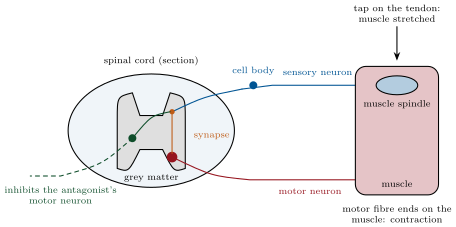
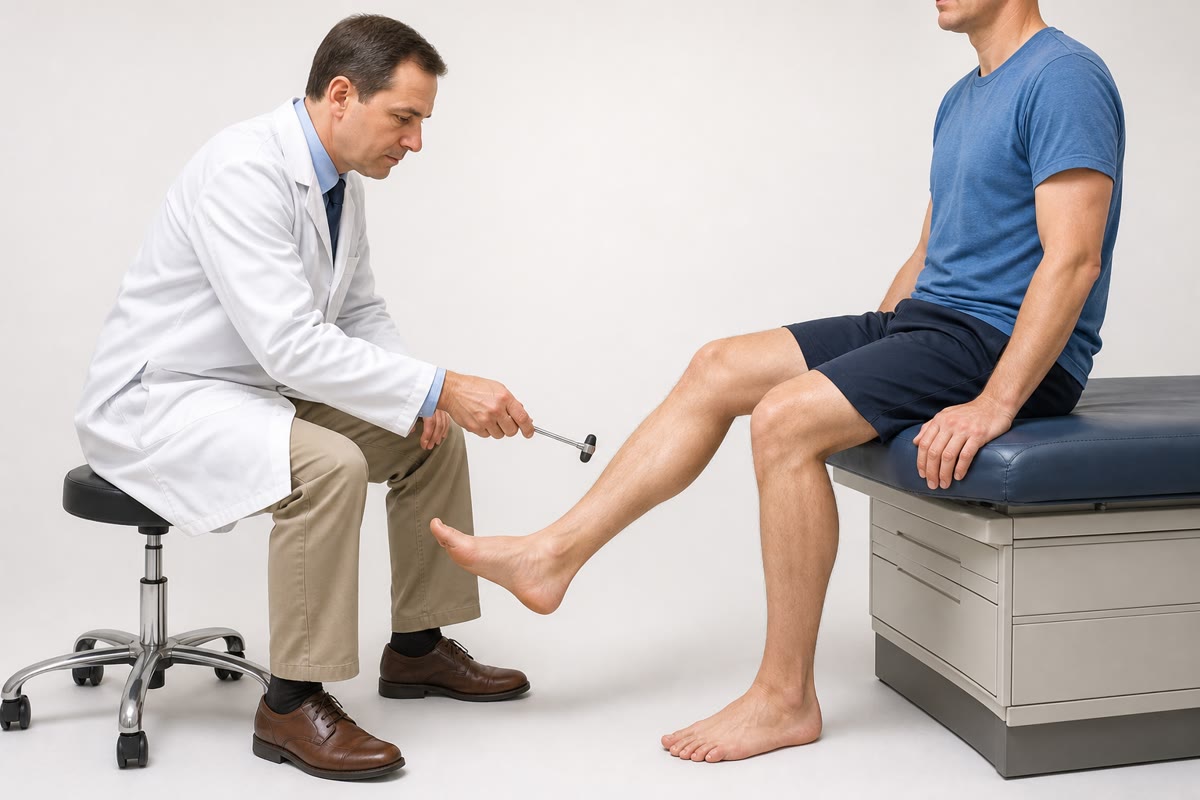
CoachA reflex is an involuntary, rapid and stereotyped response of an effector (a muscle or a gland) to a stimulus, produced by a fixed circuit of neurons, the reflex arc, that runs through the spinal cord or brainstem without requiring the brain. The stretch reflex is the simplest: the sudden stretching of a muscle makes that same muscle contract.
Examples
Example 35.3 (What the reflex is for)
Standing, you sway; each sway stretches the muscles of one side of the ankle, whose spindles fire and whose reflex contraction pulls you back before you notice. Carrying a tray, a sudden extra weight stretches the arm muscles and the reflex stiffens them within , before the tray tips. The stretch reflex is a servomechanism: it opposes any change of a muscle’s length, and the brain adjusts its sensitivity to set the body’s tone — higher when you brace, lower when you sleep.
Example 35.6 (Speed)
Action potentials travel at in thin unmyelinated fibres and up to in the thick myelinated fibres of the stretch reflex. From the knee to the spinal cord and back is about : some of travel, to which the spindle’s response, one synapse and the muscle’s activation add another — the of the knee jerk. A message from a toe to the brain, away, takes about ; the decision to move it, and its execution, some more.