 Coach
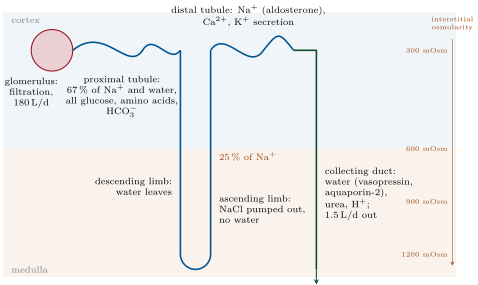
CoachEach human kidney holds about a million nephrons. Blood enters a glomerulus, a tuft of capillaries inside Bowman’s capsule, whose walls — fenestrated endothelium, basement membrane, and the slit diaphragms between the podocytes’ feet — pass water and every solute below about but hold back the proteins and cells. The filtrate flows through the proximal tubule, which reabsorbs two thirds of the water and salt and all the glucose and amino acids; down and up the loop of Henle, which reaches into the medulla and builds the concentration gradient of the next section; through the distal tubule, where salt is adjusted; and into the collecting duct, where the final water content is set by vasopressin as the duct passes through the medulla to the pelvis. The blood that leaves the glomerulus enters a second capillary bed around the tubules, which takes up what they reabsorb.
Examples
Example 20.9 (Two days)
A day without water: the plasma osmolarity rises from toward , vasopressin rises within minutes, the collecting ducts open to water, the urine concentrates to and falls to half a litre; the person is thirsty; the volume lost is mostly from the cells, whose water follows the extracellular salt. A litre of water drunk at once: osmolarity falls , vasopressin falls to nothing within twenty minutes, the ducts close, and over the next two hours the kidney passes a litre of urine at . A haemorrhage of a litre: pressure falls, renin and vasopressin both rise (volume overrides osmolarity), the arterioles constrict, sodium and water are kept, and over a day the plasma volume is refilled — with fluid drawn from the interstitium and then drunk. Diabetes insipidus, the absence of vasopressin or of its receptor, produces of dilute urine a day and a thirst to match; kidney failure, the absence of filtration, leaves a body that must be filtered by a machine three times a week, through a membrane whose clearance is a fraction of two kidneys’.