
সব বই

পেশাদার

1 Markets I: The Ecosystem and Exchange-Traded Marketsবাজার অনলাইন 2 Markets II: Rates, FX and Creditবাজার অনলাইন 3 Markets III: Commodities, Energy and Cryptoবাজার অনলাইন 4 Quantitative Methodsপদ্ধতি অনলাইন 5 Derivatives and Volatilityডেরিভেটিভস অনলাইন 6 Rates, Credit, XVA and Riskসুদহার, ঋণ ও ঝুঁকি অনলাইন 7 Research Craft: Predictors, Backtests, Measurement, Portfoliosগবেষণা অনলাইন 8 Strategies I: Equities and Futuresকৌশল অনলাইন 9 Strategies II: Volatility, Relative Value, Macro and the Bank Desksকৌশল অনলাইন 10 Microstructure and Executionএক্সিকিউশন অনলাইন 11 Market Making and High-Frequency Tradingমার্কেট মেকিং অনলাইন 12 Machine Learning for Marketsমেশিন লার্নিং অনলাইন 13 Low-Latency Softwareপ্রযুক্তি অনলাইন 14 Networks, Hardware and Trading Infrastructureপ্রযুক্তি অনলাইন 15 Research, Data and Risk Platformsপ্রযুক্তি অনলাইন 16 The Desk and the Firmপ্রতিষ্ঠান অনলাইন 17 The Industry: Firms, Roles and Careersক্যারিয়ার অনলাইন 18 Interviews I: Maths, Probability and Speedক্যারিয়ার অনলাইন 19 Interviews II: Markets, Trading Games and the Final Roundক্যারিয়ার অনলাইন 20 Interviews III: Codeক্যারিয়ার অনলাইন
অ্যাপ পরিচিতি Coach সাইন ইন পড়া শুরু করো

বইগুলো এখনো বাংলা ভাষায় পাওয়া যায় না — ইংরেজি সংস্করণ দেখানো হচ্ছে।

Biology · পরিভাষা

The nephron কী?

Definition 20.2 University Biology — Year 3 · অধ্যায় 20 — Renal Physiology and Osmoregulation

Each human kidney holds about a million nephrons. Blood enters a glomerulus, a tuft of capillaries inside Bowman’s capsule, whose walls — fenestrated endothelium, basement membrane, and the slit diaphragms between the podocytes’ feet — pass water and every solute below about 60 kDa60\,\mathrm{kDa} but hold back the proteins and cells. The filtrate flows through the proximal tubule, which reabsorbs two thirds of the water and salt and all the glucose and amino acids; down and up the loop of Henle, which reaches into the medulla and builds the concentration gradient of the next section; through the distal tubule, where salt is adjusted; and into the collecting duct, where the final water content is set by vasopressin as the duct passes through the medulla to the pelvis. The blood that leaves the glomerulus enters a second capillary bed around the tubules, which takes up what they reabsorb.
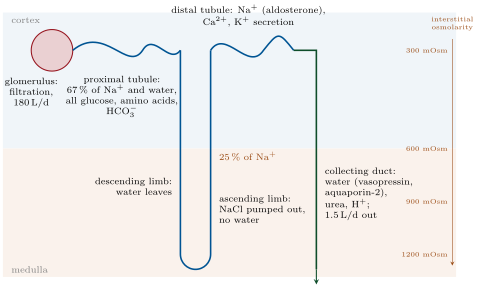
A nephron laid out. Filtration in the cortex; bulk reabsorption in the proximal tubule; the loop of Henle dipping into the medulla, where the interstitium grows saltier with depth; the collecting duct passing back through that gradient, giving up water if vasopressin allows.

উদাহরণ

Example 20.9 (Two days)

A day without water: the plasma osmolarity rises from 290290 toward 295 mOsm/L295\,\mathrm{mOsm}/\mathrm{L}, vasopressin rises within minutes, the collecting ducts open to water, the urine concentrates to 1200 mOsm/L1200\,\mathrm{mOsm}/\mathrm{L} and falls to half a litre; the person is thirsty; the volume lost is mostly from the cells, whose water follows the extracellular salt. A litre of water drunk at once: osmolarity falls 1 %1\,\%, vasopressin falls to nothing within twenty minutes, the ducts close, and over the next two hours the kidney passes a litre of urine at 50 mOsm/L50\,\mathrm{mOsm}/\mathrm{L}. A haemorrhage of a litre: pressure falls, renin and vasopressin both rise (volume overrides osmolarity), the arterioles constrict, sodium and water are kept, and over a day the plasma volume is refilled — with fluid drawn from the interstitium and then drunk. Diabetes insipidus, the absence of vasopressin or of its receptor, produces 15 L15\,\mathrm{L} of dilute urine a day and a thirst to match; kidney failure, the absence of filtration, leaves a body that must be filtered by a machine three times a week, through a membrane whose clearance is a fraction of two kidneys’.

প্রসঙ্গসহ পড়ো →