 Coach
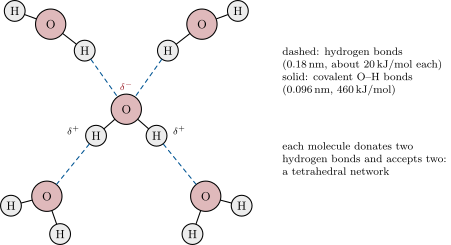
CoachWater, , is a bent molecule (the H–O–H angle is ) in which the oxygen draws the shared electrons toward itself: it is polar, with a partial negative charge on the oxygen and partial positive charges on the hydrogens. Each molecule can form up to four hydrogen bonds — an electrostatic attraction between a hydrogen bound to an electronegative atom (O, N) and a lone pair of another electronegative atom — two through its hydrogens, two through its oxygen. Liquid water is a network of such bonds, each lasting a few picoseconds.
Examples
Example 8.3 (The hydrophobic effect at work)
Shake oil into water and within minutes the droplets have merged: water squeezes out what it cannot bond to. The same effect folds a protein (its oily residues hide inside, Chapter 12), assembles a membrane (the tails of the lipids gather away from water, Chapter 9), and drives two matching molecular surfaces together. Nothing attracts the oil to the oil; water pushes.
Example 8.6 (Melting a double helix)
The two strands of DNA are held by two or three hydrogen bonds per base pair plus the stacking (van der Waals) of neighbouring pairs; a single pair would separate at once, but a thousand pairs in a row hold until the temperature reaches about , and reunite, in exactly the same register, when it is lowered (Chapter 11). Specific, strong in number, reversible.