University Biology — Year 1 · Bachelor Year 1
8Water and Small Biomolecules
A bacterium of one cubic micrometre contains some twenty billion water molecules and a few hundred million of everything else. Water is not the background of the cell but its medium: it dissolves the ions and the sugars, it hides the oily parts of proteins and membranes, it sets the acidity that every enzyme depends on, and it is a reactant or a product in half the reactions of metabolism. This chapter describes water and the weak bonds it makes and breaks, the arithmetic of acids, bases and buffers, the small organic molecules from which the macromolecules of the next four chapters are built, and the currency of energy — ATP — in which the cell pays for building them.
8.1 Water
Definition 8.1 (The water molecule)
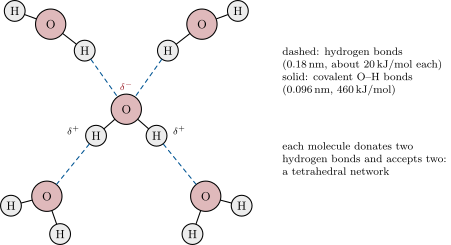
Water, , is a bent molecule (the H–O–H angle is ) in which the oxygen draws the shared electrons toward itself: it is polar, with a partial negative charge on the oxygen and partial positive charges on the hydrogens. Each molecule can form up to four hydrogen bonds — an electrostatic attraction between a hydrogen bound to an electronegative atom (O, N) and a lone pair of another electronegative atom — two through its hydrogens, two through its oxygen. Liquid water is a network of such bonds, each lasting a few picoseconds.
Proposition 8.2 (Properties of water that matter to life)
The hydrogen-bond network explains water’s exceptional properties:
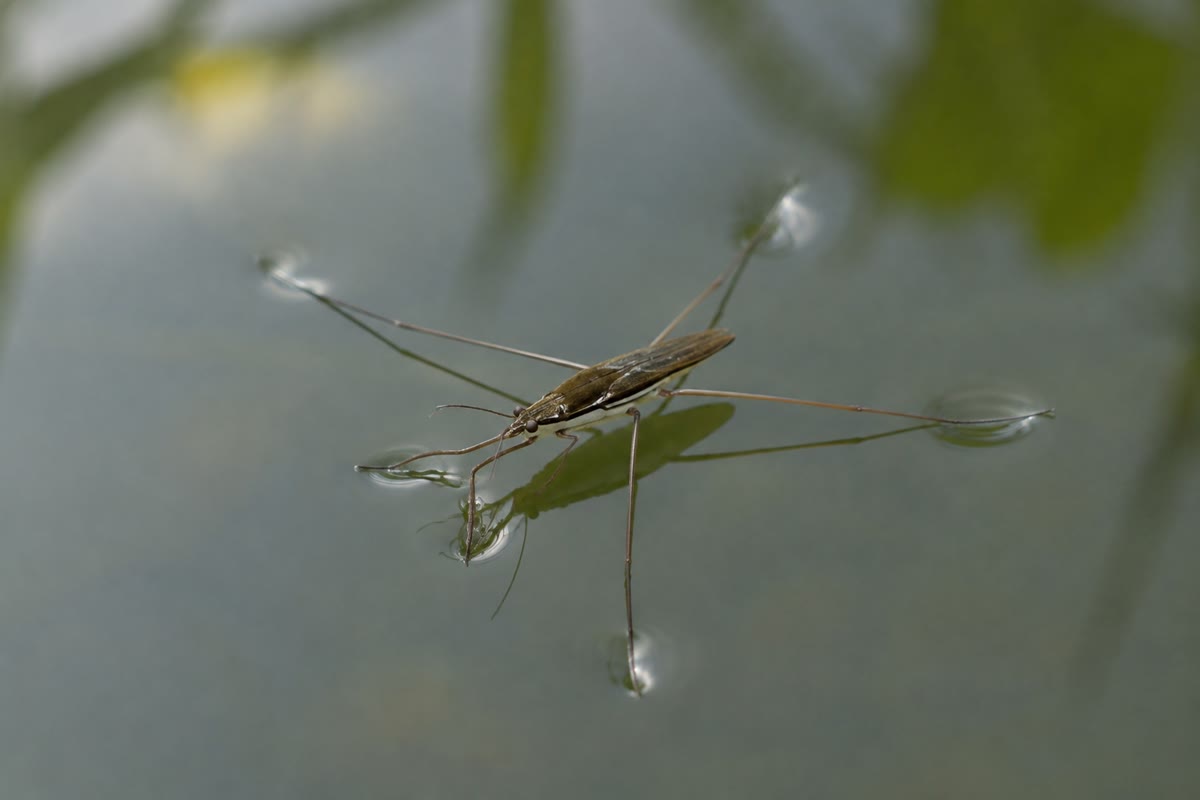
- a high cohesion and surface tension (): water columns can be pulled up a tree without breaking (Chapter 24); insects walk on ponds;
- a high heat capacity () and heat of vaporisation (): temperatures of organisms and of water bodies change slowly, and evaporating a gram of sweat removes ;
- a solid less dense than the liquid: ice floats, and lakes freeze from the top down, leaving liquid water below;
- an excellent solvent for ions and polar molecules, which it surrounds with oriented shells (hydration), and a poor one for non-polar molecules, which it forces together (the hydrophobic effect).
Partial proof. Cohesion and surface tension measure the work of separating molecules that are each held by four bonds of about . Heating water must break bonds as well as agitate molecules, hence the heat capacity; vaporising it must break them all. Ice holds every molecule in an open tetrahedral lattice of four bonds, which occupies more volume than the disordered liquid, in which molecules pack more closely. Ions and polar groups are stabilised by hydrogen bonds to water; a non-polar molecule cannot make them, and the water around it must order itself into a cage, at a cost in entropy that is reduced when non-polar molecules cluster and share one cage. ∎
Example 8.3 (The hydrophobic effect at work)
Shake oil into water and within minutes the droplets have merged: water squeezes out what it cannot bond to. The same effect folds a protein (its oily residues hide inside, Chapter 12), assembles a membrane (the tails of the lipids gather away from water, Chapter 9), and drives two matching molecular surfaces together. Nothing attracts the oil to the oil; water pushes.
8.2 Weak bonds
Definition 8.4 (Covalent and non-covalent bonds)
A covalent bond shares an electron pair between two atoms and costs to break: the skeletons of molecules are covalent, and only enzymes make or break them in the cell. Non-covalent bonds are the weak, reversible attractions that hold molecules to each other and shape them: the hydrogen bond ( in water); the ionic bond between opposite charges ( or so in water, whose dielectric constant screens charges eightyfold); van der Waals attractions between any two atoms in close contact ( each, but summed over a whole surface); and the hydrophobic effect, which is not a bond but the exclusion of non-polar surfaces by water.
Proposition 8.5 (Why weak bonds are the bonds of biology)
Thermal energy at is . A single weak bond is only a few times this and breaks within microseconds; ten together, on two surfaces that fit, hold for hours. Molecular recognition — an enzyme for its substrate, an antibody for its antigen, one DNA strand for its complement — rests on many weak bonds formed at once between complementary surfaces, which is why it is at once specific (only a fitting surface makes them all) and reversible (heat, or a competitor, undoes it). Covalent bonds, a hundredfold stronger, would be permanent.
Example 8.6 (Melting a double helix)
The two strands of DNA are held by two or three hydrogen bonds per base pair plus the stacking (van der Waals) of neighbouring pairs; a single pair would separate at once, but a thousand pairs in a row hold until the temperature reaches about , and reunite, in exactly the same register, when it is lowered (Chapter 11). Specific, strong in number, reversible.
8.3 Acids, bases and buffers
Definition 8.7 (pH, acid, base, p)
Water dissociates slightly, , with at . The pH is : 7 for pure water, lower for acids, higher for bases. An acid releases a proton, , with dissociation constant and p ; its conjugate base accepts one. A strong acid (HCl) is fully dissociated; the acids of the cell (carboxylic acids, phosphates, ammonium) are weak, with p between 2 and 10.
Theorem 8.8 (Henderson–Hasselbalch)
For a weak acid in solution,
At the acid is half dissociated; one pH unit above, it is dissociated; one below, .
Proof. Take the logarithm of : , i.e. . The ratio is , and at pH , and . ∎
Definition 8.9 (Buffer)
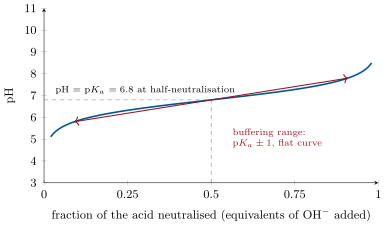
A buffer is a solution containing a weak acid and its conjugate base in comparable amounts; it resists a change of pH, because added is taken up by and added by . It works best within one unit of the p, and its capacity grows with the total concentration of the pair. The cell’s buffers: phosphate (, p 6.8) and the side chains of proteins inside cells; bicarbonate (, effective p 6.1) in the blood, whose acid partner is a gas that the lungs can remove.
Method 8.10 (Buffer arithmetic)
- Identify the acid–base pair and its p at the working temperature.
- Apply Henderson–Hasselbalch to get the ratio base/acid from the pH, or the pH from the concentrations.
- To add a strong acid: subtract its amount from the base and add it to the acid, then recompute the pH. To add a strong base: the reverse.
- If one partner can leave the system (carbon dioxide breathed out, ammonia excreted), the system is open: hold that partner at its imposed value rather than letting it accumulate. Open buffers hold pH far better than closed ones.
Example 8.11 (Blood)
Arterial blood holds of bicarbonate and dissolved at (set by the lungs): . Adding of acid turns of bicarbonate into ; if the lungs blow that off and hold the dissolved value, the pH becomes ; in a closed flask the would rise to and the pH fall to . The lungs make the difference.
8.4 Small biomolecules
Definition 8.12 (Functional groups)
The organic molecules of the cell are carbon skeletons bearing a small set of functional groups that determine their chemistry:
| group | formula | property | found in |
|---|---|---|---|
| hydroxyl | polar, H-bonding | sugars, alcohols | |
| carbonyl | polar, reactive | aldoses, ketoses | |
| carboxyl | acid (p) | fatty acids, amino acids | |
| amino | base (p) | amino acids | |
| phosphate | charged, energy-rich links | nucleotides, ATP | |
| sulfhydryl | forms S–S bridges | cysteine | |
| methyl | non-polar | lipids, DNA marks |
At the pH of the cell carboxyl groups are ionised () and amino groups protonated ().
Proposition 8.13 (Four families of building blocks)
Nearly all the organic matter of a cell is built from four kinds of small molecule, each of a few hundred daltons: sugars (Chapter 10), fatty acids (Chapter 9), amino acids (Chapter 12) and nucleotides (Chapter 11). Three of them are joined into polymers — polysaccharides, proteins, nucleic acids — by condensation (a bond formed with loss of a water molecule), and taken apart by hydrolysis (the bond broken by adding water). Condensation is uphill and paid for by ATP; hydrolysis is downhill and needs only an enzyme.

Example 8.14 (The cell’s inventory)
Of a bacterium’s dry mass, proteins are , RNA , DNA , lipids , polysaccharides , small molecules and ions the rest. By number of molecules the picture inverts: a thousand kinds of small metabolite and ion, at concentrations from nanomolar to a tenth of a mole per litre, make up most of the molecules that are not water. Potassium is at , glutamate , ATP , a transcription factor at a few molecules per cell.
8.5 Energy: free energy and ATP
Proposition 8.15 (Free energy of a reaction)
A reaction at constant temperature and pressure proceeds spontaneously in the direction that lowers the Gibbs free energy . For ,
where is the standard free-energy change (all concentrations , pH 7) and the logarithmic term corrects for the actual concentrations. At equilibrium , so : every of shifts the equilibrium constant tenfold. says which way a reaction can go, not how fast: that is the enzyme’s business (Chapter 13).
Proof. The chemical potential of each species is (the ideal-solution result of the physics course); is the sum of the products’ potentials minus the reactants’, which gives the formula; setting it to zero at equilibrium gives the relation to . ∎
Definition 8.16 (ATP, coupling)
ATP (adenosine triphosphate) is a nucleotide (Chapter 11) bearing three phosphates in a row; the two outer bonds are phosphoanhydride bonds whose hydrolysis, , has and, at the concentrations of a cell, . ATP is the cell’s energy currency: catabolism makes it (Chapter 15), and biosynthesis, transport and movement spend it. An uphill reaction is made to go by coupling it to ATP hydrolysis through a shared intermediate, so that the sum of the two is negative.
Example 8.17 (Why ATP hydrolysis releases so much)
Three reasons: the four negative charges of ATP’s phosphates repel one another and are relieved by cleavage; the products and are better stabilised by resonance and by hydration than the anhydride; and the cell keeps ATP a thousand times above its equilibrium with ADP and phosphate. The last is the largest term: with ATP at , ADP , , .
Example 8.18 (Coupling)
Glucose glucose-6-phosphate has : at equilibrium almost no glucose would be phosphorylated. Hexokinase instead transfers the phosphate straight from ATP: glucose ATP glucose-6-phosphate ADP, , equilibrium constant , reaction essentially complete. The phosphate never appears free: the two reactions are one.
8.6 Exercises
Exercise 8.1 ★
Explain, from the structure of the water molecule, why water is a good solvent for salts and a poor one for oils.
Solution
Solution of Exercise 8.1.
The bent, polar molecule has a partially negative oxygen and partially positive hydrogens: it surrounds a cation with its oxygens and an anion with its hydrogens, stabilising them (hydration), and it makes hydrogen bonds with polar groups. Oil has no charges or polar groups to bond to; water molecules around it must order into a cage, which is unfavourable, so oil is excluded.
Exercise 8.2 ★
Rank the four kinds of non-covalent interaction by strength and give one biological role of each.
Solution
Solution of Exercise 8.2.
Hydrogen bond (): base pairing in DNA, protein secondary structure. Ionic bond (about in water): salt bridges in proteins, substrate binding. Hydrophobic effect (not a bond, but comparable in total): membrane assembly, protein folding. Van der Waals ( each): the close packing of any two complementary surfaces, enzyme–substrate fit.
Exercise 8.3 ★
Compute the pH of a solution in which , and in gastric juice at pH 1.5.
Exercise 8.4 ★
From the titration figure, over what range of pH does the phosphate buffer work, and what is the ratio of base to acid at pH 7.4?
Solution
Solution of Exercise 8.4.
From about 5.8 to 7.8 (p). At 7.4: , ratio .
Exercise 8.5 ★★
Acetic acid has p 4.76. What fraction is ionised at pH 4.76, at pH 7.2 (the cytosol), and at pH 2 (the stomach)? Which form crosses a membrane more easily, and where would acetic acid be absorbed?
Solution
Solution of Exercise 8.5.
At pH 4.76: . At 7.2: , ratio : ionised. At pH 2: ratio : ionised. The neutral acid form crosses the lipid bilayer; acetic acid is absorbed in the stomach, where it is un-ionised, and trapped as acetate in the cytosol.
Exercise 8.6 ★★
A buffer contains of and of (p 6.8). Compute its pH. Compute the pH after adding of HCl, and after adding the same HCl to pure water.
Exercise 8.7 ★★
Evaporating sweat cools a runner. How much sweat must evaporate to remove ? Explain, with hydrogen bonds, why the heat of vaporisation of water is so large.
Solution
Solution of Exercise 8.7.
. To vaporise a molecule all four of its hydrogen bonds must be broken; is , roughly the energy of two bonds per molecule (each bond being shared by two).
Exercise 8.8 ★★
The reaction glucose-1-phosphate glucose-6-phosphate has at . Compute . In a cell where glucose-6-phosphate is at and glucose-1-phosphate at , compute and say which way the reaction runs.
Solution
Solution of Exercise 8.8.
. In the cell: : the reaction runs backward, toward glucose-1-phosphate (as it does in glycogen synthesis).
Exercise 8.9 ★★
Why does a lake freeze from the top down, and why does this matter to the fish in it? What would happen in a world where ice sank?
Solution
Solution of Exercise 8.9.
Water is densest at ; colder water and ice are lighter and stay at the surface, so the ice forms on top and insulates the liquid below, which stays near all winter. If ice sank, lakes would freeze solid from the bottom up and thaw only at the surface in summer; freshwater life through a winter would be impossible.
Exercise 8.10 ★★★
Compute for ATP hydrolysis in a muscle cell where ATP is , ADP and at ; then in a fatigued muscle where ATP is , ADP and . What has the fatigue done to the energy available per ATP?
Solution
Solution of Exercise 8.10.
. Rested: , : . Fatigued: , : . Fatigue has cut the energy per ATP by , enough to slow the pumps and motors that need most of it.
Exercise 8.11 ★★★
A cell at pH 7.2 and has an internal volume of . How many free ions does it contain? Compare with its buffering groups. What does the comparison say about the meaning of “the pH of a cell”?
Exercise 8.12 ★★★
“Life is a way of keeping reactions far from equilibrium.” Discuss in a paragraph, using ATP’s concentration ratio, coupling, and what happens to a cell whose ATP reaches equilibrium with ADP.
Solution
Solution of Exercise 8.12.
At equilibrium ATP, ADP and phosphate would sit at a ratio of about ; the cell holds ATP a thousand times above ADP, so that its hydrolysis releases rather than nothing. Every uphill process — synthesis, transport, movement — is coupled to that displacement; catabolism’s only role is to maintain it. A cell whose ATP reaches equilibrium has no gradient to spend: pumps stop, ions leak, the cell swells and dies within minutes. Being alive is the maintenance of that disequilibrium, not a substance.
8.7 Problem: Blood as a Buffer
Problem 8.1
Weekend problem — five litres of blood at pH 7.40 through a sprint: bicarbonate, carbon dioxide, lungs and kidneys, ending on the pH shift for a given lactate load
Arterial blood: pH 7.40, bicarbonate , dissolved carbon dioxide (proportional to its partial pressure: a partial pressure of gives ). The bicarbonate system has an effective p of 6.1: . Blood volume . The plasma proteins and haemoglobin add a second buffer of capacity of per litre per pH unit. A sprint releases of lactic acid (a strong acid at blood pH) into the blood within a minute.
Part I — The resting state.
- Verify the pH of arterial blood from the bicarbonate and carbon dioxide values.
- Compute at pH 7.40, in nanomoles per litre.
- How many free protons are there in the whole blood volume? Compare with the of bicarbonate.
- Compute the ratio of bicarbonate to dissolved carbon dioxide and the fraction of the buffer pair present as the base.
- Venous blood has a partial pressure of of and of bicarbonate. Compute its pH.
- Why is the p of 6.1, more than one unit below blood pH, not a handicap for this buffer in the body, although it would be in a flask?
Part II — The sprint, closed system. Suppose first that no carbon dioxide can leave: every proton taken up by bicarbonate becomes dissolved .
- Compute the lactic acid concentration added to the blood.
- Compute the new bicarbonate and the new dissolved if all the acid is buffered by bicarbonate.
- Compute the resulting pH.
- Compute the pH the same acid would give in of pure water.
- Is the closed bicarbonate system a good buffer for this load? Quantify by the pH shift.
- Compute the change in between pH 7.40 and the pH of question 9, and the fraction of the added protons that remain free in solution.
Part III — The sprint, open system. Now the lungs hold the dissolved at by blowing off the excess.
- Compute the pH with bicarbonate at its new value and held at .
- How many millimoles of must the lungs remove, in excess of the resting output, to hold the value?
- The resting output is of per minute. By what factor must ventilation rise for a minute to clear the excess?
- The runner hyperventilates further, driving the partial pressure of to . Compute the new dissolved and the pH.
- Now include the protein buffer: of the of protons, a share is taken by proteins in proportion to the two buffers’ capacities. Estimate the capacity of the open bicarbonate system near pH 7.4 (the millimoles of acid per litre that shift the pH by one unit, from Henderson–Hasselbalch with fixed) and the share of the protons each buffer takes.
- Recompute the pH after the sprint with both buffers.
Part IV — Recovery, and the kidney.
- Over the next hour the liver oxidises the lactate (removing the acid). What happens to the bicarbonate and the pH, with the lungs holding constant?
- A patient with kidney failure retains of acid a day and cannot excrete it. Compute the fall of bicarbonate per day (open system) and the pH after three days if bicarbonate is not replaced.
- A patient with lung disease retains at a partial pressure of with bicarbonate at . Compute the pH. The kidneys respond over days by raising bicarbonate to ; compute the pH then.
- Explain in two sentences why the lungs correct pH in minutes and the kidneys in days, and what each controls in the Henderson–Hasselbalch ratio.
- The kidneys excrete the of acid of a day in of urine at pH 5. Compute the free protons in that urine, and conclude how the acid is carried.
- Vomiting loses of HCl. Predict the direction of the pH change and compute it for the open system.
- State the result: the pH shift of the blood for a lactate load in the closed system, in the open system with bicarbonate alone, and with the protein buffers added.
Solution
Solution of Problem 8.1.
1. . 2. . 3. , six hundred thousand times fewer than the bicarbonate. 4. ; pH . 5. In a flask the ratio leaves little acid partner to absorb base, and the capacity is low at one unit from the p; in the body the acid partner is a gas whose concentration the lungs fix and can regenerate without limit, so the ratio can be reset by ventilation regardless of the p. 6. ; the base is of the pair. 7. . 8. Bicarbonate ; . 9. pH . 10. : pH . 11. A shift of units: it saves the blood from pH 1.9 but 6.06 is far below what any enzyme tolerates. Poor, as a closed system. 12. goes from to : a rise of for added, i.e. one proton in stays free; the rest are on bicarbonate. 13. pH . 14. The generated: . 15. in a minute on top of : sevenfold. 16. ; pH . 17. Open bicarbonate near 7.4: the pH changes by one unit when the bicarbonate falls tenfold, from to , i.e. of acid per unit; but over the first units the local slope is per unit. Against the proteins’ per unit, bicarbonate takes about of the protons, proteins . 18. Bicarbonate takes : ; pH (the proteins’ share consistent with per unit units , close to their ). 19. Removing the acid regenerates the bicarbonate consumed ( back to ) and, with held, the pH returns to 7.40. 20. of bicarbonate lost per day; after three days : bicarbonate is exhausted and the pH collapses well below 7 — in practice the patient must be given bicarbonate or dialysed; after one day alone, . 21. ; pH . With bicarbonate at : . 22. The lungs change the denominator (dissolved ) within breaths, because it is a gas they exhale; the kidneys change the numerator (bicarbonate) by excreting acid and regenerating bicarbonate, a process of hours to days. 23. At pH 5, : free in , a four-thousandth of the ; the acid leaves bound to buffers — as ammonium and as dihydrogen phosphate. 24. Losing acid raises pH: bicarbonate rises by to ; pH (alkalosis), before the lungs and kidneys compensate. 25. Closed: from 7.40 to 6.06, a shift of . Open, bicarbonate alone: to 7.10, a shift of . Open with proteins: to 7.22, a shift of .