
All books

Professional

Apps About Coach Log in Start reading

Chemistry · Glossary

What is Amphiphilic molecule, micelle?

Also known as: amphiphilic · micelle

Definition 31.9 School Chemistry — Grades 1 to 12 · Chapter 31 — Dissolving Ionic and Molecular Solids

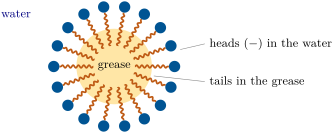
An amphiphilic molecule or ion has a hydrophilic head and a hydrophobic tail. In water, amphiphilic ions gather into micelles: tiny spheres with the tails inside, out of the water, and the heads on the surface, in contact with it.
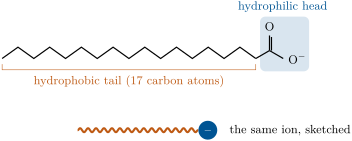
The stearate ion. In this zigzag drawing each corner of the chain is a carbon atom bearing hydrogen atoms (CH2, and CH3 at the far end); a later chapter explains the shorthand. Below, the usual sketch: a wavy tail and a round head.
The stearate ion. In this zigzag drawing each corner of the chain is a carbon atom bearing hydrogen atoms (CHX2\ce{CH2}, and CHX3\ce{CH3} at the far end); a later chapter explains the shorthand. Below, the usual sketch: a wavy tail and a round head.
A micelle in cross-section: soap ions around a droplet of grease, tails inwards, charged heads outwards. Each micelle is negatively charged on its surface, and micelles repel one another.

Examples

Example 31.10 (A soap)

Sodium stearate, CX17HX35COONa\ce{C17H35COONa} (M=306.0 g/molM = 306.0\,\mathrm{g}/\mathrm{mol}), is a typical soap, made from animal or vegetable fats. In water it dissolves as sodium ions NaX+\ce{Na+} and stearate ions CX17HX35COOX−\ce{C17H35COO-}: a head −COO−\ce{-COO-}, ionic, hydrophilic, and a tail of 17 carbon atoms, hydrophobic.

Read in context →