School Chemistry — Grades 1 to 12 · Grades 1–12
31Dissolving Ionic and Molecular Solids
A pinch of salt stirred into water vanishes in seconds; the same pinch stirred into cooking oil lies at the bottom of the glass, unchanged, for as long as anyone cares to watch. A greasy pan rinsed under the tap stays greasy; one drop of washing-up liquid, and the grease lifts off. What decides whether a substance dissolves in a liquid? The answer lies in the partial charges and the forces between particles of the previous chapter.
You already know
Solubility; miscible and immiscible liquids (Chapter 9). An ionic compound is made of cations and anions in proportions that make it neutral (Chapter 17). Polar and non-polar molecules, hydrogen bonds, van der Waals interactions (Chapter 30). Liquid–liquid extraction (Chapter 22). Molar concentration (Chapter 26).
31.1 Dissolving an ionic solid
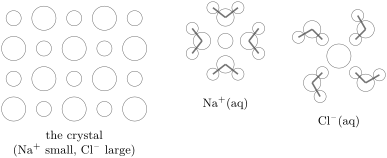
In a crystal of sodium chloride, each sodium ion is surrounded by chloride ions and each chloride ion by sodium ions, all held by the attraction between opposite charges. Water molecules, polar, are attracted by these charges: their oxygen side () turns towards the cations, their hydrogen side () towards the anions.
Definition 31.1 (Dissociation)
The dissociation of an ionic solid in a solvent is the separation of its ions from one another: they leave the crystal and move apart in the solution.
Definition 31.2 (Solvation, hydration)
The solvation of a dissolved particle is its surrounding by solvent molecules, held to it by attractions; in water it is called hydration. The symbol (aq) after a formula means “hydrated”.
Proposition 31.3 (Three stages of dissolving)
An ionic solid dissolves in water in three stages that happen together: the ions are pulled out of the crystal (dissociation), surrounded by water molecules (hydration), and spread through the whole solution (dispersion). For sodium chloride,
Proof. Admitted: the attractions between the ions and the polar water molecules, added up, are strong enough to replace those between the ions of the crystal. ∎
31.2 Concentrations of the ions
Method 31.4 (Concentration of each ion)
- Write the dissolution equation, balanced in atoms and in charge: for calcium chloride, .
- Compute the amount of solid dissolved, and the concentration of the solution in solute.
- Each ion has the concentration multiplied by its coefficient in the equation: here and .
The square brackets denote the molar concentration of a dissolved species.
Example 31.5 (Calcium chloride)
of calcium chloride () dissolved to make of solution: , , so and . The solution is neutral: of positive charge per litre for of negative.
31.3 Polarity and solubility
Proposition 31.6 (Like dissolves like)
A polar solvent, such as water, dissolves ionic solids and polar species, especially those able to form hydrogen bonds with it; a non-polar solvent, such as cyclohexane or a vegetable oil, dissolves non-polar species. Ionic solids dissolve very little in non-polar solvents, and non-polar species very little in water.
Proof. Admitted: a solute dissolves well when the attractions it can form with the solvent are at least as strong as those it breaks, between its own particles and between the solvent molecules. ∎
Example 31.7 (Three cases)
Ethanol mixes with water in all proportions: its group forms hydrogen bonds with water. Salt dissolves in water but not in oil. Iodine, , a non-polar molecule, dissolves poorly in water (about , a brown solution) but well in non-polar solvents ( per kilogram of heptane, a violet solution).
31.4 Liquid–liquid extraction, explained
A liquid–liquid extraction moves a species from one solvent into another, immiscible with the first, in which it is more soluble. The rule “like dissolves like” tells which solvent to choose.
In the lab — Extracting iodine
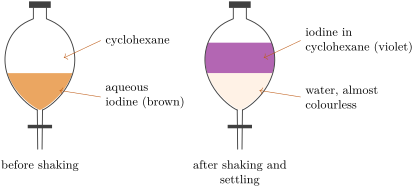
of brown aqueous iodine solution are poured into a separating funnel with of cyclohexane. The funnel is stoppered, shaken, its pressure released through the tap, and left to stand. Two layers form: cyclohexane, less dense, on top. The upper layer is now violet, the lower one almost colourless: the iodine has passed into the cyclohexane. The lower layer is run off through the tap, and the iodine is recovered in the cyclohexane.
Safety


Cyclohexane is highly flammable, its vapour makes one drowsy, it is harmful to the lungs if swallowed and very toxic to aquatic life. Iodine is harmful by skin contact and if inhaled. Fume hood, goggles and gloves, no flame anywhere near; the organic waste is collected.
31.5 Soaps and amphiphilic molecules
Definition 31.8 (Hydrophilic, hydrophobic)
A species or a part of a molecule is hydrophilic if it is attracted by water (ionic or polar groups, groups that form hydrogen bonds); it is hydrophobic if it is not (long chains of carbon and hydrogen atoms, non-polar). Hydrophobic species dissolve in fats and oils.
Definition 31.9 (Amphiphilic molecule, micelle)
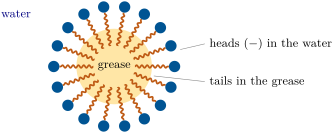
An amphiphilic molecule or ion has a hydrophilic head and a hydrophobic tail. In water, amphiphilic ions gather into micelles: tiny spheres with the tails inside, out of the water, and the heads on the surface, in contact with it.
Example 31.10 (A soap)
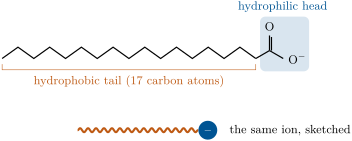
Sodium stearate, (), is a typical soap, made from animal or vegetable fats. In water it dissolves as sodium ions and stearate ions : a head , ionic, hydrophilic, and a tail of 17 carbon atoms, hydrophobic.
Proposition 31.11 (How soap removes grease)
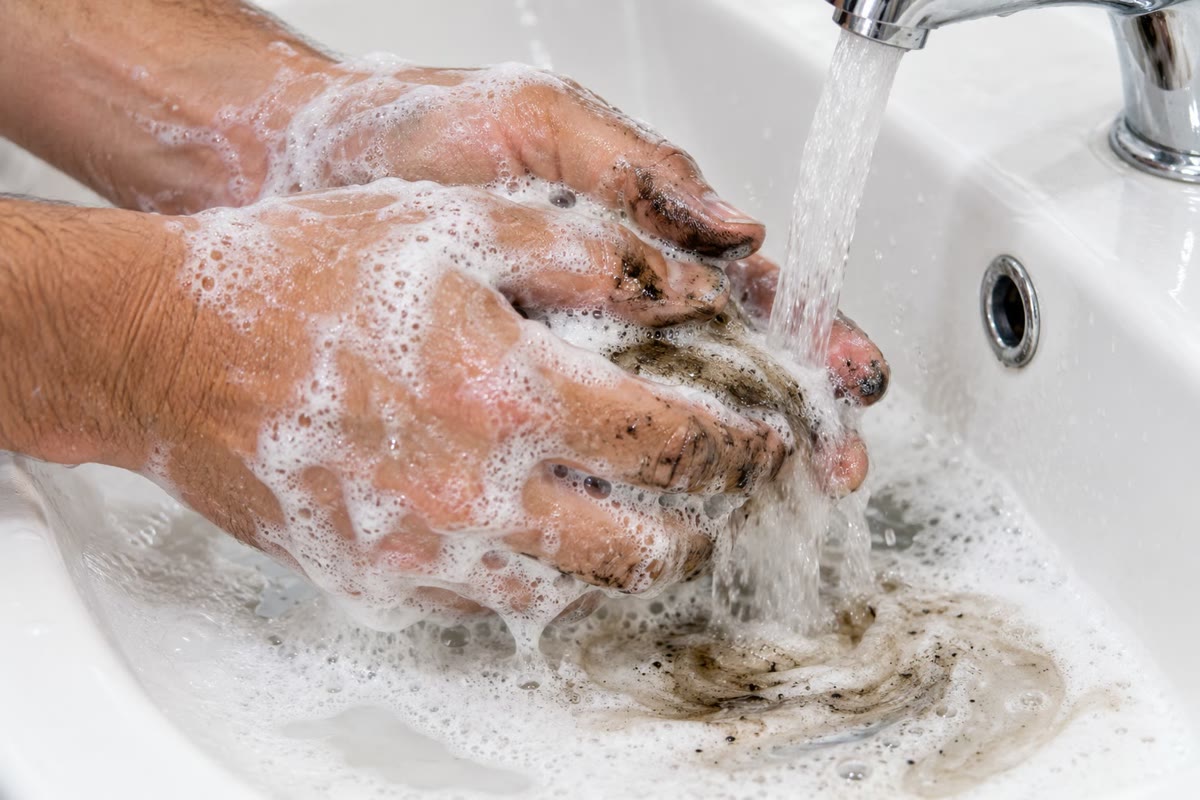
Grease is hydrophobic and does not dissolve in water. In soapy water, the tails of the soap ions dissolve in the grease while the heads stay in the water; the grease breaks into tiny droplets, each wrapped in a micelle whose charged surface faces the water, and the droplets are carried away by the rinsing water.
Proof. Admitted: it follows from “like dissolves like” applied to each end of the ion; the charged heads on the outside also keep the droplets from merging again, since like charges repel. ∎
Remark 31.12 (Hard water and scum)
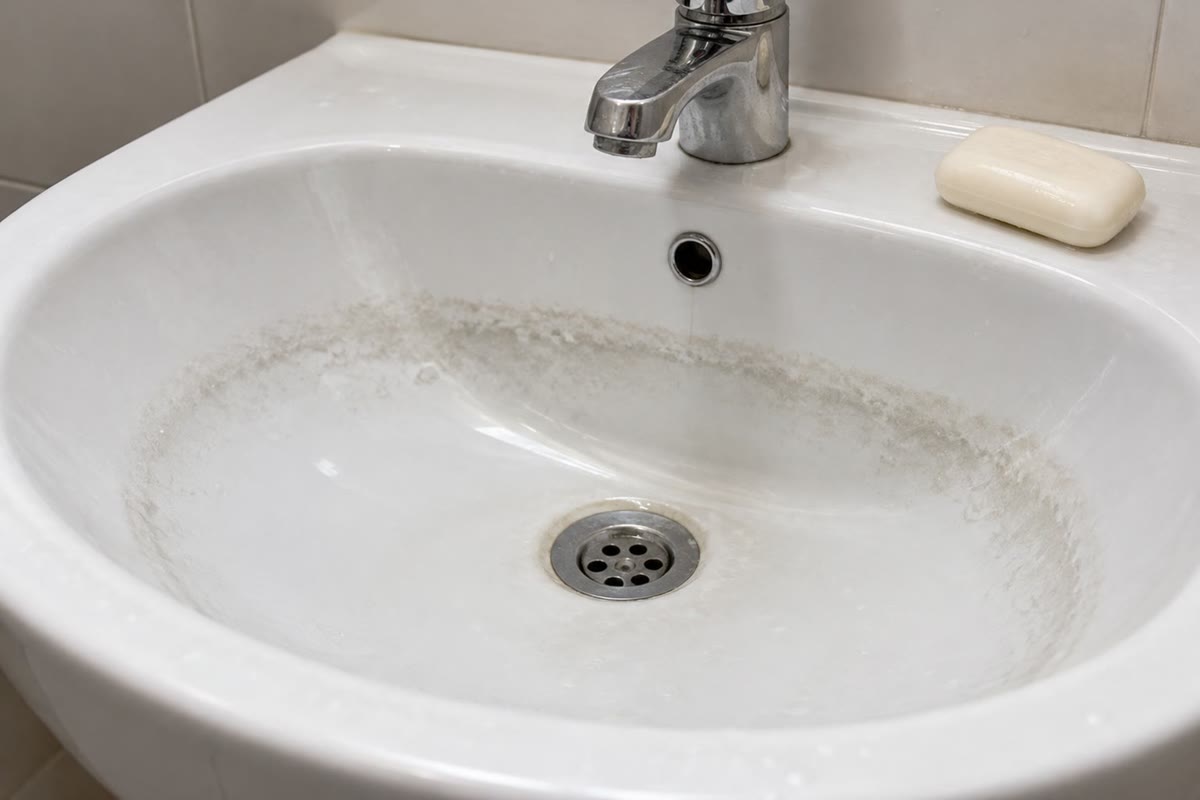
Hard water contains many calcium ions and magnesium ions , dissolved from the rocks it has run through. With stearate ions they form a precipitate (Chapter 17), calcium stearate:
This greyish solid is the scum that rings a washbasin, and every soap ion caught in it is lost for washing: in hard water, soap lathers badly until enough has been added to precipitate all the calcium.
31.6 Exercises
Exercise 31.1 ★
Write the dissolution equations in water of sodium chloride , calcium chloride , sodium sulfate and aluminium chloride .
Solution
Solution of Exercise 31.1.
; ; ; .
Exercise 31.2 ★
A solution of sodium sulfate has . Give the concentrations of the sodium ions and of the sulfate ions.
Solution
Solution of Exercise 31.2.
; .
Exercise 31.3 ★
What is meant by the hydration of an ion? Which end of a water molecule points towards a cation, which towards an anion? Why?
Exercise 31.4 ★
of aluminium chloride are dissolved to make of solution. Compute the concentration of the solution and of each ion.
Solution
Solution of Exercise 31.4.
; ; ; , .
Exercise 31.5 ★
Label each part of the stearate ion as hydrophilic or hydrophobic, and say why.
Solution
Solution of Exercise 31.5.
The head is ionic, attracted by water: hydrophilic. The tail of 17 carbon atoms, with only and nearly non-polar bonds, is non-polar: hydrophobic.
Exercise 31.6 ★★
Which solvent, water or cyclohexane, would you choose to dissolve: salt; candle wax (long hydrocarbon chains); sugar (many groups); iodine? Justify each choice.
Solution
Solution of Exercise 31.6.
Salt: water (ionic solid, polar solvent). Wax: cyclohexane (non-polar chains). Sugar: water (its groups form hydrogen bonds with water). Iodine: cyclohexane (non-polar molecule).
Exercise 31.7 ★★
Ethanol mixes with water in all proportions, but hexane does not mix with water. Explain.
Solution
Solution of Exercise 31.7.
The group of ethanol forms hydrogen bonds with water molecules, which replace those it breaks: ethanol fits into water. Hexane, non-polar, can form no such bonds; the water molecules, held to one another by hydrogen bonds, do not let it in.
Exercise 31.8 ★★
Look at the micelle figure. Why are the tails inside and the heads outside? Why do two micelles not merge into one larger drop of grease?
Solution
Solution of Exercise 31.8.
The hydrophobic tails avoid the water and dissolve in the grease, at the centre; the charged heads are attracted by water and stay outside. All the micelles carry negative charges on their surfaces, and like charges repel: they stay apart.
Exercise 31.9 ★★
A plant scent is dissolved in water. To extract it, a chemist can use ethanol or cyclohexane. Which one is suitable, and why is the other not (think of miscibility)?
Solution
Solution of Exercise 31.9.
Cyclohexane: it is immiscible with water, so it forms a separate layer that can be run off, and the scent (non-polar) dissolves well in it. Ethanol is miscible with water: no second layer forms, and nothing can be separated.
Exercise 31.10 ★★
In the iodine extraction, why is the cyclohexane layer on top? Which layer is run off through the tap? Where is the iodine at the end?
Solution
Solution of Exercise 31.10.
Cyclohexane is less dense than water. The lower, aqueous layer is run off through the tap. The iodine is in the upper cyclohexane layer, which stays in the funnel.
Exercise 31.11 ★★
A blue solution of copper sulfate is shaken with cyclohexane. What happens to the blue colour? Explain.
Solution
Solution of Exercise 31.11.
Nothing: copper sulfate is ionic and does not dissolve in non-polar cyclohexane. The water stays blue and the cyclohexane colourless.
Exercise 31.12 ★★★
What mass of calcium chloride must be dissolved to make of a solution in which ?
Solution
Solution of Exercise 31.12.
, so ; ; .
Exercise 31.13 ★★★
A sample of sea water is found to contain of calcium ions and of magnesium ions. Explain why ordinary soap lathers very badly in sea water. How much sodium stearate would be precipitated by the calcium ions alone of one litre of sea water?
Solution
Solution of Exercise 31.13.
The calcium and magnesium ions precipitate the stearate ions as scum: the soap is used up before it can form micelles, and lathers badly. Calcium alone: of takes of stearate, that is of sodium stearate per litre.
Exercise 31.14 ★★★
of sodium chloride solution at are mixed with of calcium chloride solution at . No precipitate forms. Compute the concentrations of , and in the mixture, and check that it is neutral.
Solution
Solution of Exercise 31.14.
Volume . : ; : ; : . Positive charge: ; negative: . Neutral.
Exercise 31.15 ★★★
Iodine dissolves at about per litre of water and per kilogram of heptane. Heptane has a density of about . How many times more iodine can a litre of heptane hold than a litre of water? What does this mean for an extraction?
Solution
Solution of Exercise 31.15.
A litre of heptane has a mass of and can hold of iodine, about 40 times more than a litre of water. Shaken together, nearly all the iodine passes into the heptane: the extraction is efficient.
31.7 Problem: Soap and Hard Water
Problem 31.1
Weekend problem — how much soap does a bath of hard water waste as scum?
A tap water contains of calcium ions and of magnesium ions per litre. A bath is filled with of it, and the bather uses a soap made of sodium stearate, .
Part I — What is in the water.
- Where do the calcium and magnesium ions of tap water come from?
- Compute the molar concentrations of the calcium ions and of the magnesium ions.
- The calcium ions are accompanied by hydrogencarbonate ions, , as if calcium hydrogencarbonate had been dissolved. Write that dissolution equation, and deduce the concentration of hydrogencarbonate ions that goes with the calcium.
- What amount of calcium ions does the bath contain?
Part II — The soap.
- Compute the molar mass of sodium stearate.
- Write its dissolution equation in water.
- Which part of the stearate ion is hydrophilic, which hydrophobic? Why is it called amphiphilic?
- Describe a micelle, and explain how it removes grease from the skin.
- Why must soap be dissolved in water, not in oil, to wash?
Part III — Scum.
- Write the equation of the precipitation of calcium stearate. Check that it is balanced in charge.
- Fill the progress table for of the tap water and an excess of stearate ions. Which reactant is limiting?
- What amount of stearate ions is lost per litre to the calcium?
- Compute the molar mass of calcium stearate, and the mass of scum formed per litre.
- Magnesium stearate precipitates in the same way. What amount of stearate do the magnesium ions take per litre?
Part IV — The bath.
- What amount of stearate ions does the calcium of the whole bath precipitate?
- What mass of soap is that?
- Adding the magnesium, what mass of soap is wasted in all?
- Bars of soap weigh about . How many bars does the calcium alone take?
- State the final answer: what mass of soap does the calcium of one bath of this water waste as scum?
Solution
Solution of Problem 31.1.
1. From the rocks the water has run through (limestone, dolomite, gypsum), which dissolve a little.
2. ; .
3. ; so .
4. .
5. .
6. .
7. Head : hydrophilic; tail : hydrophobic. It has both kinds of part: amphiphilic.
8. A tiny sphere of soap ions, tails inwards, heads outwards. The tails dissolve in the grease, which is broken into droplets wrapped in micelles; the charged surfaces keep the droplets apart in the water, which rinses them away.
9. The soap must form ions and micelles, which needs water around the heads; and the grease is carried off by the rinsing water. In oil the grease would simply stay dissolved on the skin.
10. : charges on the left, on the right.
11. : excess ; : ; calcium stearate: . The calcium ions are limiting: .
12. per litre.
13. ; of scum per litre.
14. per litre.
15. .
16. .
17. Magnesium: , which takes of stearate, of soap; in all about .
18. bars.
19. The calcium of one bath wastes about of soap as scum.