 Coach
CoachThe atom economy of a synthesis is the fraction of the mass of the reactants, taken in the proportions of the balanced equation, that ends up in the desired product.
Examples
Example 48.12 (Addition against substitution)
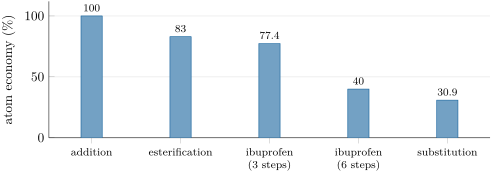
Bromoethane from ethene, : every atom ends up in the product, atom economy . Ethanol from bromoethane, : the atom economy is ; per kilogram of ethanol, of sodium bromide. An addition always has an atom economy of ; a substitution or an elimination never does.
Example 48.15 (Two routes to ibuprofen)
Ibuprofen, , is made from the hydrocarbon (isobutylbenzene). The older route uses six steps and, in each, a full amount of reagent; added together, its reactants have a molar mass sum of , for of ibuprofen: atom economy . The newer route uses three steps, two of them catalysed, and the overall equation
gives . Its by-product, ethanoic acid, is recovered and used: counted as a product, the atom economy exceeds .