
সব বই

পেশাদার

1 Markets I: The Ecosystem and Exchange-Traded Marketsবাজার অনলাইন 2 Markets II: Rates, FX and Creditবাজার অনলাইন 3 Markets III: Commodities, Energy and Cryptoবাজার অনলাইন 4 Quantitative Methodsপদ্ধতি অনলাইন 5 Derivatives and Volatilityডেরিভেটিভস অনলাইন 6 Rates, Credit, XVA and Riskসুদহার, ঋণ ও ঝুঁকি অনলাইন 7 Research Craft: Predictors, Backtests, Measurement, Portfoliosগবেষণা অনলাইন 8 Strategies I: Equities and Futuresকৌশল অনলাইন 9 Strategies II: Volatility, Relative Value, Macro and the Bank Desksকৌশল অনলাইন 10 Microstructure and Executionএক্সিকিউশন অনলাইন 11 Market Making and High-Frequency Tradingমার্কেট মেকিং অনলাইন 12 Machine Learning for Marketsমেশিন লার্নিং অনলাইন 13 Low-Latency Softwareপ্রযুক্তি অনলাইন 14 Networks, Hardware and Trading Infrastructureপ্রযুক্তি অনলাইন 15 Research, Data and Risk Platformsপ্রযুক্তি অনলাইন 16 The Desk and the Firmপ্রতিষ্ঠান অনলাইন 17 The Industry: Firms, Roles and Careersক্যারিয়ার অনলাইন 18 Interviews I: Maths, Probability and Speedক্যারিয়ার অনলাইন 19 Interviews II: Markets, Trading Games and the Final Roundক্যারিয়ার অনলাইন 20 Interviews III: Codeক্যারিয়ার অনলাইন
অ্যাপ পরিচিতি Coach সাইন ইন পড়া শুরু করো

বইগুলো এখনো বাংলা ভাষায় পাওয়া যায় না — ইংরেজি সংস্করণ দেখানো হচ্ছে।

Chemistry · পরিভাষা

Atom economy কী?

Definition 48.9 School Chemistry — Grades 1 to 12 · অধ্যায় 48 — Synthesis Strategy and Green Chemistry

The atom economy of a synthesis is the fraction of the mass of the reactants, taken in the proportions of the balanced equation, that ends up in the desired product.
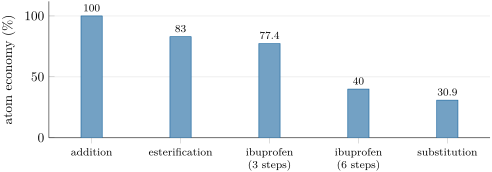
Atom economies computed from the equations: ethene with hydrogen bromide, ethanoic acid with ethanol, the two ibuprofen routes, and bromoethane with sodium hydroxide.

উদাহরণ

Example 48.12 (Addition against substitution)

Bromoethane from ethene, CX2HX4+HBr→CX2HX5Br\ce{C2H4 + HBr -> C2H5Br}: every atom ends up in the product, atom economy 108.9/(28.0+80.9)=100 %108.9/(28.0 + 80.9) = 100\,\%. Ethanol from bromoethane, CX2HX5Br+NaOH→CX2HX5OH+NaBr\ce{C2H5Br + NaOH -> C2H5OH + NaBr}: the atom economy is 46.0/(108.9+40.0)=30.9 %46.0/(108.9 + 40.0) = 30.9\,\%; per kilogram of ethanol, 2.2 kg2.2\,\mathrm{kg} of sodium bromide. An addition always has an atom economy of 100 %100\,\%; a substitution or an elimination never does.

Example 48.15 (Two routes to ibuprofen)

Ibuprofen, CX13HX18OX2\ce{C13H18O2}, is made from the hydrocarbon CX10HX14\ce{C10H14} (isobutylbenzene). The older route uses six steps and, in each, a full amount of reagent; added together, its reactants have a molar mass sum of 514.5 g/mol514.5\,\mathrm{g}/\mathrm{mol}, for 206.0 g/mol206.0\,\mathrm{g}/\mathrm{mol} of ibuprofen: atom economy 40 %40\,\%. The newer route uses three steps, two of them catalysed, and the overall equation

CX10HX14+CX4HX6OX3+HX2+CO→CX13HX18OX2+CX2HX4OX2\ce{C10H14 + C4H6O3 + H2 + CO -> C13H18O2 + C2H4O2}

gives 206.0/266.0=77 %206.0/266.0 = 77\,\%. Its by-product, ethanoic acid, is recovered and used: counted as a product, the atom economy exceeds 99 %99\,\%.

প্রসঙ্গসহ পড়ো →
Definition 31.2 University Chemistry — Year 3 · অধ্যায় 31 — Green Chemistry and Industrial Processes

The atom economy of a reaction is the molar mass of the desired product divided by the sum of the molar masses of all the reactants in the balanced equation, as a percentage.

প্রসঙ্গসহ পড়ো →