University Chemistry — Year 3 · Bachelor Year 3
31Green Chemistry and Industrial Processes
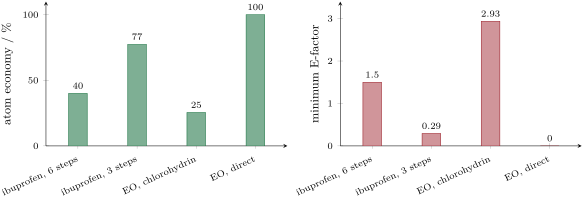
Ibuprofen used to be made in six steps that threw away more mass than they kept: aluminium salts, sodium chloride, ethanol, ammonia and acetic acid left the plant for every kilogram of drug. Since 1992 a three-step catalytic route has turned most of the atoms it uses into the product, and its only by-product, acetic acid, is recovered and sold. This chapter puts numbers on such comparisons: atom economy, E-factors and process mass intensity; it then looks at solvents, energy and life-cycle assessment, at how some of the largest chemical processes were made cleaner, and at what renewable feedstocks and enzymes change.
You already know
The school volume introduced atom economy and green chemistry; the Year 1 volume yields; the Year 2 volume reactors, conversion, selectivity, residence time, single-pass conversion, recycle and purge, adiabatic temperature rise, electrolysers and fuel cells. Chapter 16 and Chapter 21 treated catalysis, Chapter 30 the measures of a synthetic route.
31.1 Measuring greenness
Definition 31.1 (Green chemistry)
Green chemistry is the design of chemical products and processes that reduce or eliminate the use and generation of hazardous substances, summarised in twelve principles: prevent waste, maximise atom economy, use and make less hazardous substances, design safer products, use safer solvents, save energy, use renewable feedstocks, avoid unnecessary derivatives, prefer catalysts to stoichiometric reagents, design for degradation, monitor in real time, and choose inherently safer chemistry.
Definition 31.2 (Atom economy)
The atom economy of a reaction is the molar mass of the desired product divided by the sum of the molar masses of all the reactants in the balanced equation, as a percentage.
Proposition 31.3 (Atom economy by reaction class)
Additions and rearrangements have an atom economy of 100 %; substitutions and eliminations have less.
Proof. In an addition, , or a rearrangement, , the only product contains all the atoms of the reactants, so its molar mass equals the sum of theirs. A substitution, , or an elimination, , produces a second product that carries away mass. ∎
Definition 31.4 (E-factor)
The E-factor of a process is the mass of waste per mass of product. In the complete E-factor all inputs not ending in the product count as waste, solvents and water included; the simple E-factor leaves out solvents and water.
Definition 31.5 (Process mass intensity)
The process mass intensity (PMI) is the total mass of materials put into a process (reactants, reagents, solvents, water) per mass of product.
Proposition 31.6 (PMI and E-factor)
For the same boundary, , with the complete E-factor.
Proof. By conservation of mass, everything put in leaves either as product or as waste: . Dividing by gives . ∎
Definition 31.7 (Reaction mass efficiency)
The reaction mass efficiency (RME) of a reaction is the mass of product obtained divided by the total mass of the reactants used.
Proposition 31.8 (RME from yield and atom economy)
, where the stoichiometric factor is the mass of reactants used divided by the mass the balanced equation requires.
Proof. For one mole of product expected, the equation needs a mass of reactants and the run uses ; it gives of product. Dividing: . ∎
Method 31.9 (Computing the metrics of a route)
- Write the balanced equation of each step and compute the atom economy of the route from all the reactants that enter it.
- From the batch record, add the masses of everything charged (reactants, reagents, solvents, water, work-up materials): PMI = total in / product.
- ; subtract recovered and reused streams if they are inside the boundary, and say so.
- RME for each step: product / reactants, to find where material is lost (low yield, excess reagent, or poor atom economy).
31.2 Solvents and energy
Solvents are usually the largest part of the mass of a fine-chemical or pharmaceutical process. Solvent selection guides rank them by safety, health and environmental criteria: water, ethanol, ethyl acetate, 2-methyltetrahydrofuran and anisole are recommended; dichloromethane, chloroform, benzene, hexane, dimethylformamide and 1,4-dioxane are to be avoided or banned. Water, supercritical carbon dioxide (which dissolves non-polar compounds and leaves no residue when the pressure is released) and solvent-free reactions remove the problem at its source.
Method 31.10 (Using a solvent selection guide)
- List what the solvent must do: dissolve the reactants, survive the reagents, boil at a usable temperature, separate from water in the work-up.
- Pick from the recommended class first; check its hazard statements.
- If a problematic solvent is needed, look for a recommended one with the same function (2-methyltetrahydrofuran for dichloromethane or THF in extractions, ethyl acetate and heptane for hexane in chromatography).
- Plan its recovery by distillation, and count what is lost in the E-factor.
Definition 31.11 (Process intensification)
Process intensification is the redesign of equipment and operating conditions to make a process much smaller, safer or more efficient: continuous flow reactors with small volumes and large heat-exchange areas, reactive distillation, microwave heating.
In a flow reactor only a small volume of a hazardous intermediate exists at any moment, and heat is removed far faster than in a large batch vessel; reactions that would run away in a tank can be run at higher temperatures and concentrations. Catalysts replace stoichiometric reagents, saving both the reagent and the waste it becomes: the Friedel–Crafts acylation of the old ibuprofen route used aluminium chloride in stoichiometric amount, destroyed in the work-up; the new one uses hydrogen fluoride as catalyst and solvent, recovered and reused.
31.3 Life-cycle thinking
Definition 31.12 (Life-cycle assessment)
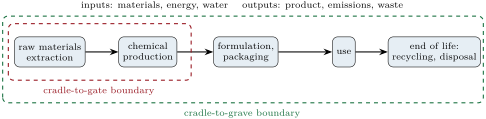
A life-cycle assessment (LCA) evaluates the environmental impacts of a product over its life, from raw-material extraction to disposal. It is expressed per functional unit, the service delivered (for example, one wash of a load of laundry), within a system boundary that states which processes are included. A cradle-to-gate assessment stops when the product leaves the factory.
Definition 31.13 (Carbon footprint)
The carbon footprint of a product is its life-cycle emission of greenhouse gases, expressed as the mass of carbon dioxide with the same warming effect.
Method 31.14 (Setting up a comparative LCA)
- State the goal and the functional unit: compare what delivers the same service, not the same mass.
- Draw the same system boundary for both options.
- Inventory inputs and outputs of every process inside it, with data sources and dates.
- Convert to impact categories, then look for trade-offs (lower carbon but more water) and test how sensitive the conclusion is to the data.
31.4 Major processes and their improvement
Proposition 31.15 (Carbon dioxide from ammonia)
Making ammonia with hydrogen from steam reforming of methane releases, from the feedstock alone, mole of per mole of : about of per tonne of ammonia.
Proof. Reforming followed by the water–gas shift is overall . The synthesis is : two moles of ammonia need three of hydrogen, that is mole of methane and mole of ; per mole of ammonia, . A tonne of ammonia () is , giving of . Burning methane for the heat of reforming adds more. ∎
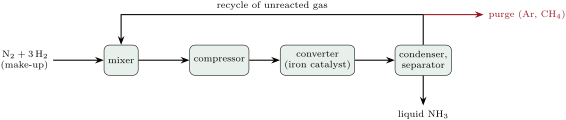
Ammonia plants, which make about 150 million tonnes of nitrogen a year, are among the largest single sources of industrial carbon dioxide; hydrogen from electrolysis with low-carbon electricity, or carbon capture at the reformer, are the routes to cut it. The ammonia loop itself, with its low single-pass conversion, recycle of unreacted gas and purge of the argon and methane that would otherwise accumulate, is already efficient.
Other large processes show the same lessons. The contact process for sulfuric acid is so exothermic that a modern plant exports steam and electricity. Ethylene oxide was first made through ethylene chlorohydrin, with calcium chloride as waste; direct oxidation of ethylene with oxygen over silver, an addition with 100 % atom economy, replaced it, at the cost of some ethylene burnt to carbon dioxide. Propylene oxide is now also made with hydrogen peroxide on a titanium zeolite catalyst, with water as the only by-product. Adipic acid, made by oxidising cyclohexanol and cyclohexanone with nitric acid, releases nitrous oxide, a strong greenhouse gas, which plants now destroy catalytically.
31.5 Renewable feedstocks and biocatalysis
Definition 31.16 (Renewable feedstocks)
A renewable feedstock is a raw material replenished on a human time scale, such as plant biomass. A platform molecule is a simple compound made from it in large amounts and converted into many products: ethanol, lactic acid, succinic acid, glycerol, levulinic acid, furfural, 5-(hydroxymethyl)furfural.
Definition 31.17 (Biocatalysis)
Biocatalysis is the use of enzymes, isolated or in cells, as catalysts for chemical transformations.
Enzymes work in water near room temperature with exquisite selectivity, and directed evolution now tailors them to non-natural substrates: a transaminase evolved for the purpose replaced a rhodium-catalysed asymmetric hydrogenation in the manufacture of the diabetes drug sitagliptin, and ketoreductases make many chiral alcohols. Carbon dioxide itself is a feedstock: urea is made from it and ammonia, and methanol from it and hydrogen. Polyethylene terephthalate can be depolymerised by glycolysis or methanolysis back to its monomers, or by engineered enzymes, and repolymerised.
In the lab — Replacing dichloromethane in a work-up
A product that was extracted from water with dichloromethane is extracted instead with 2-methyltetrahydrofuran: it is made from biomass, separates cleanly from water (it is only partly miscible), and is the upper layer, not the lower one, which changes the order of the separating-funnel operations. The organic layers are dried, the solvent distilled off at reduced pressure and collected for reuse.
Safety


Ethylene oxide: extremely flammable gas under pressure, toxic if inhaled, may cause cancer and genetic defects; it exists only in closed industrial systems and sterilisation units. Dichloromethane is a suspected carcinogen, and 2-methyltetrahydrofuran is flammable and corrosive to the eyes: a greener solvent is not a harmless one.
History — Twelve principles and one number
Paul Anastas and John Warner published the twelve principles of green chemistry in 1998. Roger Sheldon introduced the E-factor in 1992, observing that the fine-chemical and pharmaceutical industries, though small in tonnage, produced far more waste per kilogram of product than bulk chemistry. The three-step ibuprofen process, started in 1992, became one of the early examples of the new approach.
31.6 Exercises
Exercise 31.1 ★
Compute the atom economy of the Diels–Alder reaction of butadiene with ethene, of the esterification of acetic acid with ethanol, and of the Wittig reaction of benzaldehyde with (giving styrene and triphenylphosphine oxide).
Solution
Solution of Exercise 31.1.
Diels–Alder: 100 % (an addition). Esterification: %. Wittig: %, triphenylphosphine oxide carrying away most of the mass.
Exercise 31.2 ★
A batch uses 120 kg of materials (reactants, solvents and water) and gives 8.0 kg of product. Compute PMI and the complete E-factor.
Solution
Solution of Exercise 31.2.
; .
Exercise 31.3 ★
Choose a functional unit for comparing two laundry detergents, and say why “one kilogram of powder” would be a poor choice.
Solution
Solution of Exercise 31.3.
One wash of a standard load at a given temperature and cleaning result. Detergents are dosed differently: a concentrated powder needs less per wash, so equal masses do not deliver the same service.
Exercise 31.4 ★
Suggest greener replacements for dichloromethane in an extraction, hexane in chromatography, and DMF in an amide coupling.
Solution
Solution of Exercise 31.4.
2-Methyltetrahydrofuran or ethyl acetate for dichloromethane; heptane (with ethyl acetate) for hexane; for DMF, ethyl acetate, 2-methyltetrahydrofuran or dimethyl carbonate, or a coupling in water with surfactants, depending on the reagents.
Exercise 31.5 ★★
An esterification of 60.0 g of acetic acid with 92.0 g of ethanol (twice the stoichiometric amount) gives 70.4 g of ethyl acetate. Compute the yield, the atom economy, the stoichiometric factor and the RME, and check the relation between them.
Solution
Solution of Exercise 31.5.
1.000 mol of acid; 0.800 mol of ester (): yield 80 %. AE 83.0 %. SF . ; .
Exercise 31.6 ★★
Compute the atom economies of the chlorohydrin and direct-oxidation routes to ethylene oxide, and the mass of calcium chloride made per tonne of ethylene oxide by the first.
Solution
Solution of Exercise 31.6.
Chlorohydrin: %; direct oxidation: 100 %. One mole of per mole of ethylene oxide: per tonne.
Exercise 31.7 ★★
Check the per tonne of ammonia of the chapter, and compute the per tonne of hydrogen made by steam reforming.
Solution
Solution of Exercise 31.7.
of per tonne of ammonia. For hydrogen, : mole per mole, of per tonne of hydrogen.
Exercise 31.8 ★★
Compute the minimum electrical energy, in kWh, to make one kilogram of hydrogen by electrolysis of liquid water at , from , and the energy from .
Solution
Solution of Exercise 31.8.
One kilogram is . From : . From : (the difference is heat that the surroundings can supply).
Exercise 31.9 ★★
If one mole of is formed per mole of adipic acid () and the global warming potential of is 273 (data of the exercise), compute the and the equivalent per tonne of adipic acid without abatement.
Solution
Solution of Exercise 31.9.
of , ; of equivalent per tonne of adipic acid.
Exercise 31.10 ★★★
Show that for a sequence of steps the overall RME is not the product of the step RMEs when excess reagents are recycled, and explain how recycling changes the E-factor.
Solution
Solution of Exercise 31.10.
The RME of a step counts the excess reagent as consumed; if the excess is recovered and fed back, only the part actually lost is consumed, and the overall mass efficiency is higher than the product of the step values. In the E-factor the recycled stream is not waste, provided the recycling is inside the boundary; its energy and losses must then be counted.
Exercise 31.11 ★★★
A process improvement cuts the solvent in a step from 20 L to 5 L per kilogram of product (solvent density , 90 % recovered by distillation before and after; data of the exercise). Compute the change in the complete E-factor.
Solution
Solution of Exercise 31.11.
Before: of solvent, 10 % lost: of waste. After: , lost. The complete E-factor falls by 1.2 kg per kilogram of product (and the distillation energy by three quarters).
Exercise 31.12 ★★★
A bio-based route to a monomer has a lower carbon footprint but needs more land and water than the petrochemical route. How would a comparative LCA present this, and what would you need to decide between them?
Solution
Solution of Exercise 31.12.
Per functional unit and with the same boundary, it would report each impact category separately (climate, land use, water use…) rather than one score. A decision needs the weights given to these categories, the local scarcity of water and land, the uncertainty of the data, and whether the bio-based feedstock competes with food.
31.7 Problem: Ibuprofen, Six Steps or Three?
Problem 31.1
Weekend problem — ibuprofen, six steps or three: the atom economies of the two routes, their E-factors, the catalysts that make the difference, and the waste avoided in a year
Data of the problem, per tonne of ibuprofen. Three-step route: 0.71 t of isobutylbenzene, 0.55 t of acetic anhydride, 0.010 t of hydrogen, 0.14 t of carbon monoxide, 0.05 t of solvent and catalyst losses; 0.31 t of acetic acid recovered and sold. Six-step route: 2.0 t of reagents and 1.5 t of unrecovered solvents and auxiliaries. A plant makes 3000 t of ibuprofen a year.
Part I — Atom economy.
- Write the three steps of the catalytic route.
- Write its overall equation.
- Compute the molar masses involved and the atom economy.
- List the reactants of the six-step route (Friedel–Crafts acylation, Darzens condensation with ethyl chloroacetate and sodium ethoxide, hydrolysis and decarboxylation, oxime formation, dehydration to the nitrile, hydrolysis).
- Compute its atom economy from the sum of their molar masses (with two waters).
- Which by-products leave the old route?
Part II — E-factors.
- Compute the mass put into the new route per tonne of product.
- Compute its PMI and its complete E-factor, acetic acid counted as waste.
- Compute the E-factor if the recovered acetic acid is counted as a product.
- Compute PMI and E-factor for the old route.
- Why is the real E-factor larger than ?
- Which of the twelve principles do the differences illustrate?
Part III — Catalysts.
- What does hydrogen fluoride replace in the acylation, and why does it matter?
- What catalyses the hydrogenation of the ketone to the alcohol?
- What catalyses the carbonylation of the alcohol, and which chapter’s chemistry is it?
- Why is acetic acid a by-product in both routes?
- What hazards does the new route bring, and how are they managed?
- Why does fewer steps also mean less energy?
Part IV — A year.
- Compute the waste of the old route for the plant’s annual output.
- Compute that of the new route (acetic acid sold).
- Compute the waste avoided per year.
- Is a lower E-factor always a lower environmental impact?
- What would a life-cycle assessment add?
- State the result: the atom economy of the three-step route.
Solution
Solution of Problem 31.1.
1. (HF); (Raney nickel); (palladium).
2. .
3. of reactants; ibuprofen : AE %.
4. Isobutylbenzene, acetic anhydride, ethyl chloroacetate, sodium ethoxide, aqueous acid (), hydroxylamine and water.
5. : AE %.
6. Acetic acid, sodium chloride, ethanol, carbon dioxide, water, ammonia (as an ammonium salt), and aluminium salts from the stoichiometric aluminium chloride.
7. .
8. PMI 1.46; .
9. .
10. PMI ; .
11. Yields below 100 %, excess reagents, solvent and catalyst losses, and work-up materials all add waste that the atom economy ignores.
12. Prevent waste, maximise atom economy, use catalysts rather than stoichiometric reagents, avoid unnecessary derivatives and steps, save energy.
13. The stoichiometric aluminium chloride, hydrolysed to aluminium waste in the work-up; hydrogen fluoride is both catalyst and solvent and is recovered and reused.
14. Raney nickel (a heterogeneous hydrogenation catalyst).
15. A palladium phosphine complex: the carbonylation chemistry of Chapter 21.
16. Acetic anhydride transfers one acetyl group; the other half of the molecule leaves as acetic acid.
17. Hydrogen fluoride is very toxic and corrosive, carbon monoxide toxic and flammable: closed equipment of resistant materials, detectors and trained operators.
18. Each step adds heating, cooling, separations and solvent recovery; three steps need fewer of all of them.
19. a year.
20. a year.
21. About of waste avoided each year.
22. No: the nature of the waste matters (a tonne of salt water is not a tonne of a persistent toxic compound), and so do energy, emissions and the hazards of the reagents.
23. The impacts of making the reagents and energy upstream, of emissions to air and water, and of the product’s use and disposal, per functional unit, in several impact categories.
24. The three-step catalytic route has an atom economy of about 77 % (40 % for the six-step route).