School Chemistry — Grades 1 to 12 · Grades 1–12
48Synthesis Strategy and Green Chemistry
The same painkiller, ibuprofen, has been made in two ways. The older route takes six steps, and of every hundred kilograms of starting materials it buys, sixty end up as waste. The newer one takes three steps, and keeps almost every atom it buys. Both give the same white powder in the tablet; they differ in the planning. A chemist who plans a synthesis asks four questions: how to go fast, how to get much, how to touch only the right part of a molecule, and how to waste little.
You already know
A synthesis: reaction, separation, purification, identification; its yield (Chapter 28). Curly arrows, substitution, addition, elimination (Chapter 40). A catalyst speeds up a reaction without being consumed (Chapter 42). A non-total reaction stops at ; an excess of a reactant, or the removal of a product, carries it further (Chapter 43).
48.1 Optimising a synthesis
Two different things can be improved: the rate, which decides how long the synthesis takes, and the yield, which decides how much product it gives.
Proposition 48.1 (Levers on rate and yield)
- The rate rises with the temperature, with the concentrations of the reactants, and with a catalyst.
- The final yield of a total reaction is fixed by the limiting reactant; that of a non-total reaction rises with an excess of one reactant, or with the removal of a product as it forms. A catalyst does not change it: it only brings the system faster to the same final state.
Proof. The first point gathers the kinetic factors of Chapters 41 and 42. The second follows from at the end of a non-total reaction: adding a reactant or removing a product makes , and the reaction goes on forwards. ∎
Example 48.2 (Esterification with a water trap)
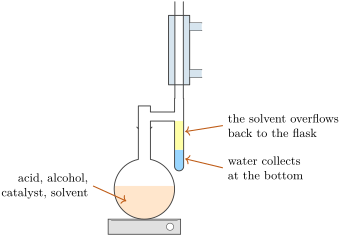
Ethanoic acid and ethanol, one mole of each, give only of ester at equilibrium. If the mixture is heated under reflux in a solvent that does not mix with water, with a little acid as catalyst, the vapour condenses into a side tube, a water trap: the water, denser, settles at the bottom and stays there, while the solvent flows back into the flask. Water leaves the reaction as it forms, stays below , and the esterification goes almost to completion. The heating gives the rate, the catalyst more rate, the trap the yield.
48.2 Selectivity
A real molecule often carries several functional groups. A reagent that attacks them all gives a mixture; a good synthesis uses one that attacks only the group to be changed.
Definition 48.3 (Chemoselective reaction)
A reaction is chemoselective when, on a molecule carrying several functional groups, its reagent transforms one group and leaves the others unchanged.
Example 48.4 (A reductant that chooses)
Sodium borohydride, , reduces the carbonyl group of aldehydes and ketones into an alcohol group, but leaves esters untouched. On a molecule that carries a ketone and an ester, only the ketone changes:
A stronger reductant, lithium aluminium hydride , would reduce both groups: it is not chemoselective here.
Remark 48.5 (Several kinds of selectivity)
Chemoselectivity chooses between groups. A reaction can also choose between two positions of the same group, or between two stereoisomers of the product, as the enzymes of Chapter 42 and the chiral molecules of Chapter 39 showed. Each kind is studied in the university volumes.
48.3 Protecting groups
When no reagent is selective enough, the chemist hides the group that must not react, does the reaction, and then uncovers the group again.
Definition 48.6 (Protecting group)
A protecting group is a group attached to a functional group to stop it from reacting during one or more steps of a synthesis, and removed afterwards to give back the original group. The three operations are protection, reaction and deprotection.
Method 48.7 (Planning a protection)
- List the groups of each reactant, and the one bond to be made.
- Mark every other group that the reagent of that step could also attack.
- Protect each of them with a group that resists the reaction conditions and that can be removed under gentle conditions that leave the new bond intact.
- Count the cost: each protection adds two steps, protection and deprotection, and lowers the overall yield.
Example 48.8 (Making one dipeptide, not four)
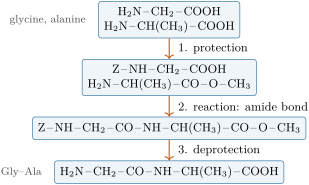
Glycine, , and alanine, , each carry an amine group and an acid group. An amide bond between the acid of glycine and the amine of alanine gives the dipeptide Gly–Ala. Mixed directly, the two amino acids give four dipeptides, Gly–Ala, Ala–Gly, Gly–Gly and Ala–Ala, in a mixture hard to separate. The plan:
- protect the amine of glycine with a group written , and the acid of alanine as its methyl ester;
- form the amide bond: only one acid group and one amine group are left free;
- remove both protecting groups.
48.4 Atom economy
A yield of says that every molecule of the limiting reactant became product. It does not say how many of the atoms bought ended up in the product: the other products of the equation, however pure, are waste unless someone can use them.
Definition 48.9 (Atom economy)
The atom economy of a synthesis is the fraction of the mass of the reactants, taken in the proportions of the balanced equation, that ends up in the desired product.
Proposition 48.10 (Atom economy from the equation)
For a balanced equation ,
Proof. For moles of reaction, the mass of reactants consumed is and the mass of desired product formed is ; their ratio does not depend on . ∎
Method 48.11 (Computing an atom economy)
- Write the balanced equation; for a route of several steps, add the steps so that every intermediate cancels.
- Compute the molar mass of each reactant and of the desired product.
- Apply the formula, with the stoichiometric coefficients.
- The waste per kilogram of product is kilograms.
Example 48.12 (Addition against substitution)
Bromoethane from ethene, : every atom ends up in the product, atom economy . Ethanol from bromoethane, : the atom economy is ; per kilogram of ethanol, of sodium bromide. An addition always has an atom economy of ; a substitution or an elimination never does.
48.5 Green chemistry
Definition 48.13 (Green chemistry)
Green chemistry is the design of chemical products and processes that reduce or eliminate the use and the production of hazardous substances, from the choice of the starting materials to the fate of the product after use.
Twelve principles summarise the approach; each is a question to ask of a process.
- Prevent waste rather than treat it.
- Maximise atom economy.
- Design less hazardous syntheses.
- Design safer chemicals and products.
- Use safer solvents and reaction conditions.
- Increase energy efficiency: work near room temperature and pressure.
- Use renewable feedstocks.
- Avoid chemical derivatives, such as protecting groups.
- Use catalysts, not stoichiometric reagents.
- Design products that degrade after use.
- Analyse in real time to prevent pollution.
- Minimise the potential for accidents.
Remark 48.14 (Principles, not laws)
The principles often pull in opposite directions: a protecting group breaks principle 8 but may save a whole synthesis; a catalyst that saves energy may contain a scarce metal. Judging a process means weighing them, with numbers wherever possible: atom economy, yield, mass of waste, energy.
History — Green chemistry, 1998
In 1998 the chemists Paul Anastas and John Warner published a book, Green Chemistry: Theory and Practice, which laid out the twelve principles. A year earlier, a government prize for greener syntheses had gone to the three-step route to ibuprofen, run on an industrial scale since 1992. Since then, the principles have been taught to chemists as part of their trade.
Example 48.15 (Two routes to ibuprofen)
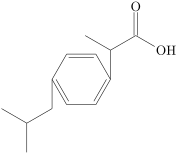
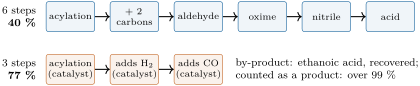
Ibuprofen, , is made from the hydrocarbon (isobutylbenzene). The older route uses six steps and, in each, a full amount of reagent; added together, its reactants have a molar mass sum of , for of ibuprofen: atom economy . The newer route uses three steps, two of them catalysed, and the overall equation
gives . Its by-product, ethanoic acid, is recovered and used: counted as a product, the atom economy exceeds .
Example 48.16 (Greener solvents)
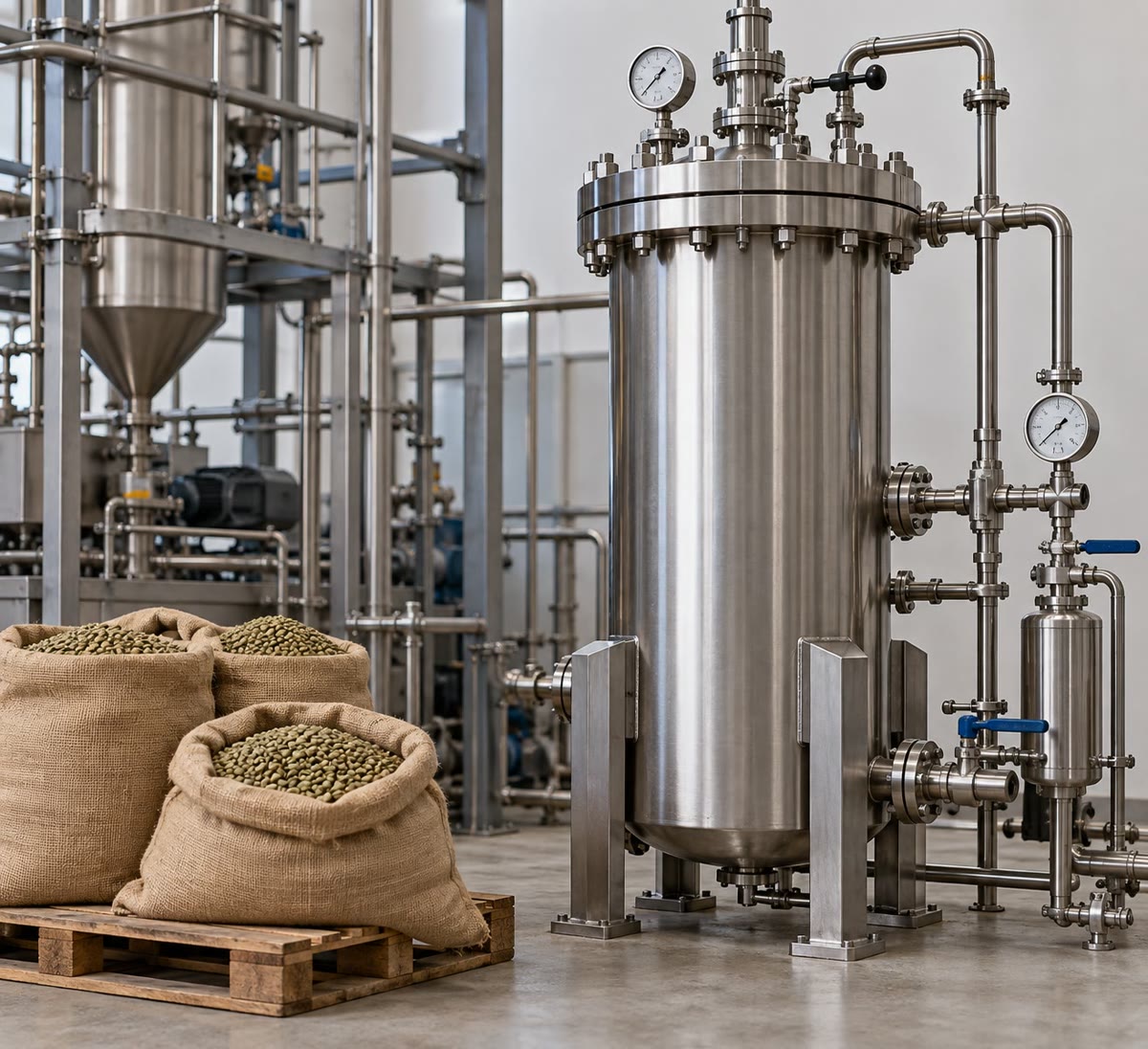
Many reactions and extractions use organic solvents that are toxic, flammable or volatile. Water is the safest solvent of all, when the reactants dissolve in it. Carbon dioxide becomes another: above and it is a supercritical fluid, neither liquid nor gas, which dissolves many organic molecules. It extracts caffeine from coffee beans, for example; when the pressure is released, it simply turns back into a gas and leaves no residue in the product.
48.6 Exercises
Exercise 48.1 ★
Ethanol can be made by hydration of ethene, , or by fermentation of glucose, . Compute the atom economy of each.
Solution
Solution of Exercise 48.1.
Hydration: . Fermentation: .
Exercise 48.2 ★
In the dipeptide scheme of this chapter, name the step at which each protecting group is put on, and the step at which it is taken off.
Exercise 48.3 ★
A factory replaces a chlorinated solvent by water in one of its reactions. Which principle of green chemistry does it apply?
Exercise 48.4 ★
Why does an excess of ethanol raise the yield of an esterification, but a catalyst does not?
Solution
Solution of Exercise 48.4.
An excess of ethanol makes , so the reaction goes further forwards. A catalyst speeds up both directions alike: the same final state is reached, only sooner.
Exercise 48.5 ★
Sodium borohydride reduces aldehydes and ketones, not esters. Is its reaction with methyl 4-oxopentanoate (a ketone and an ester) chemoselective? Which group changes?
Exercise 48.6 ★★
One mole of ethanoic acid and one of ethanol give of ester at equilibrium. Propose two ways to raise this amount, and one way to reach it faster.
Exercise 48.7 ★★
Methyl 4-oxopentanoate, , is treated once with sodium borohydride, once with an excess of lithium aluminium hydride, which reduces the ester into two alcohols. Write each product.
Solution
Solution of Exercise 48.7.
With :
With :
(pentane-1,4-diol), plus methanol from the ester’s other half.
Exercise 48.8 ★★
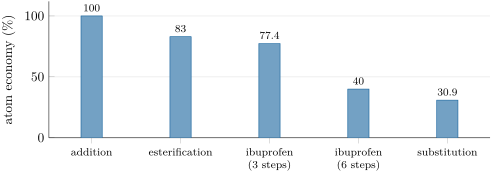
On the bar chart of atom economies, which reactions keep more than three quarters of the atoms? By what factor is the three-step route to ibuprofen better than the six-step one?
Solution
Solution of Exercise 48.8.
The addition (), the esterification () and the three-step route to ibuprofen (). : almost twice as good.
Exercise 48.9 ★★
Aspirin is made by . Compute its atom economy and the mass of by-product per kilogram of aspirin.
Solution
Solution of Exercise 48.9.
. Ethanoic acid: per kilogram of aspirin.
Exercise 48.10 ★★
Why is a synthesis heated under reflux rather than in an open flask? Which of the two, rate or yield, does the heating improve?
Exercise 48.11 ★★
On the figure of the two ibuprofen routes, count the steps and say which principles of green chemistry the newer route applies. Give three.
Solution
Solution of Exercise 48.11.
Six steps against three. Principles: prevent waste (1), maximise atom economy (2), use catalysts (9); also fewer steps, less energy (6).
Exercise 48.12 ★★★
A three-step synthesis has yields of , and . Compute the overall yield. What amount of starting material is needed to obtain of final product, one mole of starting material giving at best one mole of product?
Solution
Solution of Exercise 48.12.
: . Starting material: .
Exercise 48.13 ★★★
Plan the synthesis of the dipeptide Ala–Gly (the acid of alanine bonded to the amine of glycine): which groups do you protect, and how many steps does the plan take?
Solution
Solution of Exercise 48.13.
Protect the amine of alanine () and the acid of glycine (methyl ester); form the amide bond between the free acid of alanine and the free amine of glycine; remove both protecting groups. Three stages, that is five reactions if each protection and deprotection is counted.
Exercise 48.14 ★★★
A company calls its process “green” because it uses a catalyst. The process runs at in benzene, a toxic solvent, and its atom economy is . Judge the claim, principle by principle.
Solution
Solution of Exercise 48.14.
The catalyst applies principle 9. But goes against principle 6, benzene against principles 3 and 5, and an atom economy of against principle 2: of waste per kilogram of product. One green feature does not make a green process.
Exercise 48.15 ★★★
Caffeine is extracted from coffee beans either with dichloromethane, a volatile chlorinated solvent, or with supercritical carbon dioxide at about and . Explain why the second is supercritical, why it needs a strong vessel, and give two advantages it has over the first.
Solution
Solution of Exercise 48.15.
and are above the critical point of carbon dioxide, and . The pressure is a hundred times atmospheric pressure: the vessel is thick steel. Carbon dioxide is neither toxic nor flammable, and it turns back into a gas leaving no residue, and can be reused; no chlorinated solvent escapes.
48.7 Problem: Two Routes to Ibuprofen
Problem 48.1
Weekend problem — how much waste does the three-step route avoid per tonne of ibuprofen?
The older route to ibuprofen takes six steps. Added together, its reactants are , , , , an acid counted as , and two . The newer route takes three steps:
Part I — The equations.
- Check that the equation of the newer route is balanced in carbon, hydrogen and oxygen.
- Name the by-product of the newer route.
- In the older route, which elements of the reactants end up entirely in the waste?
- Which of the two routes uses catalysts? Which principle does that apply?
Part II — Atom economies.
- Compute the molar mass of ibuprofen.
- Compute the sum of the molar masses of the reactants of the older route.
- Deduce its atom economy.
- Compute the sum of the molar masses of the reactants of the newer route.
- Deduce its atom economy.
- What does it become if the ethanoic acid is counted as a product?
Part III — Waste per tonne.
- For the older route, at yield, what mass of reactants is bought per tonne of ibuprofen?
- What mass of waste does it give per tonne?
- Same question for the newer route: mass of reactants per tonne.
- Mass of ethanoic acid per tonne.
- What mass of waste per tonne is avoided if the ethanoic acid is counted as waste?
Part IV — Yields and the real world.
- Suppose that every step has a yield of . Compute the overall yield of the older route.
- Same for the newer route.
- Give one more reason why fewer steps mean less waste, besides the equation.
- In practice the ethanoic acid is recovered and used. What mass of waste per tonne does the newer route then give, at yield?
- State the final answer: how much waste does the three-step route avoid per tonne of ibuprofen?
Solution
Solution of Problem 48.1.
1. C: ; H: ; O: .
2. Ethanoic acid, .
3. Nitrogen, chlorine and sodium: ibuprofen holds only carbon, hydrogen and oxygen.
4. The newer one: principle 9, catalysts rather than stoichiometric reagents.
5. .
6. .
7. .
8. .
9. .
10. on paper; over in practice.
11. .
12. .
13. .
14. .
15. .
16. : .
17. : .
18. Each step uses solvents, separations and purifications, and loses some product: fewer steps, fewer of these losses.
19. Almost none: its only by-product is used.
20. The three-step route avoids about of waste per tonne of ibuprofen ( even if its ethanoic acid were thrown away).