
All books

Professional

Apps About Coach Log in Start reading

Chemistry · Glossary

What is Coagulation and stabilisation?

Also known as: coagulation · flocculation · critical coagulation concentration · steric stabilisation

Definition 17.20 University Chemistry — Year 3 · Chapter 17 — Interfaces, Surfactants and Colloids

Coagulation is the aggregation of colloidal particles caused by the loss of their electrostatic repulsion; flocculation is aggregation into loose flocs, often bridged by adsorbed polymers. The critical coagulation concentration (CCC) of an electrolyte is the concentration above which a colloid coagulates rapidly. Steric stabilisation keeps particles apart with adsorbed or grafted polymer chains, whose overlap would cost entropy.
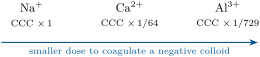
The Schulze–Hardy rule for a negatively charged colloid: the critical coagulation concentration falls as the sixth power of the counterion charge.
Read in context →