
全部书籍

专业

应用 关于 Coach 登录 开始阅读

书籍暂未推出简体中文版——当前显示英文版。

Chemistry · 术语表

什么是 Coagulation and stabilisation?

又称: coagulation · flocculation · critical coagulation concentration · steric stabilisation

Definition 17.20 University Chemistry — Year 3 · 第 17 章 — Interfaces, Surfactants and Colloids

Coagulation is the aggregation of colloidal particles caused by the loss of their electrostatic repulsion; flocculation is aggregation into loose flocs, often bridged by adsorbed polymers. The critical coagulation concentration (CCC) of an electrolyte is the concentration above which a colloid coagulates rapidly. Steric stabilisation keeps particles apart with adsorbed or grafted polymer chains, whose overlap would cost entropy.
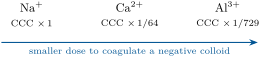
The Schulze–Hardy rule for a negatively charged colloid: the critical coagulation concentration falls as the sixth power of the counterion charge.
在原文中阅读 →