
All books

Professional

Apps About Coach Log in Start reading

Chemistry · Glossary

What is Hydrophilic, hydrophobic, amphiphilic?

Also known as: hydrophilic · hydrophobic · amphiphilic

Definition 4.16 University Chemistry — Year 1 · Chapter 4 — Intermolecular Forces and Solvents

A group is hydrophilic when it interacts favourably with water (ionic or polar groups: −COOX−\ce{-COO^-}, −OH\ce{-OH}, −SOX3X−\ce{-SO3^-}) and hydrophobic when it does not (hydrocarbon chains). A molecule is amphiphilic when it carries both a hydrophilic head and a hydrophobic tail.
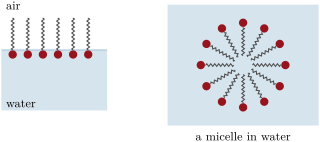
Amphiphilic molecules (red hydrophilic head, zigzag hydrophobic tail) at the surface of water and gathered into a micelle, drawn in cross-section; micelles are studied in the Year 3 volume.

Examples

Example 4.17 (Soap)

Sodium dodecanoate, CHX3(CHX2)X10COOX− NaX+\ce{CH3(CH2)10COO- Na+}, is amphiphilic. At the surface of water its molecules stand with the head in the water and the tail in the air. In the bulk, above a small concentration, they gather into spheres — micelles — with the tails inside and the heads outside. Grease, apolar, dissolves in the hydrophobic core of the micelles and is carried away by the water.

Read in context →