
All books

Professional

Apps About Coach Log in Start reading

Chemistry · Glossary

What is Protecting group?

Also known as: protection · deprotection

Definition 48.6 School Chemistry — Grades 1 to 12 · Chapter 48 — Synthesis Strategy and Green Chemistry

A protecting group is a group attached to a functional group to stop it from reacting during one or more steps of a synthesis, and removed afterwards to give back the original group. The three operations are protection, reaction and deprotection.
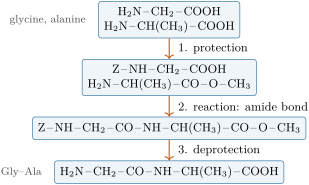
Protection, reaction, deprotection: the only amide bond that can form is the one wanted.

Examples

Example 48.8 (Making one dipeptide, not four)

Glycine, HX2N−CHX2−COOH\ce{H2N-CH2-COOH}, and alanine, HX2N−CH(CHX3)−COOH\ce{H2N-CH(CH3)-COOH}, each carry an amine group and an acid group. An amide bond between the acid of glycine and the amine of alanine gives the dipeptide Gly–Ala. Mixed directly, the two amino acids give four dipeptides, Gly–Ala, Ala–Gly, Gly–Gly and Ala–Ala, in a mixture hard to separate. The plan:

  1. protect the amine of glycine with a group written Z\ce{Z}, and the acid of alanine as its methyl ester;
  2. form the amide bond: only one acid group and one amine group are left free;
  3. remove both protecting groups.
Read in context →
Definition 23.6 University Chemistry — Year 1 · Chapter 23 — Carbonyls: Nucleophilic Additions, Acetals and Protection

A protecting group is a group introduced into a molecule to mask a function temporarily, so that it does not react in a step aimed at another part of the molecule. Its introduction is the protection, its removal the deprotection.

Examples

Example 23.8 (A ketone in the way)

To add a Grignard reagent to the aldehyde group of a molecule that also carries a ketone, no simple acetal choice exists (aldehydes form acetals more readily than ketones, so the wrong group would be protected); the order of the steps or the reagents must change. Protection is a strategy, not a reflex.

Read in context →