University Chemistry — Year 1 · Bachelor Year 1
23Carbonyls: Nucleophilic Additions, Acetals and Protection
Dissolve glucose in water and almost none of it stays as the open-chain aldehyde drawn in textbooks: the molecule bends round, its own hydroxyl group adds to its aldehyde, and a six-membered ring closes. The same addition of an alcohol to a carbonyl group, repeated once more with an acid catalyst, gives acetals, compounds stable towards bases and the most reactive nucleophiles. That stability is a tool: an aldehyde that would be destroyed by a Grignard reagent can be hidden as an acetal, carried through the reaction, and recovered at the end. This chapter studies the carbonyl group as an electrophile, the additions of water and alcohols, and the strategy of protection.
You already know
Grignard additions to carbonyl compounds (Chapter 21); the reaction quotient and the evolution of a system while (Chapter 7); curly arrows, nucleophiles and electrophiles (Chapter 18). The school volume (grade 12) introduced the idea of protecting a group during a synthesis.
23.1 The carbonyl group as an electrophile
The C=O bond is polarised towards oxygen (Chapter 2), and a resonance structure puts a full positive charge on carbon: the carbon is electrophilic, attacked by nucleophiles perpendicular to the plane of the group. Strong nucleophiles (Grignard reagents, hydride, cyanide) add directly. Weak nucleophiles — water, alcohols — need help.
Definition 23.1 (Electrophilic activation)
Electrophilic activation of a carbonyl group is its protonation (or its coordination to a Lewis acid) on oxygen. The cation , whose positive charge is shared by carbon through the resonance structure , is attacked even by weak nucleophiles.

23.2 Hydrates and hemiacetals
Water adds reversibly to aldehydes and ketones, ; the hydrate is usually minor for ketones and can be major for methanal. An alcohol adds the same way.
Definition 23.2 (Hemiacetal and acetal)
A hemiacetal is a compound in which one carbon carries both an OH and an OR group, formed by the addition of an alcohol to a carbonyl group. An acetal is a compound in which one carbon carries two OR groups, formed from a hemiacetal and a second alcohol molecule, with loss of water.
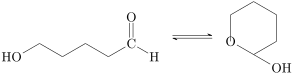
Open-chain hemiacetals are usually minor in their equilibrium with the aldehyde and the alcohol; when the OH and the C=O belong to the same molecule and a five- or six-membered ring can close, the cyclic hemiacetal predominates. That is the case of glucose, and of the simpler 5-hydroxypentanal.
23.3 Acetals
Proposition 23.3 (Mechanism of acetal formation)
In acid, an aldehyde or ketone and an alcohol give the hemiacetal, then the acetal, by the steps: protonation of C=O; addition of the alcohol; loss of a proton (hemiacetal); protonation of the OH; loss of water, giving a carbocation stabilised by the remaining OR group (an oxocarbenium ion); addition of a second alcohol; loss of a proton. Every step is reversible.
Proof. Each step is an acid–base proton transfer or the addition (or loss) of a nucleophile to (or from) an electrophilic carbon, as described in Chapter 18. The loss of water is possible because the cation formed, , has a resonance structure in which every atom has an octet (Proposition 18.8). Acid is consumed in the protonations and regenerated in the deprotonations: it is a catalyst. ∎


The overall reaction, , has a modest equilibrium constant, and water is a product.
Proposition 23.4 (Driving the acetalisation)
If the water formed is removed continuously, the acetalisation goes on until the carbonyl compound (or the alcohol) is used up.
Proof. The reaction quotient stays below as long as water is removed: by Chapter 7 the reaction keeps going forward, whatever the value of . With a diol (ethane-1,2-diol) the acetal is cyclic, and the equilibrium is also more favourable, one molecule of diol replacing two of alcohol. ∎
Proposition 23.5 (Stability of acetals)
Acetals are stable in neutral and basic media and towards nucleophiles, Grignard reagents and hydride reagents; aqueous acid hydrolyses them back to the carbonyl compound and the alcohol.
Proof. An acetal carbon carries no leaving group that a base or a nucleophile could expel: , a strong base, does not leave, and there is no C=O left to attack. In aqueous acid the mechanism above runs backwards: the large excess of water makes for the reverse reaction. ∎
23.4 Protecting and deprotecting
Definition 23.6 (Protecting group)
A protecting group is a group introduced into a molecule to mask a function temporarily, so that it does not react in a step aimed at another part of the molecule. Its introduction is the protection, its removal the deprotection.
Method 23.7 (Protect, react, deprotect)
- Identify the function that would react, or would destroy the reagent, in the planned step.
- Choose a protecting group stable in that step and removable in conditions the rest of the molecule tolerates (for an aldehyde or ketone facing bases, nucleophiles or hydrides: a cyclic acetal).
- Protect; carry out the planned step; deprotect.
- Count the cost: two more steps, each with its yield.
Example 23.8 (A ketone in the way)
To add a Grignard reagent to the aldehyde group of a molecule that also carries a ketone, no simple acetal choice exists (aldehydes form acetals more readily than ketones, so the wrong group would be protected); the order of the steps or the reagents must change. Protection is a strategy, not a reflex.
23.5 Exercises
Exercise 23.1 ★
Identify hemiacetal, acetal, hydrate, ether or alcohol carbons in: , , , , .
Solution
Solution of Exercise 23.1.
: hemiacetal. : acetal. : hydrate. : ether. : acetal (of a ketone).
Exercise 23.2 ★
Write the overall equation of the formation of the acetal of propanal with methanol, and of the cyclic acetal of propanone with ethane-1,2-diol.
Solution
Solution of Exercise 23.2.
; propanone with ethane-1,2-diol gives 2,2-dimethyl-1,3-dioxolane and water, .
Exercise 23.3 ★
Which of these reagents leave an acetal unchanged: sodium hydroxide solution, methylmagnesium bromide, dilute sulfuric acid in water, sodium borohydride?
Solution
Solution of Exercise 23.3.
Sodium hydroxide, methylmagnesium bromide and sodium borohydride leave it unchanged; dilute aqueous sulfuric acid hydrolyses it.
Exercise 23.4 ★
Draw the cyclic hemiacetal formed by 4-hydroxybutanal. What is the size of the ring?
Solution
Solution of Exercise 23.4.
The OH on carbon 4 adds to the aldehyde carbon 1: a five-membered ring of four carbons and one oxygen, with an OH on the carbon next to the ring oxygen.
Exercise 23.5 ★★
Write the full mechanism of the acid-catalysed formation of the dimethyl acetal of ethanal, with curly arrows, and show that the acid is regenerated.
Solution
Solution of Exercise 23.5.
Protonation of C=O; methanol adds to carbon; loss of : hemiacetal; protonation of its OH; loss of water to ; second methanol adds; loss of : . The two protons taken are given back: the acid is a catalyst.
Exercise 23.6 ★★
Write the mechanism of the acid hydrolysis of 2,2-dimethoxypropane. Why is a large amount of water used?
Solution
Solution of Exercise 23.6.
Protonation of one OCH3; loss of methanol to ; water adds; loss of : hemiacetal; protonation, loss of methanol, loss of : propanone. Excess water keeps below for the hydrolysis, which goes to completion.
Exercise 23.7 ★★
An acetalisation of of a ketone is followed with a Dean–Stark trap. What volume of water should be collected at full conversion (density about )? After an hour, have collected: what is the conversion?
Exercise 23.8 ★★
Explain why a cyclic acetal with ethane-1,2-diol forms more completely than the acetal with two molecules of methanol, for the same carbonyl compound.
Solution
Solution of Exercise 23.8.
With the diol, one molecule replaces two: the reaction does not decrease the number of molecules (one aldehyde and one diol give one acetal and one water), and the second OH is held close to the reacting carbon, which closes the ring easily. Both make the cyclic acetal more favourable.
Exercise 23.9 ★★
Why must the acid catalyst be removed (or neutralised) before a protected compound is treated with a Grignard reagent?
Solution
Solution of Exercise 23.9.
The acid would destroy the Grignard reagent (proton transfer); traces of water and diol must be removed too.
Exercise 23.10 ★★★
Propose a synthesis of 5-hydroxy-5-methylhexan-2-one, , from 4-chlorobutan-2-one and propanone, using a protection. Give each step, its reagents and the role of each.
Solution
Solution of Exercise 23.10.
1. Protect the ketone of 4-chlorobutan-2-one as a cyclic acetal (ethane-1,2-diol, acid catalyst, Dean–Stark). 2. Magnesium in dry ether: the Grignard reagent of the protected chloride, no longer destroyed by its own carbonyl. 3. Add propanone; work-up with aqueous ammonium chloride: the tertiary alcohol. 4. Dilute aqueous acid: deprotection to 5-hydroxy-5-methylhexan-2-one.
Exercise 23.11 ★★★
Show with the reaction quotient that a large excess of methanol also drives the acetalisation of an aldehyde, and compare this method with the removal of water.
Solution
Solution of Exercise 23.11.
: a large excess of methanol, squared in the denominator, keeps until little aldehyde remains. Removing water acts on the numerator; using methanol as the solvent is simpler but needs an easily separated product.
Exercise 23.12 ★★★
Explain why the cyclic hemiacetal of glucose is attacked, in acidic methanol, to give a methyl acetal (a methyl glycoside) while the other OH groups of glucose are not converted into ethers.
Solution
Solution of Exercise 23.12.
Only the hemiacetal OH can leave as water to give a cation stabilised by the neighbouring ring oxygen (); the other OH groups would have to leave from ordinary carbons, giving unstabilised cations. Methanol adds to the stabilised cation: a methyl acetal.
23.6 Problem: A Grignard Reagent that Carries an Aldehyde
Problem 23.1
Weekend problem — why 4-bromobutanal cannot give a Grignard reagent, its protection as a cyclic acetal with a Dean–Stark trap, the Grignard addition to propanone, the deprotection, and the volume of water collected
A chemist needs 5-hydroxy-5-methylhexanal, , and plans to make it from 4-bromobutanal, , and propanone. She starts from of 4-bromobutanal. Molar masses (): 150.9, 62.0, 194.9, 58.0, 174.0, 130.0, 18.0; density of water .
Part I — The problem.
- Write the Grignard reagent that 4-bromobutanal would give.
- Why can that reagent not exist? Write the reaction that destroys it.
- Which function must be protected, and against what?
- Why is an acetal suitable?
- Why is a cyclic acetal (with ethane-1,2-diol) preferred?
- Compute the amount of 4-bromobutanal.
- Compute the mass of diol for a excess.
Part II — Protection.
- Write the equation of the acetalisation with ethane-1,2-diol.
- What is the role of the acid catalyst (4-methylbenzenesulfonic acid)?
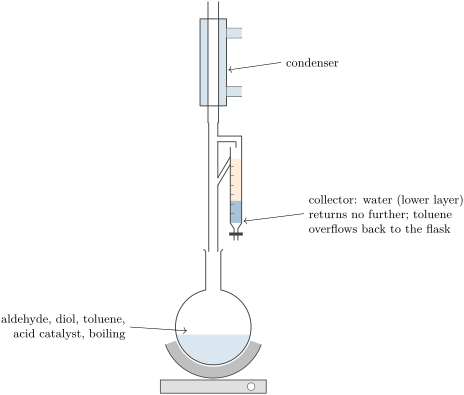
- Describe the operation of the Dean–Stark trap.
- Explain with and why removing water drives the reaction.
- Why is the toluene, and not the water, returned to the flask?
- How does the chemist know the reaction is complete?
- Compute the mass of protected bromide expected at full conversion.
Part III — The Grignard step.
- Write the formation of the Grignard reagent from the protected bromide.
- Write its addition to propanone and the alkoxide formed.
- Why must the work-up of this step be mildly basic or neutral (for example aqueous ammonium chloride) rather than acidic?
- Compute the mass of protected alcohol for a yield of this step.
Part IV — Deprotection.
- Write the deprotection in aqueous acid.
- Why does the tertiary alcohol survive mild aqueous acid?
- The product can close a six-membered ring by adding its OH to the aldehyde. Draw that cyclic hemiacetal.
- Compute the mass of hydroxy aldehyde at yield of deprotection.
- What overall yield from 4-bromobutanal does the chemist reach?
- Compute the mass of water formed in the protection step at full conversion.
- State the volume of water collected in the Dean–Stark trap at full conversion.
Solution
Solution of Problem 23.1.
1. . 2. Its carbanion-like carbon would attack the aldehyde of another molecule (or of itself): adds to , giving an alkoxide. 3. The aldehyde, against the Grignard reagent. 4. Acetals are stable towards Grignard reagents and bases and are removed by aqueous acid. 5. It forms more completely (one diol for two alcohol molecules) and is easy to hydrolyse. 6. . 7. . 8. (2-(3-bromopropyl)-1,3-dioxolane). 9. It activates the carbonyl and allows the loss of water in the second stage; it is regenerated. 10. Toluene and water distil together, condense and fall into the collector; water sinks and stays, toluene overflows back. 11. contains in its numerator; removing water keeps , and the reaction proceeds. 12. Water is denser and does not mix with toluene: it collects at the bottom; only the upper layer reaches the return arm. 13. When water stops collecting, at the expected volume. 14. . 15. (dry ether). 16. The reagent adds to : the alkoxide on the protected chain, with . 17. Acid would remove the protecting group too early and could dehydrate the tertiary alcohol. 18. . 19. The acetal + the aldehyde + ethane-1,2-diol (acid catalyst). 20. Its loss of water needs strong acid and heat; mild, cold aqueous acid hydrolyses the acetal much faster. 21. The OH of carbon 5 adds to the aldehyde carbon 1: a six-membered ring (five carbons and one oxygen) with two methyl groups on the carbon next to the ring oxygen and an OH on the other carbon next to it. 22. , . 23. (protection taken as complete). 24. . 25. of water in the trap.