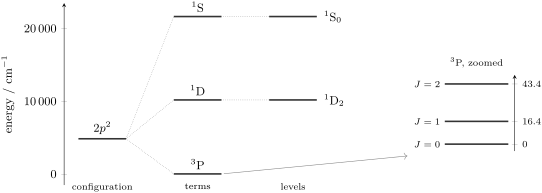
A spectroscopic term is the set of the (2L+1)(2S+1) states of a configuration with given L and S. Its spin multiplicity is 2S+1. The term symbol is 2S+1L, with the letters S, P, D, F, G, H for L=0,1,2,3,4,5; a state of given J is written 2S+1LJ — for example 3P2.
Examples
Example 2.15 (The terms of p2)
Two electrons in p (ml=1,0,−1) give (26)=15 determinants. Their table by ML and MS is:
| MS=1 | MS=0 | MS=−1 |
|---|
| ML=2 | – | (1+,1−) | – |
| ML=1 | (1+,0+) | (1+,0−), (1−,0+) | (1−,0−) |
| ML=0 | (1+,−1+) | (1+,−1−), (1−,−1+), (0+,0−) | (1−,−1−) |
| ML=−1 | (0+,−1+) | (0+,−1−), (0−,−1+) | (0−,−1−) |
| ML=−2 | – | (−1+,−1−) | – |
(with ml± for ms=±21). ML=2 occurs only with MS=0: a 1D term (5 states). The largest remaining ML=1 comes with MS=1: a 3P term (9 states). One state with ML=MS=0 remains: a 1S term. Indeed 5+9+1=15.
Example 2.16 (Carbon, measured)
The ground configuration 2p2 of carbon gives the levels 3P0, 3P1, 3P2 at 0, 16.4 and 43.4cm−1, then 1D2 at 10193cm−1 and 1S0 at 21648cm−1: the 3P term is lowest, as Hund’s rules predict.
 Coach
Coach