University Chemistry — Year 3 · Bachelor Year 3
2Many-Electron Atoms and Term Symbols
In 1868 a yellow line in the spectrum of the Sun revealed an element unknown on Earth, helium. When it was finally isolated in the laboratory, in 1895, its spectrum looked like that of two elements: two families of lines, which for a while were attributed to “orthohelium” and “parahelium”, and which never exchanged light with each other. There is only one helium. The two families are the triplet and singlet states of the same atom, kept apart by the electron’s spin and by a rule more fundamental than any force: the wavefunction of two electrons must change sign when they are exchanged. This chapter follows that rule from the Pauli principle to the term symbols with which spectroscopists label every state of every atom and ion — including the transition-metal ions whose colours are explained in Chapter 18.
You already know
The Year 1 volume labelled electrons by four quantum numbers , , , , built ground configurations with the Pauli principle, the Klechkowski rule and Hund’s rule, and counted unpaired electrons. The Year 2 volume gave orbital energies and Slater’s rules for screening. Chapter 1 supplied operators, eigenvalues, the rotor’s angular momentum ( with eigenvalues ) and the hydrogen atom.
2.1 Spin and spin-orbitals
The electron carries an intrinsic angular momentum, its spin, with quantum number : has the single eigenvalue , and the two eigenvalues . The two spin functions are written () and (); they are orthonormal, and . Spin has no classical counterpart; it is not the rotation of a small sphere, and it does not enter a non-relativistic Hamiltonian at all.
Definition 2.1 (Spin-orbital)
A spin-orbital is the product of a spatial orbital and a spin function: or . A spin-orbital holds the complete description of one electron.
An atomic orbital labelled in the Year 1 volume thus gives two spin-orbitals, which is why a subshell holds electrons. The real question is why a spin-orbital holds at most one.
2.2 Indistinguishable electrons and the Slater determinant
Definition 2.2 (Indistinguishable particles, antisymmetric wavefunction)
Particles are indistinguishable if no measurement can tell them apart: every electron is identical to every other. A wavefunction of several electrons is an antisymmetric wavefunction if it changes sign when the coordinates (space and spin) of any two electrons are exchanged: .
Indistinguishability alone requires to be unchanged by an exchange, so can at most change sign. Nature has chosen: the wavefunction of any system of electrons — of any fermions — is antisymmetric. This is a postulate of quantum mechanics, confirmed by every atomic spectrum.
Definition 2.3 (Slater determinant)
For electrons in different spin-orbitals , the Slater determinant is
where row holds electron in each spin-orbital. It is written for short .
Theorem 2.4 (The Pauli principle)
A Slater determinant is antisymmetric, and it vanishes if two electrons occupy the same spin-orbital. Hence no two electrons of an atom can have the same four quantum numbers.
Proof. Exchanging electrons and exchanges two rows of the determinant, which changes its sign: antisymmetry holds for every pair. If two spin-orbitals are equal, two columns are equal and the determinant is zero: no such state exists. Two electrons of the same atom with the same , , and would sit in the same spin-orbital. ∎
Example 2.5 (The ground state of helium)
With both electrons in ,
The spatial part is symmetric, the spin part antisymmetric: the two spins are paired, with total spin zero.
2.3 Helium: Coulomb repulsion and exchange
Excite one electron of helium to . Four determinants can be built from , , , with one electron in each orbital. Rearranged, they become products of one spatial and one spin function:
The antisymmetric spatial function must be paired with a symmetric spin function, of which there are three: , and , the three components of a total spin . The symmetric must be paired with the single antisymmetric spin function, .
Definition 2.6 (Singlet and triplet states)
A state of total spin is a singlet state; one of total spin , whose three components have the same energy in the absence of a magnetic field, is a triplet state.
Definition 2.7 (Exchange integral)
For two orbitals and and the electron repulsion , the exchange integral is
the same integral as the classical electron repulsion (with on both sides) except that the electrons are swapped on one side. is positive and has no classical counterpart.
Proposition 2.8 (Singlet and triplet energies)
To first order in the electron repulsion, the states of helium have energies , the singlet () above the triplet () by .
Proof. The unperturbed energy of both is (hydrogen-like orbitals of nuclear charge 2). The first-order correction is the expectation value of the repulsion in the normalised state: . The two direct terms give ; the two cross terms give , since is symmetric in the electrons. So , and the spin functions, normalised and untouched by , only multiply by 1. ∎
The triplet lies lower although the Hamiltonian contains no spin: its spatial function vanishes when , so the two electrons avoid each other and repel less. This “Fermi hole” is the physical content of Hund’s first rule.
Example 2.9 (The exchange integral of helium, measured)
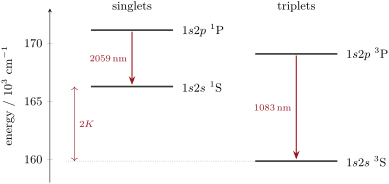
The levels of helium lie at (S) and (S) above the ground state: the singlet is , , higher, and . The figure below shows the two families.
2.4 Russell–Saunders coupling and term symbols
In a light atom, the orbital angular momenta of the electrons add up to a total , their spins to a total , and only then do and couple weakly with each other.
Definition 2.10 (Russell–Saunders coupling)
In Russell–Saunders coupling, the states of a configuration are labelled by the total orbital angular momentum quantum number (, with ), the total spin quantum number (), and the total angular momentum quantum number , which takes the values .
Definition 2.11 (Spectroscopic term, spin multiplicity, term symbol)
A spectroscopic term is the set of the states of a configuration with given and . Its spin multiplicity is . The term symbol is , with the letters S, P, D, F, G, H for ; a state of given is written — for example .
Proposition 2.12 (Closed shells)
A filled subshell has and ; it contributes nothing to the term symbol.
Proof. In a filled subshell every appears twice and every appears times, so and ; and there is only one way to fill it (one determinant). A single state with can only belong to , . ∎
Proposition 2.13 (Counting the states of a configuration)
electrons in a subshell of spin-orbitals give determinants, and the degeneracies of its terms add up to this number.
Proof. A determinant is fixed by the set of occupied spin-orbitals (their order only changes its sign): one chooses of the . The terms are the same states regrouped, so their counts must agree. ∎
Method 2.14 (Terms of a configuration)
- List the determinants allowed by the Pauli principle and tabulate them by and .
- Find the largest ; with the largest that accompanies it, it starts a term with , .
- Strike out one determinant for each pair with , .
- Repeat with what is left, until the table is empty; check the count.
Example 2.15 (The terms of )
Two electrons in () give determinants. Their table by and is:
| – | – | ||
| , | |||
| , , | |||
| , | |||
| – | – |
(with for ). occurs only with : a D term (5 states). The largest remaining comes with : a P term (9 states). One state with remains: a S term. Indeed .
Example 2.16 (Carbon, measured)
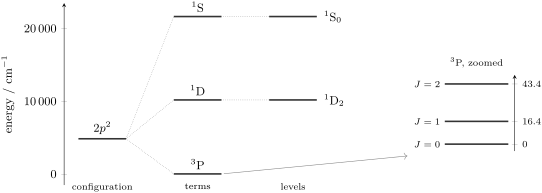
The ground configuration of carbon gives the levels , , at 0, 16.4 and , then at and at : the P term is lowest, as Hund’s rules predict.
2.5 Hund’s rules and spin–orbit coupling
Proposition 2.17 (Hund’s rules for terms)
For the ground configuration of an atom or ion, the lowest term is the one with (1) the largest , then (2) for that , the largest . Its lowest level has (3) if the subshell is less than half full, if it is more than half full.
Status. These rules are established experimentally, for ground configurations only; they are not theorems. Rule 1 is the exchange stabilisation of the previous section; rule 2 says that electrons turning in the same direction meet less often; rule 3 follows from the sign of the spin–orbit coupling, below. ∎
Method 2.18 (The ground term from a box diagram)
- Fill the boxes of the open subshell from downwards, one electron per box with spins parallel, then pair from again.
- (number of unpaired electrons); .
- for less than half full, for more than half full; for exactly half full and .
Example 2.19 (Ground terms)
, : boxes filled, , , : . , : , , . , : five up, one down in : , , more than half full, . , : , , . Each agrees with the ground level that atomic spectroscopy measures.
Definition 2.20 (Spin–orbit coupling, fine structure)
Spin–orbit coupling is the interaction between the magnetic moments of an electron’s spin and of its orbital motion, written for a term. It splits a term into its levels of different : the fine structure of the term.
Proposition 2.21 (Landé interval rule)
Within a term, , so that . (normal) for a subshell less than half full, (inverted) for one more than half full.
Proof. gives , so , whose eigenvalue in a state of given , , is . The difference between and is . The sign of is admitted: a more-than-half-full subshell behaves as the corresponding number of positive holes. ∎
Example 2.22 (Testing the interval rule)
For P the rule predicts intervals in the ratio , that is 2. Carbon: . Oxygen (, inverted, lowest, then at and at ): . The rule holds within 20 %: Russell–Saunders coupling is a good description of light atoms, not an exact one.
Example 2.23 (The sodium doublet)
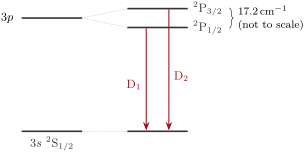
The levels of sodium lie at 16956.17 and : the D lines are at and in vacuum, separated by . For P, , so .
Proposition 2.24 (Selection rules for atoms)
In Russell–Saunders coupling, an electric-dipole transition requires , , (but not ), and a change of parity: for a one-electron jump, .
Status. is proved in Chapter 7: the dipole operator does not act on spin. The others follow from the vector character of the dipole operator and are admitted here. ∎
History — Two heliums and the exclusion principle
Helium was named after the Sun in 1868 and found on Earth by William Ramsay in 1895. Its two series of lines puzzled spectroscopists for thirty years. In 1925 Wolfgang Pauli proposed that no two electrons share the same quantum numbers, the same year as electron spin was proposed by George Uhlenbeck and Samuel Goudsmit; in 1926 Werner Heisenberg showed that the symmetry of the wavefunction alone splits helium into its singlet and triplet families.
In the lab — Resolving the sodium doublet
A sodium lamp is placed before the slit of a grating spectrometer. With a grating of 600 lines per millimetre, the first-order angles of the two lines differ by about °: a good spectrometer separates them, a student prism does not. The lamp runs hot; it is handled only after it has cooled.
2.6 Exercises
Exercise 2.1 ★
Write the Slater determinant of the ground state of lithium, , with the electron of spin . Why is there no determinant for ?
Solution
Solution of Exercise 2.1.
offers only two spin-orbitals, and ; a third electron would repeat one of them, making two columns equal: the determinant is zero.
Exercise 2.2 ★
Count the determinants of the configurations , and . The terms of are S, D, P and those of are F, P, G, D, S: check both counts.
Solution
Solution of Exercise 2.2.
, , . : S (4) + D (10) + P (6) = 20. : F (21) + P (9) + G (9) + D (5) + S (1) = 45.
Exercise 2.3 ★
Give the ground term and level of N, O, F, and ().
Solution
Solution of Exercise 2.3.
N (, half full): . O (, more than half): . F (): . (): . (, half full, all spins parallel, ): .
Exercise 2.4 ★
List the levels of the terms D and P with their degeneracies , and check that the degeneracies add up to .
Solution
Solution of Exercise 2.4.
D: (6 states) and (4); . P: (5), 1 (3), 0 (1); .
Exercise 2.5 ★★
Carbon’s P levels lie at 0, 16.4 and . Compute the ratio of the intervals and the spin–orbit constant from each interval. What does the difference between the two values of say?
Solution
Solution of Exercise 2.5.
Intervals () and (): ratio 1.65 instead of 2. from the first, from the second. A single does not fit: the levels are slightly mixed with those of other terms (D, S), and Russell–Saunders coupling is an approximation.
Exercise 2.6 ★★
The levels of sodium lie at 16956.17 and . Compute the vacuum wavelengths of the D lines, their separation in and in meV, and for the term.
Solution
Solution of Exercise 2.6.
: (D) and (D). Separation . , so .
Exercise 2.7 ★★
Which of these transitions of sodium are allowed in emission: , , , , ? Justify each.
Solution
Solution of Exercise 2.7.
: allowed (). : forbidden (). : allowed. : forbidden (, no change of parity). : allowed.
Exercise 2.8 ★★
The levels of helium are , , at 169086.76, 169086.84, and at . Compute the mean energy of the P term, then in eV. Compare with and explain the difference.
Solution
Solution of Exercise 2.8.
Mean P: . Gap to P: , so , three times smaller than . The exchange integral measures the overlap of the two orbitals’ densities; the orbital penetrates into the region (it has density near the nucleus), the orbital vanishes at the nucleus and overlaps less.
Exercise 2.9 ★★
Find the terms of by the method of this chapter, starting from the largest (you may skip writing the whole table, but justify each term).
Solution
Solution of Exercise 2.9.
The largest needs both electrons in , spins opposite: a singlet, G (9 states). The next, , comes from , with possible: F (21). Remaining with only: D (5). Remaining with : P (9). One state left with : S. Total 45.
Exercise 2.10 ★★★
Show that the triplet spatial function vanishes when and that the singlet function does not. Relate this to the sign of .
Solution
Solution of Exercise 2.10.
At the triplet function is ; the singlet function is . In the triplet the electrons are never found at the same point and are on average farther apart, so their repulsion is smaller: .
Exercise 2.11 ★★★
For () the F levels lie at 0 (), 1360.7 () and (). Explain the order, compute the ratio of the intervals and compare with Landé’s prediction. Give from the larger interval.
Solution
Solution of Exercise 2.11.
is more than half full: the coupling is inverted, lowest. Intervals: and ; ratio 1.50, against Landé’s . (). Spin–orbit coupling is much larger in this heavier ion than in carbon ().
Exercise 2.12 ★★★
Show that the expectation value of , summed over all the states of a term, is zero, so that spin–orbit coupling leaves the weighted mean of the levels unchanged. Check it on carbon’s P.
Solution
Solution of Exercise 2.12.
(the states can be counted in either basis, and over the uncoupled ones). For P: . Carbon’s weighted mean is : the energy the term would have without spin–orbit coupling.
2.7 Problem: Two Heliums
Problem 2.1
Weekend problem — the singlet and triplet families of helium: determinants, the terms of transition-metal ions, the selection rules that separate the two families, and the exchange integral measured
Data (NIST, in above the ground state of each species). Helium: 159855.97, 166277.44; 169086.76, 169086.84, 169087.83, 171134.89. : 0, 184.9, 420.4; 10538.4, 10603.6, 10721.2. .
Part I — Spin-orbitals and determinants.
- List the four spin-orbitals available to the configuration .
- Write the four determinants with one electron in and one in .
- Show that is the product of an antisymmetric spatial function and the spin function .
- Combine and to obtain the component of the same spatial function, and a fourth state.
- Which spatial function, symmetric or antisymmetric, goes with ? With ?
- Why are these called singlet and triplet?
Part II — The terms of .
- Give the configuration of and the number of its determinants.
- Find its ground term and level with Hund’s rules; check against the data.
- Its other terms are P, G, D and S: check the count of states.
- Is the F fine structure normal or inverted? Test the Landé interval rule.
- Compute the weighted mean energies of the F and P terms.
- Their separation is , where is a Racah parameter of the ion (Chapter 18). Compute .
Part III — Why two families.
- Which selection rule forbids a transition between a singlet and a triplet?
- The lowest triplet, , cannot emit to the ground state . Give two reasons. What is such a state called?
- Compute the wavelength of the line P S (use the mean of the P levels).
- Compute the wavelength of P S.
- Compute the wavelength of P S. In which region of the spectrum is it?
- Explain why nineteenth-century spectroscopists, seeing these lines, believed in two different gases.
Part IV — The exchange integral, measured.
- Write the first-order energies of the singlet and triplet in terms of , , and .
- Which is lower, and why, in terms of the electrons’ positions?
- Compute the singlet–triplet gap in and eV.
- Compute in eV from the levels.
- Why is larger than ?
- Is Hund’s first rule borne out by helium’s excited states?
- State the result: the exchange integral of helium, in eV.
Solution
Solution of Problem 2.1.
1. , , , . 2. , , , . 3. , by expanding the determinant. 4. Their sum is (times , then normalised); their difference gives . 5. Symmetric space with the antisymmetric spin function (); antisymmetric space with the three symmetric spin functions (). 6. and 3: one and three states of the same energy. 7. ; determinants. 8. Maximum , maximum , less than half full: , the level at 0 in the data. 9. . 10. Normal ( lowest). Intervals 184.9 and 235.5: ratio 1.27 against ; the rule holds within 5 %. 11. F: ; P: . 12. , . 13. . 14. is forbidden, and has (no parity change; SS also has between two S states). The state is metastable: it lives far longer than ordinary excited states. 15. : , in the near infrared. 16. : . 17. : , in the vacuum ultraviolet (absorbed by air). 18. Each family has its own lines and its own lowest state, and the two never connect by light: they behave like two gases with two spectra. 19. (singlet , triplet ). 20. The triplet: its spatial function vanishes when the electrons meet, so they repel less. 21. , . 22. Gap , so . 23. penetrates the region and overlaps it more than does. 24. Yes: in both configurations the triplet (larger ) lies lowest. 25. : the exchange integral of helium is , measured as half the singlet–triplet gap.