সব বই

পেশাদার

1 Markets I: The Ecosystem and Exchange-Traded Marketsবাজার অনলাইন 2 Markets II: Rates, FX and Creditবাজার অনলাইন 3 Markets III: Commodities, Energy and Cryptoবাজার অনলাইন 4 Quantitative Methodsপদ্ধতি অনলাইন 5 Derivatives and Volatilityডেরিভেটিভস অনলাইন 6 Rates, Credit, XVA and Riskসুদহার, ঋণ ও ঝুঁকি অনলাইন 7 Research Craft: Predictors, Backtests, Measurement, Portfoliosগবেষণা অনলাইন 8 Strategies I: Equities and Futuresকৌশল অনলাইন 9 Strategies II: Volatility, Relative Value, Macro and the Bank Desksকৌশল অনলাইন 10 Microstructure and Executionএক্সিকিউশন অনলাইন 11 Market Making and High-Frequency Tradingমার্কেট মেকিং অনলাইন 12 Machine Learning for Marketsমেশিন লার্নিং অনলাইন 13 Low-Latency Softwareপ্রযুক্তি অনলাইন 14 Networks, Hardware and Trading Infrastructureপ্রযুক্তি অনলাইন 15 Research, Data and Risk Platformsপ্রযুক্তি অনলাইন 16 The Desk and the Firmপ্রতিষ্ঠান অনলাইন 17 The Industry: Firms, Roles and Careersক্যারিয়ার অনলাইন 18 Interviews I: Maths, Probability and Speedক্যারিয়ার অনলাইন 19 Interviews II: Markets, Trading Games and the Final Roundক্যারিয়ার অনলাইন 20 Interviews III: Codeক্যারিয়ার অনলাইন
অ্যাপ পরিচিতি Coach সাইন ইন পড়া শুরু করো

বইগুলো এখনো বাংলা ভাষায় পাওয়া যায় না — ইংরেজি সংস্করণ দেখানো হচ্ছে।

Mathematics · পরিভাষা

Generated subgroup; order কী?

অন্য নাম: cyclic group · order of an element

Definition 1.13 University Mathematics — Year 2 · অধ্যায় 1 — Sets and Structures

Let GG be a group and A⊆GA \subseteq G. The subgroup generated by AA, written ⟨A⟩\langle A \rangle, is the smallest subgroup containing AA — concretely, all finite products of elements of AA and their inverses. A group is cyclic when generated by one element: ⟨a⟩={ak:k∈Z}\langle a\rangle = \{a^k : k \in \Z\}. The order of a∈Ga \in G is ord⁡(a)=∣⟨a⟩∣\operatorname{ord}(a) = \abs{\langle a \rangle} (possibly infinite); when finite, it is the least n≥1n \geq 1 with an=ea^n = e, and ak=e  ⟺  ord⁡(a)∣ka^k = e \iff \operatorname{ord}(a) \mid k.

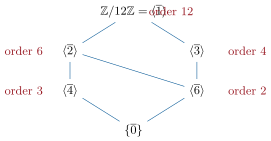
The subgroup lattice of ℤ/12ℤ: one subgroup per divisor of 12 (), with an edge when one contains the other with prime index. Inclusions run against divisibility of the generator: 4 ⊂eq 2 because 4 is a multiple of 2.
The subgroup lattice of Z/12Z\Z/12\Z: one subgroup per divisor of 1212 (Proposition 1.17), with an edge when one contains the other with prime index. Inclusions run against divisibility of the generator: ⟨4‾⟩⊆⟨2‾⟩\langle\overline 4\rangle \subseteq \langle\overline2\rangle because 44 is a multiple of 22.

উদাহরণ

Example 1.15 (Cosets in action: A3A_3 inside S3\mathfrak{S}_3)

Take G=S3G = \mathfrak{S}_3 (order 66) and H=A3={id, (1 2 3), (1 3 2)}H = A_3 = \{\mathrm{id},\ (1\,2\,3),\ (1\,3\,2)\}. The left cosets are

H={id, (1 2 3), (1 3 2)},(1 2)H={(1 2), (2 3), (1 3)}:H = \{\mathrm{id},\ (1\,2\,3),\ (1\,3\,2)\}, \qquad (1\,2)H = \{(1\,2),\ (2\,3),\ (1\,3)\} :

two classes of three elements partitioning GG, exactly as the count ∣G∣=∣H∣×(number of cosets)\abs G = \abs H \times (\text{number of cosets}) demands — and visibly the partition into even and odd permutations. Note (1 3)H=(1 2)H(1\,3)H = (1\,2)H although (1 3)≠(1 2)(1\,3) \neq (1\,2): cosets are classes, not labelled by their representatives, and x−1y∈Hx^{-1}y \in H is the only legitimate comparison. This two-class picture is the general one for the signature: AnA_n and its lone companion coset split Sn\mathfrak{S}_n in half, which is how the weekend problem counts reachable puzzle positions.

Example 1.16

Two immediate dividends. Groups of prime order are cyclic: if ∣G∣=p\abs G = p is prime and a≠ea \neq e, then ord⁡(a)\operatorname{ord}(a) divides pp and is not 11, so it is pp: ⟨a⟩=G\langle a\rangle = G. The subgroup lattice of Z/12Z\Z/12\Z: by Proposition 1.17 below, there is exactly one subgroup per divisor of 1212 — orders 1,2,3,4,6,121, 2, 3, 4, 6, 12, generated respectively by 0‾\overline 0, 6‾\overline 6, 4‾\overline 4, 3‾\overline 3, 2‾\overline 2, 1‾\overline 1. The closing caution: the converse of Lagrange fails in general — A4A_4 has order 1212 but no subgroup of order 66, as we prove in this chapter’s weekend problem (Problem 1.1, question 14). Lagrange restricts the possible orders; it does not promise them.

Example 1.20 (Cycle type as a census)

How many permutations of S9\mathfrak{S}_9 have the cycle type (4,3,2)(4, 3, 2) — one 44-cycle, one 33-cycle, one transposition? Choose the supports and the cyclic orders:

9!4⋅3⋅2=362 88024=15 120:\frac{9!}{4\cdot 3\cdot 2} = \frac{362\,880}{24} = 15\,120 :

list the nine symbols in a row (9!9! ways), bracket the first four, next three, last two into cycles, and divide by the rotations inside each bracket (44, 33 and 22 of them) which give the same permutation. (Distinct cycle lengths here, so no further division; equal lengths would also require dividing by the permutations of the equal brackets.) Every such permutation has order lcm⁡(4,3,2)=12\operatorname{lcm}(4,3,2) = 12 and signature (−1)3(−1)2(−1)1=+1(-1)^3(-1)^2(-1)^1 = +1 (Theorem 1.19 and the signature theorem below). One partition of 99, one conjugacy class, one census — the combinatorics of Sn\mathfrak{S}_n is the arithmetic of partitions.

প্রসঙ্গসহ পড়ো →