For , the -th roots of unity are the solutions of .
 Coach
Log in
Start reading
Coach
Log in
Start reading
Mathematics · Glossary
For , the -th roots of unity are the solutions of .
The -th roots of unity are the solutions of :
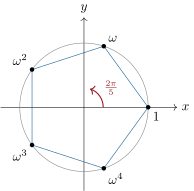
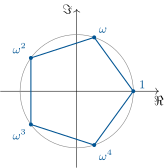
They form a group under multiplication (Chapter 7) and sit at the vertices of a regular -gon inscribed in the unit circle.
Example 3.20 (Square roots in algebraic form)
To solve without trigonometry, set :
Adding the first and last: , so , then with the same sign pairing (): . Combined with the usual formula, this solves every quadratic equation with complex coefficients (Exercise 3.7).
Example 3.16 (A non-real right-hand side)
Solve . Exponential form of the right side: modulus , argument with , , i.e. . The four roots are
(Check: , so .) Once one root is found, the other three come free: they are its successive rotations by , i.e. its products with the fourth roots of unity — the general structure behind Theorem 3.14, worth exploiting before recomputing each root from scratch. No conjugate symmetry this time: the right-hand side is not real.