The length of a C1 arc f:[a,b]→R2 is the integral of the speed:
L=∫ab∥f′(t)∥dt=∫abx′(t)2+y′(t)2dt.
(Motivation: on a small interval, M(t+h)≈M(t)+hf′(t), so the arc is close to a polygon whose segment lengths sum to a Riemann sum of ∥f′∥, Theorem 15.20.) For a polar curver=r(θ), the velocity r′u+rv has orthogonal components, so
L=∫θ1θ2r′(θ)2+r(θ)2dθ.
The length does not depend on the (monotone, C1) parametrization chosen: substituting t=φ(s) in the integral (Theorem 15.15) multiplies f′ by φ′ and dt by φ′−1.
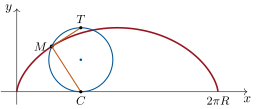
One arch of the cycloid (radius R=1), the rolling circle at t=2, and the two guide lines of the weekend problem: the chord MC to the contact point is normal to the curve, the chord MT to the top of the circle is tangent.
Examples
Example 24.10(Sanity check: the circle)
For f(t)=(Rcost,Rsint) on [0,2π]: ∥f′∥=R, so L=2πR — the definition returns the circumference. Reparametrization test: the mapg(t)=(Rcos2t,Rsin2t) on [0,π] draws the same circle at doubled speed ∥g′∥=2R, and
∫0π2Rdt=2πR
again: half the time, twice the speed, same length — the invariance promised in the definition, watched once on numbers. (Running g on all of [0,2π] would give 4πR: a curve traversed twice is twice as long as a journey; length measures the parametrized path, and honest bookkeeping of the interval is part of the computation.) For the astroid (cos3t,sin3t): ∥f′∥=3∣sintcost∣=23∣sin2t∣, and by symmetry L=4∫0π/223sin2tdt=6: a curve drawn inside the unit circle, of length6<2π. The weekend problem measures the most famous arch of all.
 Coach
Coach