সব বই

পেশাদার

1 Markets I: The Ecosystem and Exchange-Traded Marketsবাজার অনলাইন 2 Markets II: Rates, FX and Creditবাজার অনলাইন 3 Markets III: Commodities, Energy and Cryptoবাজার অনলাইন 4 Quantitative Methodsপদ্ধতি অনলাইন 5 Derivatives and Volatilityডেরিভেটিভস অনলাইন 6 Rates, Credit, XVA and Riskসুদহার, ঋণ ও ঝুঁকি অনলাইন 7 Research Craft: Predictors, Backtests, Measurement, Portfoliosগবেষণা অনলাইন 8 Strategies I: Equities and Futuresকৌশল অনলাইন 9 Strategies II: Volatility, Relative Value, Macro and the Bank Desksকৌশল অনলাইন 10 Microstructure and Executionএক্সিকিউশন অনলাইন 11 Market Making and High-Frequency Tradingমার্কেট মেকিং অনলাইন 12 Machine Learning for Marketsমেশিন লার্নিং অনলাইন 13 Low-Latency Softwareপ্রযুক্তি অনলাইন 14 Networks, Hardware and Trading Infrastructureপ্রযুক্তি অনলাইন 15 Research, Data and Risk Platformsপ্রযুক্তি অনলাইন 16 The Desk and the Firmপ্রতিষ্ঠান অনলাইন 17 The Industry: Firms, Roles and Careersক্যারিয়ার অনলাইন 18 Interviews I: Maths, Probability and Speedক্যারিয়ার অনলাইন 19 Interviews II: Markets, Trading Games and the Final Roundক্যারিয়ার অনলাইন 20 Interviews III: Codeক্যারিয়ার অনলাইন
অ্যাপ পরিচিতি Coach সাইন ইন পড়া শুরু করো

বইগুলো এখনো বাংলা ভাষায় পাওয়া যায় না — ইংরেজি সংস্করণ দেখানো হচ্ছে।

Mathematics · পরিভাষা

projection কী?

অন্য নাম: symmetry

Definition 20.14 University Mathematics — Year 1 · অধ্যায় 20 — Linear Maps

Let E=F⊕GE = F \oplus G. The projection onto FF along GG maps x=f+gx = f + g (unique decomposition) to p(x)=fp(x) = f; the associated symmetry is s(x)=f−gs(x) = f - g. Both are linear, and s=2p−ids = 2p - \mathrm{id}.

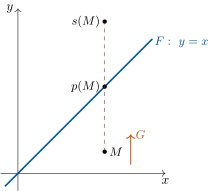
The projection onto F = Vect(1,1) along G = Vect(0,1) and its symmetry, on the point M = (2,\ 0.5): sliding vertically, M hits F at p(M) = (2,2) and lands at s(M) = 2p(M) - M = (2,\ 3.5), as far above F (measured along G) as M was below.
The projection onto F=Vect⁡(1,1)F = \operatorname{Vect}(1,1) along G=Vect⁡(0,1)G = \operatorname{Vect}(0,1) and its symmetry, on the point M=(2, 0.5)M = (2,\ 0.5): sliding vertically, MM hits FF at p(M)=(2,2)p(M) = (2,2) and lands at s(M)=2p(M)−M=(2, 3.5)s(M) = 2p(M) - M = (2,\ 3.5), as far above FF (measured along GG) as MM was below.

উদাহরণ

Example 20.16 (A projection and its symmetry, explicitly)

In R2\R^2, project onto F=Vect⁡(1,1)F = \operatorname{Vect}(1,1) along G=Vect⁡(0,1)G = \operatorname{Vect}(0,1). Decompose (x,y)=a(1,1)+b(0,1)(x, y) = a(1,1) + b(0,1): the first coordinate gives a=xa = x, the second b=y−xb = y - x. Hence

p(x,y)=(x,x),s(x,y)=2p(x,y)−(x,y)=(x, 2x−y).p(x, y) = (x, x), \qquad s(x, y) = 2p(x,y) - (x,y) = (x,\ 2x - y).

Check the algebra: p(p(x,y))=p(x,x)=(x,x)p(p(x,y)) = p(x,x) = (x,x), and s(s(x,y))=s(x,2x−y)=(x,2x−(2x−y))=(x,y)s(s(x,y)) = s(x, 2x - y) = (x, 2x - (2x - y)) = (x, y). Geometrically, ss is the “oblique reflection” across the line y=xy = x in the vertical direction: it fixes FF pointwise and reverses GG. Had we projected onto the same FF along G′=Vect⁡(1,−1)G' = \operatorname{Vect}(1,-1) instead, the formula would change to p′(x,y)=(x+y2,x+y2)p'(x,y) = \bigl(\frac{x+y}2, \frac{x+y}2\bigr): a projection is determined by its image and its kernel, never by the image alone.

প্রসঙ্গসহ পড়ো →