সব বই

পেশাদার

1 Markets I: The Ecosystem and Exchange-Traded Marketsবাজার অনলাইন 2 Markets II: Rates, FX and Creditবাজার অনলাইন 3 Markets III: Commodities, Energy and Cryptoবাজার অনলাইন 4 Quantitative Methodsপদ্ধতি অনলাইন 5 Derivatives and Volatilityডেরিভেটিভস অনলাইন 6 Rates, Credit, XVA and Riskসুদহার, ঋণ ও ঝুঁকি অনলাইন 7 Research Craft: Predictors, Backtests, Measurement, Portfoliosগবেষণা অনলাইন 8 Strategies I: Equities and Futuresকৌশল অনলাইন 9 Strategies II: Volatility, Relative Value, Macro and the Bank Desksকৌশল অনলাইন 10 Microstructure and Executionএক্সিকিউশন অনলাইন 11 Market Making and High-Frequency Tradingমার্কেট মেকিং অনলাইন 12 Machine Learning for Marketsমেশিন লার্নিং অনলাইন 13 Low-Latency Softwareপ্রযুক্তি অনলাইন 14 Networks, Hardware and Trading Infrastructureপ্রযুক্তি অনলাইন 15 Research, Data and Risk Platformsপ্রযুক্তি অনলাইন 16 The Desk and the Firmপ্রতিষ্ঠান অনলাইন 17 The Industry: Firms, Roles and Careersক্যারিয়ার অনলাইন 18 Interviews I: Maths, Probability and Speedক্যারিয়ার অনলাইন 19 Interviews II: Markets, Trading Games and the Final Roundক্যারিয়ার অনলাইন 20 Interviews III: Codeক্যারিয়ার অনলাইন
অ্যাপ পরিচিতি Coach সাইন ইন পড়া শুরু করো

বইগুলো এখনো বাংলা ভাষায় পাওয়া যায় না — ইংরেজি সংস্করণ দেখানো হচ্ছে।

Mathematics · পরিভাষা

radius of curvature কী?

অন্য নাম: center of curvature · osculating circle

Definition 18.14 University Mathematics — Year 2 · অধ্যায় 18 — Curves

When κ(s)≠0\kappa(s) \neq 0, the radius of curvature is R(s)=1/∣κ(s)∣R(s) = 1/\abs{\kappa(s)} and the center of curvature is γ~(s)+1κ(s)N(s)\tilde\gamma(s) + \frac{1}{\kappa(s)} N(s); the circle with that center and radius R(s)R(s) is the osculating circle, the best circular approximation of the curve at γ~(s)\tilde\gamma(s).

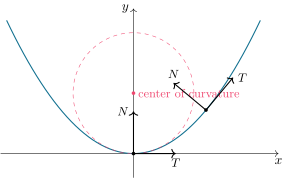
The parabola y = x2/2, its moving Frenet frame (T, N), and the osculating circle at the vertex (radius 1, since (0) = 1). The frame turns as the point moves; curvature is the rate of that turning per unit of arc length.
Figure 18.1. The parabola y=x2/2y = x^2/2, its moving Frenet frame (T,N)(T, N), and the osculating circle at the vertex (radius 11, since κ(0)=1\kappa(0) = 1). The frame turns as the point moves; curvature is the rate of that turning per unit of arc length.

উদাহরণ

Example 18.15 (The osculating circle of the exponential)

For y=exy = \eu^x at the point (0,1)(0, 1): f′(0)=f′′(0)=1f'(0) = f''(0) = 1, so by the graph formula below,

κ(0)=1(1+1)3/2=122,R=22.\kappa(0) = \frac{1}{(1 + 1)^{3/2}} = \frac1{2\sqrt2}, \qquad R = 2\sqrt2 .

The unit tangent is T=(1,1)2T = \frac{(1, 1)}{\sqrt2}, the direct normal N=(−1,1)2N = \frac{(-1, 1)}{\sqrt2}, and the center of curvature is

(0,1)+22⋅(−1,1)2=(−2, 3):(0, 1) + 2\sqrt2\cdot\frac{(-1, 1)}{\sqrt2} = (-2,\ 3) :

the osculating circle has equation (x+2)2+(y−3)2=8(x + 2)^2 + (y - 3)^2 = 8. As a check of the “best circular approximation” claim: solving the circle’s equation for yy near (0,1)(0,1) and expanding gives y=1+x+x22+O(x3)y = 1 + x + \frac{x^2}2 + O(x^3) — exactly the second-order Taylor expansion of ex\eu^x. The osculating circle matches value, slope and second derivative; an ordinary tangent circle would match only the first two.

Example 18.16 (The evolute of a circle is its center)

For the circle of radius RR traversed counterclockwise, κ=1/R\kappa = 1/R and NN points toward the center, so the center of curvature γ~+1κN\tilde\gamma + \frac1\kappa N is the center of the circle, for every ss: the osculating circle of a circle is the circle itself, and the locus of centers of curvature collapses to a point. This degenerate case calibrates Exercise 18.6: there the evolute’s velocity is −κ′κ2N-\frac{\kappa'}{\kappa^2}N, which vanishes identically precisely when κ\kappa is constant.

Example 18.18 (Circle, line, parabola)

A line has κ=0\kappa = 0 (and conversely: T′=0T' = 0 means TT constant, so γ~(s)=γ~(0)+sT\tilde\gamma(s) = \tilde\gamma(0) + sT, a line). The circle of radius RR traversed counterclockwise has κ=1/R\kappa = 1/R: with γ(t)=(Rcos⁡t,Rsin⁡t)\gamma(t) = (R\cos t, R\sin t), the formula gives κ=R2/R3\kappa = R^2/R^3. For the parabola y=x2/2y = x^2/2: κ(x)=1/(1+x2)3/2\kappa(x) = 1/(1 + x^2)^{3/2}, maximal at the vertex — the parabola is most sharply bent where it turns around.

প্রসঙ্গসহ পড়ো →