University Mathematics — Year 1 · Licence 1
3Complex Numbers
Complex numbers were met in the High School volume as a computational device for quadratic equations. This chapter treats them as a central object: the exponential form and its consequences (de Moivre, -th roots, roots of unity), the systematic translation between and plane geometry, and the use of as a machine for proving trigonometric identities.
3.1 The field , modulus and conjugate
Definition 3.1 (The complex field)
with the usual addition and the multiplication determined by . Every nonzero has an inverse: — in the language of Chapter 7, is a field. One writes , , (the conjugate) and (the modulus).
Proposition 3.2 (Rules for conjugate and modulus)
For :
- , , ;
- ; , ;
- , and for ;
- (triangle inequality) , with equality if and only if and lie on a common ray from ( or with );
- (reverse triangle inequality) .
Proof. (1) and (2) are direct computations on real and imaginary parts. (3): , then take square roots; apply to for the inverse.
(4) Both sides are nonnegative, so compare squares:
and gives . Equality forces , i.e. ; if this gives with (and the case is trivial).
(5) gives ; swap and for the other sign. ∎
Example 3.3 (A complete modulus-and-argument workout)
Put in algebraic form and compute its modulus twice. Multiplying by the conjugate of the denominator:
Directly: . Via the quotient rule (Proposition 3.2 (3)): — same answer, no algebraic form needed. The lesson generalizes: moduli and arguments travel well through products and quotients, real and imaginary parts travel well through sums. Choose the representation that matches the operations at hand, and convert only when forced.
Example 3.4 (Equations involving the conjugate)
Solve in : . An equation mixing and is not polynomial in ; the reliable move is to split into real coordinates. With :
so the equation reads and : the unique solution is . (Check: .) Alternatively, conjugate the whole equation to get and solve the linear system in the unknowns — same answer, and a useful trick when the coefficients are complex. Equations in and are really systems of two real equations; expecting “degree , one solution” is safe here, but (no solution) shows the polynomial intuition failing as soon as products appear.
3.2 Exponential form
Definition 3.5 (Complex exponential of an imaginary argument)
For one defines
Every can be written with ; is an argument of , determined up to adding a multiple of . The value in is the principal argument, written .
Example 3.6 (First values, and one famous identity)
Reading the definition at the cardinal angles:
The second one, rearranged as , is Euler’s celebrated identity linking , , , and ; at this stage of the book it is a definition unwinding rather than a theorem, and its real content — why the analytic exponential function of Chapter 4, extended to imaginary arguments, deserves the same name — is settled by the power series of Chapter 17. Meanwhile the display above is worth memorizing as a conversion table: it is used silently every time an argument is read off a picture.
Theorem 3.7 (The functional equation)
For all :
Consequently carries the arguments too: .
Proof. Expand the product and use the addition formulas:
which is . The modulus is , and the conjugate formula is the parity of cosine and sine; it inverts since . ∎
Corollary 3.8 (de Moivre’s formula)
For and : .
Proof. For , induct. The case reads . Assuming the formula for , the functional equation (Theorem 3.7) gives
which is the formula at rank . For , write with : since has inverse (Theorem 3.7 again),
∎
Example 3.9 (Expanding by de Moivre)
Write , . De Moivre and the binomial theorem give
and identifying real parts, then substituting :
The imaginary part yields for free: one complex identity always carries two real ones. Read backwards, the boxed identity is the key to the classical trisection equation: constructing from means solving the cubic , which is where the algebra of Chapter 8 takes over.
Proposition 3.10 (Euler’s formulas)
Proof. Add, respectively subtract, and . ∎
Method 3.11 (Trigonometry via exponentials)
- Linearize (turn powers into a sum of , ): substitute Euler’s formulas, expand with the binomial theorem (Theorem 2.16), regroup conjugate terms.
- Expand as a polynomial in : write , expand, and convert even powers of via .
- Sum trigonometric series like : recognize the real part of a geometric sum .
The half-angle factorization: for all ,
Example 3.12 (Linearization)
This form integrates immediately — the very reason linearization matters in Chapter 15. A mixed product works the same way, only with both Euler formulas at once:
where the double-angle shortcut in the first step saved one binomial expansion — always worth scanning for before mechanizing.
Example 3.13 (A binomial trigonometric sum)
For and , evaluate . Recognize the real part of a binomial expansion:
then factor the half-angle (Method 3.11 (4)): , so
The imaginary part yields for free. Sanity checks: recovers , and gives for (each factor vanishes), i.e. the alternating row sum of Example 2.17. The method — “see the cosine sum as the shadow of a complex power, then factor half-angles” — is exactly that of Exercise 3.6, with the binomial theorem replacing the geometric series.
3.3 Roots of complex numbers
Theorem 3.14 (-th roots)
Let and . The equation has exactly solutions:
Proof. Write (). Then if and only if (moduli) and (arguments), i.e. and for some . It remains to see when two integers yield the same number: this happens exactly when the angles differ by a multiple of ,
By Euclidean division, every is congruent mod to exactly one element of , so this range lists each solution once and the count is exactly . (The same argument, run inside , shows the roots form a regular -gon: consecutive values of rotate by the fixed angle .) ∎
Example 3.15 (Cube roots of )
Solve . Exponential form of the right side: , so the three roots are
Two checks. First, the real root is the obvious one, and the other two are its rotations by — equivalently and . Second, algebra confirms: , and the quadratic has discriminant with roots . The insight: for real right-hand sides, the non-real roots always come in conjugate pairs, so a picture of the solution set is symmetric about the real axis — a preview of the real factorization theorem of Chapter 8.
Example 3.16 (A non-real right-hand side)
Solve . Exponential form of the right side: modulus , argument with , , i.e. . The four roots are
(Check: , so .) Once one root is found, the other three come free: they are its successive rotations by , i.e. its products with the fourth roots of unity — the general structure behind Theorem 3.14, worth exploiting before recomputing each root from scratch. No conjugate symmetry this time: the right-hand side is not real.
Definition 3.17 (Roots of unity)
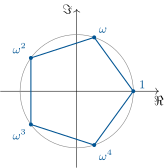
The -th roots of unity are the solutions of :
They form a group under multiplication (Chapter 7) and sit at the vertices of a regular -gon inscribed in the unit circle.
Proposition 3.18 (Sum of the roots of unity)
For , the -th roots of unity sum to zero: .
Proof. Geometric sum with ratio : since . ∎
Example 3.19 (Reading real and imaginary parts)
Splitting into real and imaginary parts yields two trigonometric identities for free:
Geometrically: the centroid of a regular -gon inscribed in the unit circle is its center — the vertices balance out exactly. For the first identity gives (pairing with ), the starting point of Exercise 3.8’s computation of .
Example 3.20 (Square roots in algebraic form)
To solve without trigonometry, set :
Adding the first and last: , so , then with the same sign pairing (): . Combined with the usual formula, this solves every quadratic equation with complex coefficients (Exercise 3.7).
3.4 Complex numbers and plane geometry
Proposition 3.21 (Geometric dictionary)
Identify the point of the plane with its affix . For distinct points of affixes :
- is the distance ;
- is the angle between the vectors and (mod );
- are aligned if and only if ; the lines and are perpendicular if and only if .
Proof. (1) is the definition of the modulus applied to , the affix of . (2): write , ; then has argument , the angle from to . (3): alignment means angle or , i.e. argument in , i.e. the quotient is real; perpendicularity means angle , i.e. the quotient is purely imaginary. (The quotient is nonzero since .) ∎
Remark 3.22 (Interlude: is the plane with a multiplication)
It is worth pausing on what makes this chapter possible at all: the plane carries additions in every direction, but no God-given multiplication — and is the plane equipped with one, in which multiplying by a fixed number rotates and scales. This one structure will be milked three more times in this volume. In Chapter 21, multiplication by reappears as the matrix with rows and : complex arithmetic is a first, entirely concrete family of matrix products. In Chapter 23, the formula turns out to be the dot product, and the Euclidean norm: the triangle inequality proved here is the model for the Cauchy–Schwarz story there. And in Chapter 24, a moving point is best written , so that velocity and acceleration become complex-valued derivatives — circular motion, for one, is simply . One good multiplication, four chapters of dividends.
Proposition 3.23 (Maps )
Let , . The transformation of the plane:
- is a translation if ;
- otherwise has a unique fixed point , and : is the rotation of center and angle , composed with the scaling of center and ratio .
In particular is the rotation of angle about the origin, and is the reflection in the real axis.
Proof. If , translates by the vector of affix . If , the fixed-point equation has the unique solution , and then . Writing , multiplication by scales distances to by and adds to angles at , which is the announced composition. ∎
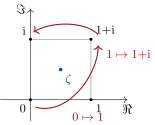
Example 3.24 (Classifying a map )
Take . Here : the fixed point is
and since , there is no scaling at all: is the pure rotation of center and angle . Check: , and , , : the four points of the unit square cycle around their center , one quarter turn at a time — exactly what a rotation by about the square’s center must do.
Remark 3.25 (Common pitfalls with moduli and arguments)
- No inequalities in . Writing for non-real numbers is meaningless; only moduli, real parts and imaginary parts can be compared.
- is reserved for . Every nonzero complex number has two square roots and neither is privileged: write “let be a square root of ” (computed as in Example 3.20), never — the rule already fails at .
- Arguments live modulo . From conclude , not ; forgetting the is how solution sets of lose of their elements.
- is not . Equality in the triangle inequality is the exceptional aligned case (Proposition 3.2 (4)); in general the modulus of a sum must be estimated, not computed.
Example 3.26
(affixes , pairwise distinct) form an equilateral triangle with the vertices in direct (counterclockwise) order if and only if : the rotation of center and angle sends to . Both orientations together are captured by the symmetric equation (Exercise 3.10).
Remark 3.27 (Where this chapter is used)
The exponential form is the single most reused computational device of the volume. Roots of unity become the standard example of a cyclic group in Chapter 7 and drive the factorization of in Chapter 8; grouping conjugate roots there produces the real factorizations used by partial fractions in Chapter 9. Linearization (Method 3.11) is the standard preparation for integrating trigonometric powers in Chapter 15, and the characteristic equations of Chapter 5 have complex roots whose real and imaginary parts produce the oscillating solutions . The geometric dictionary returns in matrix clothing: rotations and similarities become the orthogonal matrices of Chapters 21 and 23, and parametrized curves in Chapter 24 are often best written as maps .
3.5 Exercises
Exercise 3.1 ★
Put in exponential form: ; ; ; . Deduce and .
Solution
Solution of Exercise 3.1.
; ; ;
Computing the same quotient algebraically (multiply by the conjugate):
Identifying with :
Exercise 3.2 ★
Compute . For which is a real number?
Solution
Solution of Exercise 3.2.
, so .
In exponential form , real if and only if , i.e. . So exactly for the multiples of (value ).
Exercise 3.3 ★
Describe geometrically the set of such that: ; ; (for ).
Solution
Solution of Exercise 3.3.
: equidistance from the points and — the perpendicular bisector of the segment joining and .
: the circle of center and radius .
: by Proposition 3.21 (3), the points , , satisfy: lines and perpendicular (or , where the quotient is ). The set is the circle of diameter (the unit circle), minus the point where the quotient is undefined. Check by computation: gives .
Exercise 3.4 ★
Linearize , and expand as a polynomial in .
Solution
Solution of Exercise 3.4.
Linearization:
Expansion: by de Moivre, with , ; substituting :
Exercise 3.5 ★
Solve and place the solutions on a picture. Solve and factor into two real quadratic polynomials.
Solution
Solution of Exercise 3.5.
, so the cube roots are , :
an equilateral triangle on the circle of radius .
, so has solutions : , , , . Pairing conjugate roots:
since and similarly for the other pair. (Expand to check.)
Exercise 3.6 ★★
For with and , compute
by summing the geometric series and using the half-angle factorization.
Solution
Solution of Exercise 3.6.
(geometric sum, ratio ). Half-angle factorization (Method 3.11 (4)) on numerator and denominator:
Taking real and imaginary parts:
Exercise 3.7 ★★
Solve in : . (Compute the discriminant, extract its square roots as in Example 3.20.)
Solution
Solution of Exercise 3.7.
Discriminant: . Square roots of : solve , , ; then , , same signs: . Hence
Check: sum and product , as required by the coefficients.
Exercise 3.8 ★★
Let .
- Justify .
- Set and . Compute and , and deduce that and are the roots of .
- Conclude that .
Solution
Solution of Exercise 3.8.
- Proposition 3.18 with .
by (1). For the product, expand and reduce exponents modulo :
So and have sum and product : they are the two roots of .
- (the angle is acute), and the positive root of is . Hence .
Exercise 3.9 ★★
Prove that for all (parallelogram identity):
and interpret it geometrically in the parallelogram with vertices .
Solution
Solution of Exercise 3.9.
Expand both squares as in the proof of Proposition 3.2 (4):
and add. Geometrically, and are the lengths of the two diagonals of the parallelogram with vertices , while and are the side lengths: the sum of the squares of the diagonals equals the sum of the squares of the four sides.
Exercise 3.10 ★★★
Prove that three pairwise distinct points of affixes form an equilateral triangle (either orientation) if and only if
Hint: the direct case is and the indirect case , where satisfies ; or factor and .
Solution
Solution of Exercise 3.10.
Let , so and , . The triangle is equilateral direct iff , indirect iff (Example 3.26).
Consider and . Using and :
so the direct case reads ; the same computation with in place of gives , so the indirect case reads . Hence: equilateral (either orientation) . Expanding, with :
So the triangle is equilateral if and only if .
Exercise 3.11 ★★★
For , evaluate where . Hint: ; divide by and evaluate at . Deduce .
Solution
Solution of Exercise 3.11.
Since the , , are exactly the roots of (Theorem 3.14), and the polynomial is monic:
Dividing by : . Evaluating at gives .
Now , so taking moduli in (each for ):
Exercise 3.12 ★★
Let . Solve the equation in : show that it has exactly solutions, all purely imaginary, namely
Hint: is not a solution, so divide and use the roots of unity; then apply the half-angle factorization of Method 3.11.
Solution
Solution of Exercise 3.12.
is not a solution (), so the equation is equivalent to , i.e. with and . The value is excluded ( is impossible). For , solving gives , so with and the half-angle factorizations , :
purely imaginary as claimed. The map is injective on (it is strictly decreasing), so the values are pairwise distinct: the equation, of degree once expanded (the terms cancel), has exactly these solutions.
3.6 Problem: Napoleon’s theorem
Problem 3.1
Erect an equilateral triangle outward on each side of an arbitrary triangle: the three centers of those triangles always form an equilateral triangle. This is Napoleon’s theorem — a statement with no visible reason to be true, which the algebra of proves in three lines of computation. This problem builds the full toolkit (rotations, direct similarities, the -criterion of Exercise 3.10), proves Napoleon’s theorem inner and outer, locates the degenerate case, and closes with a second jewel of the same school: van Schooten’s theorem on equilateral triangles and Ptolemy’s inequality. Throughout, points of the plane are identified with their affixes.
Part I — The number and rotations.
- Compute the algebraic form of , then , , , and . Place , , on a sketch of the unit circle.
- Show that the rotation of center and angle is , and that the composition of two rotations, of angles and , is a rotation of angle if , and a translation otherwise. (Use Proposition 3.23.)
- Let . Show that there are exactly two points making equilateral, namely . For a direct triangle , check on the example , , that the choice is the one lying on the far side of the line from — the outward apex.
From the solution of Exercise 3.10, is direct equilateral iff . Prove the two rotation identities
and deduce that the criterion is invariant under cyclic permutation of .
- Show that if and two of the three points coincide, then all three coincide. (So the criterion exactly characterizes: direct equilateral triangle, or a single point.)
Part II — Direct similarities.
- Show that the maps with (direct similarities) are stable under composition and inversion: the composition of two of them, and the inverse of any of them, is again of this form. (In the language of Chapter 7: they form a group.)
- Given and , show there is a unique direct similarity with and , and give and explicitly.
- Show that a direct similarity multiplies all distances by and preserves the shape of any triangle (numerator and denominator are both multiplied by ). Deduce that two triangles are directly similar exactly when their shapes are equal.
- Determine completely the direct similarity with and : give , , the fixed point, the ratio and the angle.
- Let . Show that the “weighted point” commutes with every direct similarity: . Deduce that centroids, midpoints, and the Napoleon centers below are all transported by similarities — the algebraic license behind every “without loss of generality, place the circumcircle at the unit circle” argument.
Part III — Napoleon’s theorem. Let be a direct triangle. On each side erect the outward equilateral triangle (question 3) and let , , be the centers (centroids) of the triangles erected on , , respectively.
Show that
- Check , and deduce that the triangle has the same centroid as .
Using the identities of question 4, show that
- Compute and conclude: , so for every triangle: the outer Napoleon triangle is direct equilateral (or a point). Napoleon’s theorem is proved.
- Erect the equilateral triangles inward instead (choice in question 3) and let be their centers. Show (and cyclically), then prove : the inner Napoleon triangle is equilateral too, with the opposite orientation.
- Locate the degeneracy: show that happens exactly when , i.e. when is an indirect equilateral triangle. (Two points among coincide iff all three do, by question 5; then use and check .)
- Carry out the whole computation on the triangle , , : give exactly, and verify by direct computation of the three squared side lengths that the triangle is equilateral, of squared side .
Part IV — Ptolemy and van Schooten.
Prove the identity, valid for all complex :
Deduce Ptolemy’s inequality: for any four points ,
with equality if and only if and lie on a common ray from .
- Show that for , .
(van Schooten’s theorem) Let — by Part II this loses no generality among direct equilateral triangles — and let with , a point of the circumcircle on the arc not containing . Prove
(Express the three distances with question 20 and use a sum-to-product formula.)
- Verify at that this is exactly the equality case of Ptolemy’s inequality for the cyclic order : compute and and check that their ratio is a positive real.
Part V — Synthesis.
- Compute the outer Napoleon triangle of the equilateral triangle itself, and describe the result geometrically.
- Where exactly did the problem use: (i) multiplication as rotation; (ii) the group structure of similarities and the shape invariant; (iii) the half-angle factorization of Method 3.11? One sentence each.
- In a short paragraph, articulate the moral of the problem: what does the dictionary between plane geometry and the algebra of buy, what does it cost, and which of the two proofsteps — the identity or the classical picture — explains Napoleon’s theorem better in your view? Mention one place where the dictionary will reappear in matrix form later in this volume.
Solution
Solution of Problem 3.1.
1. ; ; ; (sum of the cube roots of unity, Proposition 3.18); (since ). On the unit circle, , , are the vertices of a direct equilateral triangle.
2. The rotation of center and angle fixes and turns every vector issued from by : , i.e. . Composing and :
a map of the form with of modulus . By Proposition 3.23, it is a rotation of angle if , and a translation if , i.e. if .
3. is equilateral iff . Writing , the first equality says and the second ; together, (the two intersection points of the circles and are ). Hence . For , , (a direct triangle): the choice gives
which lies on the far side of the line () from : outward. The choice gives , on the same side as : inward.
4. Multiply by : (using , ); and by : . These are the two identities. If then : the criterion holds for and as well — cyclic invariance (as it must be: an equilateral triangle does not care which vertex is listed first).
5. If : (using ), so . If : , so . If : , so . In each case all three points coincide.
6. with : same form. The inverse of is , again of the same form. With the identity map as neutral element, the direct similarities form a group under composition.
7. satisfies , iff and ; subtracting, , so
are forced, and conversely this choice works: existence and uniqueness.
8. : all distances are multiplied by . For the shape:
If two triangles and have equal shapes, let be the unique direct similarity with and (question 7); then the shape of equals that of , hence that of , and the shape determines the third vertex from the first two: . Conversely equal shapes follow from the displayed invariance.
9. ; gives . Ratio , angle . Fixed point:
So is the direct similarity of center , ratio and angle .
10. With and :
the key being . Midpoints (), centroids (iterate), and the Napoleon centers below are therefore equivariant: transforming the triangle transforms them accordingly. Hence proving a similarity-invariant statement for one well-placed triangle proves it for all — the license used in question 21.
11. The outward apex on is (question 3), so the center is
with and . The same computation on the sides and gives and (cyclic shift of the roles).
12. . Hence
the two triangles share their centroid.
13. Group by and and apply question 4’s identities to :
14. With :
so , hence , and question 13 gives for every triangle . By the criterion (questions 4–5), the centers form a direct equilateral triangle or a single point: Napoleon’s theorem.
15. The inward apex is , and the computation of question 11 with swaps and : , , . Using the analogous identities and for :
since (question 14). So the inner centers satisfy the indirect equilateral criterion: equilateral with the opposite orientation (or a point).
16. By question 5 applied to the triple (which satisfies the direct criterion), two centers coincide iff all three do; and all three coincide iff both criteria hold, i.e. iff additionally . Compute as in question 13, with the identities , :
Directly: , so . Hence the outer Napoleon triangle degenerates iff , i.e. iff is an indirect equilateral triangle — in that case the “outward” constructions all point into the triangle’s circumscribed region and share one center.
17. With , , :
Squared sides: gives ; gives ; gives the same value again. All three squared sides equal : equilateral, as promised.
18. Expand:
and : equal.
19. Take moduli in question 18 and apply the triangle inequality (Proposition 3.2 (4)):
with equality iff the two summands lie on a common ray from (the equality case of the triangle inequality).
20. Half-angle factorization (Method 3.11 (4)): , and taking moduli kills the unimodular factors: .
21. With , , question 20 gives
On the arc, : then ; , so the second sine is positive; , so the third is negative and . Sum to product:
so : van Schooten’s theorem.
22. At : , and all sides of the equilateral triangle have length , so both sides of Ptolemy read . Algebraically, using and :
The two terms are equal, so their ratio is : the equality case of question 19, matching exactly.
23. For : (question 14) ; numerically . Likewise and . The outer Napoleon triangle of is : the original triangle reflected through its centroid — same size, half-turn rotated. An equilateral triangle is a fixed shape of the Napoleon construction, not a shrinking limit.
24. (i) Multiplication by a unimodular number as rotation built the apexes and centers (questions 2–3, 11) and converted circle distances into sines (question 20). (ii) The group structure and the shape invariant justified normalizing the circumcircle to the unit circle and the triangle to in question 21, via the equivariance of question 10. (iii) The half-angle factorization powered both question 20 and the sum-to-product step finishing van Schooten.
25. The dictionary converts geometric statements into polynomial identities in which every hypothesis is an equation: what it buys is mechanization — Napoleon’s theorem reduced to , one line of arithmetic in ; what it costs is geometric visibility — the computation certifies but does not show why the centers close up into an equilateral triangle. A fair answer is that the identity explains the theorem’s inevitability (it holds identically in , so no cleverness of configuration is involved), while the picture explains its content. The same dictionary returns in matrix form when rotations become the orthogonal matrices of Chapter 21 and Chapter 23, where “multiplication by ” is the prototype of a linear isometry.