
Physics · Glossary

What is Critical angle and total internal reflection?

Also known as: critical angle · total internal reflection

Definition 3.16 High School Physics · Chapter 3 — Refraction of Light

Let light travel in a medium of index n1n_1 toward a medium of smaller index n2<n1n_2 < n_1. The critical angle ici_c is the angle of incidence for which the refracted ray grazes the surface (i2=90i_2 = 90^\circ). For i1>ici_1 > i_c no refracted ray exists: the surface reflects all the light back into the first medium, following the law of reflection. This is total internal reflection.
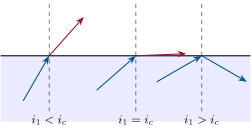
From water toward air, at increasing incidence: refraction away from the normal, then a refracted ray grazing the surface at the critical angle, then total internal reflection — the surface has become a perfect mirror.

Examples

Example 3.18 (Three critical angles)

Toward air: for water, sinic=1/1.33=0.752\sin i_c = 1/1.33 = 0.752, so ic=48.8i_c = 48.8^\circ; for glass, sinic=1/1.50\sin i_c = 1/1.50, so ic=41.8i_c = 41.8^\circ; for diamond, sinic=1/2.42=0.413\sin i_c = 1/2.42 = 0.413, so ic=24.4i_c = 24.4^\circ. The higher the index, the narrower the escape cone: in diamond, any ray more than 24.424.4^\circ off a facet’s normal is trapped — the secret of its sparkle, dissected in Problem 3.1.

Read in context →