High School Physics · Grades 10–12
3Refraction of Light
Dip a straw into a glass of water: it looks snapped at the waterline. Swimming pools are always deeper than they look, diamonds flash colored fire from a colorless stone, and the sentence you are reading probably crossed an ocean inside a glass thread thinner than a hair. One law explains all four — an equality between two sines, found by Snell in 1621 after fifteen centuries of physicists staring at tables of angles without seeing the pattern.
3.1 Reflection: a reminder
In a homogeneous transparent medium, light travels in straight lines — the rays of Chapter 2. At the boundary between two media, part of the light bounces back (reflection) and part crosses over (refraction). Both obey exact geometric laws, stated with one convention: angles are measured from the normal, never from the surface.
Definition 3.1 (Normal and angle of incidence)
At the point where a ray meets a surface, the normal is the line perpendicular to the surface at that point. The angle of incidence is the angle between the incoming ray and the normal; the angles of reflection and of refraction are measured from the normal in the same way.
Proposition 3.2 (Law of reflection)
The reflected ray lies in the plane containing the incident ray and the normal, on the other side of the normal, and the angle of reflection equals the angle of incidence:
Proof. Admitted at this level. ∎
Example 3.3 (Reading angles correctly)
A laser beam strikes a mirror “at ” — measured from the mirror’s surface, as beams are often described. The angle of incidence is , so the reflected ray also leaves at from the normal, and the beam turns by . Forgetting the normal convention is the most common error of this chapter; it costs every time.
3.2 Refraction and the refractive index
Hold a pencil in a half-filled glass: it looks broken at the surface. Light from the underwater part changes direction as it leaves the water, so the eye — which assumes straight rays — reconstructs the tip somewhere it is not.
Definition 3.4 (Refraction)
Refraction is the change of direction of light as it crosses the boundary between two transparent media. The ray in the second medium is the refracted ray, and its angle from the normal is the angle of refraction .
Refraction happens because light has different speeds in different media; each material is characterized by how much it slows light down.
Definition 3.5 (Refractive index)
The refractive index of a transparent medium is the ratio
where is the speed of light in vacuum and its speed in the medium. Since , the index satisfies ; it has no unit. Some useful values:
| medium | air | water | plexiglas | glass | diamond |
Example 3.6 (Speed of light in water)
In water, . In diamond, light crawls at — less than half its vacuum speed. For air, changes the speed by : in this chapter we treat air as vacuum and take .
Theorem 3.7 (Snell’s law of refraction)
The refracted ray lies in the plane of the incident ray and the normal, on the other side of the normal, and the angles of incidence and refraction satisfy
where and are the refractive indices of the two media. The path is reversible: light traveling backwards along the refracted ray exits along the incident ray.
Proof. Admitted at this level. ∎
Remark 3.8
The laws of reflection and refraction are stated here as experimental facts. They are honestly derived in the Year 1 volume, where light is treated as a wave: both laws — and the formula itself — then follow from the wave slowing down in the denser medium.
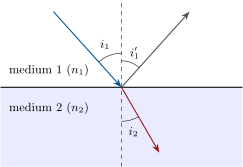
Example 3.9 (Air to water)
A ray hits a calm pond at . With and :
The ray bends toward the normal, as it always does when entering a slower medium (). Leaving the water, the same computation runs backwards and the ray bends away from the normal.
Method 3.10 (Solving a refraction problem)
- Draw the surface, the normal, and the ray; identify (medium of the incident ray) and .
- Check that the given angles are measured from the normal; convert if they are measured from the surface.
- Write and isolate the unknown sine; get the angle with the calculator’s inverse sine, as in the mathematics volume.
- Sanity check: the ray bends toward the normal if , away from it if , and must come out between and .
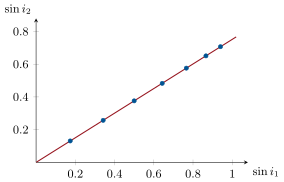
The experiment behind the law fits on a desk: a half-disc of plexiglas, a protractor, a laser. Raw angle pairs look irregular — Ptolemy tabulated them around the year 150 and wrongly concluded that was proportional to . Plot sine against sine instead, and the data straighten into a line through the origin of slope : that line is Snell’s law.
Proposition 3.11 (Apparent depth)
An object at depth under water, viewed from above at small angles, appears to be at the apparent depth
where is the index of water. A pool of depth looks only deep — a classic cause of imprudent dives.
Proof. Admitted at this level. ∎
Remark 3.12
The formula follows from Snell’s law applied to the almost-vertical rays reaching the eye; the derivation is done in the Year 1 volume. The direction of the effect needs no formula: rays leaving the water bend away from the normal, so the eye traces them back to a point higher than the object.
3.3 Dispersion: one law per color
A prism turns white sunlight into a rainbow, as the spectra of Chapter 2 showed. Refraction explains why: the refractive index of a medium is not quite the same for every color.
Definition 3.13 (Dispersion)
A medium is dispersive when its refractive index depends on the wavelength of the light. In glass and water, is slightly larger for blue light (short wavelength) than for red light (long wavelength) — so blue bends more.
Example 3.14 (Two colors, one surface)
A beam of white light hits crown glass at . For this glass and . Snell’s law, once per color:
A single surface splits white light by half a degree — invisible on a window pane, but a prism refracts twice in the same rotational sense, widens the fan, and a few meters away the colors are centimeters apart.
Remark 3.15
The rainbow is the same computation run inside a raindrop: sunlight refracts entering the drop, reflects on its back wall, and refracts again on the way out. Water’s index runs from (red) to (blue), so each color exits at its own angle — and no two observers see the same rainbow.
3.4 Total internal reflection
Snell’s law contains a trap. Going from water toward air, the refracted ray bends away from the normal: . Increase , and the formula soon demands , which no angle can deliver. Refraction then simply stops happening.
Definition 3.16 (Critical angle and total internal reflection)
Let light travel in a medium of index toward a medium of smaller index . The critical angle is the angle of incidence for which the refracted ray grazes the surface (). For no refracted ray exists: the surface reflects all the light back into the first medium, following the law of reflection. This is total internal reflection.
Proposition 3.17 (Critical angle formula)
For ,
Proof. Set in Snell’s law: . For , Snell’s law would require : no refracted direction exists. (That the light is then entirely reflected — not absorbed — is an experimental fact, confirmed by the wave theory of the Year 1 volume.) ∎
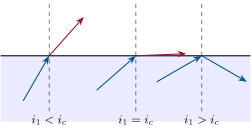
Example 3.18 (Three critical angles)
Toward air: for water, , so ; for glass, , so ; for diamond, , so . The higher the index, the narrower the escape cone: in diamond, any ray more than off a facet’s normal is trapped — the secret of its sparkle, dissected in Problem 3.1.
3.5 Optical fibers
Total internal reflection turns a glass thread into a pipe for light: a ray entering nearly parallel to the axis strikes the wall far beyond the critical angle, reflects without loss, and does so millions of times per kilometer without leaking.
Definition 3.19 (Optical fiber)
An optical fiber is a thin glass thread made of a core of index wrapped in a cladding of slightly smaller index . Light injected at one end travels along the core by repeated total internal reflection on the core–cladding boundary.
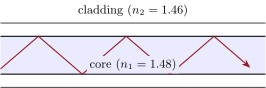
Example 3.20 (A fiber by the numbers)
With and ,
only rays within about of the axis are guided — which is fine, since that is exactly how laser light is injected. Inside the core the light travels at : a pulse crosses a fiber in about half a millisecond.
Remark 3.21 (Order of magnitude of data links)
Submarine cables — bundles of a few dozen fibers on the ocean floor — carry almost all intercontinental traffic. A single modern fiber transports on the order of bits per second by sending many wavelengths at once; a whole cable reaches bits per second, with an amplifier every or so. Satellites, for comparison, handle a small fraction of a percent of the traffic.
3.6 Exercises
Exercise 3.1 ★
A laser beam strikes a flat mirror at from the mirror’s surface. Give the angle of incidence, the angle of reflection, and the angle between the incident and reflected beams.
Solution
Solution of Exercise 3.1.
Angles are measured from the normal: the angle of incidence is , so the angle of reflection is also . The incident and reflected beams make an angle of with each other.
Exercise 3.2 ★
- Compute the speed of light in water () and in diamond ().
- In a certain solid, light travels at . Compute its refractive index and identify the material.
Solution
Solution of Exercise 3.2.
1. : in water ; in diamond .
2. : glass.
Exercise 3.3 ★
A ray in air strikes a glass block () at . Compute the angle of refraction. At what angle would a ray traveling inside the glass have to hit the surface to exit into the air at ?
Solution
Solution of Exercise 3.3.
, so . By reversibility of light paths, a ray inside the glass hitting the surface at exits into the air at exactly .
Exercise 3.4 ★
Sunlight reaches the surface of a lake at from the vertical. Compute the angle of the refracted ray, and state whether the ray bends toward or away from the normal — with the one-word reason.
Solution
Solution of Exercise 3.4.
, so . The ray bends toward the normal, because water is the slower medium ().
Exercise 3.5 ★
To identify a clear liquid, a ray is sent onto its surface at ; the refracted ray is measured at . Compute the refractive index and identify the liquid from the table of Definition 3.5.
Solution
Solution of Exercise 3.5.
: the liquid is water.
Exercise 3.6 ★★
A half-disc of a transparent plastic gives the following measurements:
- Compute for each pair. What do you observe?
- Deduce the refractive index of the plastic and identify it.
- Why is plotting against a better test of Snell’s law than plotting against ?
Solution
Solution of Exercise 3.6.
1. The five ratios are
constant within measurement error — Snell’s law.
2. : plexiglas.
3. Snell’s law predicts : sine against sine, the data must align on a straight line through the origin, which a ruler checks at a glance. Plotted angle against angle, the data lie on a curve; at small angles the curve is deceptively close to a straight line, which is exactly what fooled Ptolemy.
Exercise 3.7 ★★
Compute the critical angle toward air for water, glass () and diamond. Then explain, with Snell’s law, why there is no critical angle for light going from air into water.
Solution
Solution of Exercise 3.7.
with : water , ; glass , ; diamond , .
From air into water, for every incidence: a refracted angle always exists, so nothing special ever happens — total internal reflection needs .
Exercise 3.8 ★★
- A pool is deep. What depth does a swimmer standing at the edge perceive?
- A heron eyes a fish swimming below the surface. At what depth does the fish appear, and should the heron strike above, at, or below the image it sees?
Solution
Solution of Exercise 3.8.
1. .
2. The fish appears at : the image is above the fish, so the heron must strike below the image it sees. Herons, unburdened by Snell’s law, learn this by trial and error.
Exercise 3.9 ★★
A ray hits a window pane (, parallel faces) at .
- Compute the angle of refraction at the first face.
- The refracted ray hits the second face from inside, at the same angle. Compute the exit angle and compare it with .
- What, then, does a thick window do to the direction and to the position of a ray crossing it?
Solution
Solution of Exercise 3.9.
1. , so .
2. Glass to air at : , so — the exit angle equals the entry angle.
3. The two refractions undo each other: the ray leaves parallel to its original direction, merely shifted sideways. That is why a window does not distort the scene, only (imperceptibly) translates it.
Exercise 3.10 ★★
White light strikes a block of flint glass at . For this glass, and . Compute the refraction angles of the red and blue rays and the angle between them. Which color ends up closer to the normal?
Solution
Solution of Exercise 3.10.
. Red: , . Blue: , . The two colors are separated by ; blue, with the larger index, bends more and ends up closer to the normal.
Exercise 3.11 ★★
An optical fiber has a core of index and a cladding of index .
- Compute the critical angle on the core–cladding boundary.
- A guided ray bounces along at exactly the critical angle. Show that over of straight fiber it travels about more than a ray going straight down the axis.
Solution
Solution of Exercise 3.11.
1. , so .
2. A ray at from the normal makes with the axis, so its path along an axis length is :
about more than the axial ray.
Exercise 3.12 ★★★
A diver’s eye is below a perfectly calm surface. Because of refraction, the diver sees the entire sky compressed into a bright disc directly overhead — Snell’s window.
- Explain why light from the horizon reaches the diver’s eye at the critical angle of water, from the vertical.
- Compute the radius of the bright disc on the surface, using the tangent in the right triangle eye–vertical–disc edge.
- What does the diver see on the surface outside the disc?
Solution
Solution of Exercise 3.12.
1. Light grazing from the horizon arrives at close to ; it refracts to , i.e. — the critical angle, as reversibility demands. Rays from the whole sky therefore reach the eye within a cone of half-angle .
2. The disc’s edge is where that cone meets the surface:
3. Outside the disc, light from below hits the surface beyond the critical angle and is totally reflected: the diver sees a silvery mirror showing the bottom of the pool.
Exercise 3.13 ★★★
A prism has angles , , . A thin beam of white light enters perpendicular to one of the sides adjacent to the right angle, crosses undeviated, and strikes the long face from inside at . For this glass, and .
- Compute the exit angles of the red and blue rays and the angular width of the fan between them.
- The prism is replaced by a –– prism, so the internal angle of incidence becomes . Show that no light exits through the long face at all.
Solution
Solution of Exercise 3.13.
1. Red: , so . Blue: , so . The white beam fans out over — a prism spectrum from a single refraction.
2. At : (and for blue). No refracted angle exists for either color: the critical angle is , so the long face totally reflects the whole beam.
Exercise 3.14 ★★★
Periscopes fold light with –– glass prisms (): the beam enters one short face perpendicularly and hits the long face from inside at .
- Show that the long face acts as a perfect mirror. Why is this better than a metallic mirror, which absorbs a few percent at each reflection?
- The periscope floods and the long face is now in contact with water. Compute the new critical angle of the glass–water boundary and show the mirror fails.
- At what angle does the light of question 2 leave the prism into the water?
Solution
Solution of Exercise 3.14.
1. Critical angle glass–air: , so : the beam is totally reflected — of the light, with no coating to tarnish. A metallic mirror loses a few percent at each bounce, and a periscope needs two.
2. Glass–water: , so . Now : the incidence is below critical, most of the light refracts out into the water, and the mirror — hence the image — fails.
3. , so into the water.
Exercise 3.15 ★★★
A transatlantic cable runs of fiber (core index ) between London and New York.
- Compute the speed of light in the core and the one-way travel time of a pulse.
- A radio wave travels at . How long would it need over the same distance, and how much round-trip time does the fiber’s glass cost compared with radio?
- Some financial firms pay fortunes to shave milliseconds off this link. Propose two distinct physical ways to make the light arrive earlier.
Solution
Solution of Exercise 3.15.
1. , so
2. Radio: . The glass costs each way, about per round trip.
3. Lower the index — hollow-core fibers guide light through air (), and microwave links through the atmosphere do the same — or shorten the path: a cable laid closer to the great-circle route between the two cities. Both are actually sold, at prices per millisecond.
3.7 Problem: The diamond, the pool and the fiber
Problem 3.1
Weekend problem — three lives of Snell’s law: a pool that lies about its depth, a stone cut so that light cannot leave, and the sixty-millisecond ocean under the internet
One equality of two sines, three careers. In a swimming pool it cheats your eyes about depth and squeezes the whole sky into a circle. In a diamond, pushed to its breaking point, it refuses to let light out — and jewelers have cut stones around that refusal for centuries. Under the Atlantic it guides laser pulses inside a strand of glass, and sets the speed limit of the global internet. This problem works through the three lives in order, with the same law each time.
Part I — Warming up.
- Compute the speed of light in water () and in diamond (). By what factor does diamond slow light down?
- A ray in air strikes a pond at . Compute the angle of refraction.
- A ray in the water hits the surface from below at . At what angle does it exit into the air? State the principle this illustrates.
- Compute the critical angle of the water–air boundary, and describe what happens to an underwater ray hitting the surface at .
- The index of air is . Compute the speed of light in air and justify the approximation used throughout.
Part II — The pool.
- A pool is deep. Using the apparent-depth formula (Proposition 3.11), compute the depth a person standing above perceives.
- Explain with a two-ray sketch (described in words) why a coin on the bottom seems to rise: what do rays leaving the water do, and where does the eye place their intersection?
- A diver’s eye is at . Compute the radius of Snell’s window — the bright disc through which the diver sees the whole sky (Exercise 3.12).
- A lamp on the bottom sends rays upward at , and from the vertical. For each ray, say whether it escapes and at what angle, or what happens instead.
- A spear-fisher on the bank aims at a fish. Should the strike be aimed above, at, or below the fish’s image — and does the fish, looking back, see the fisher displaced too?
Part III — The diamond.
- Compute the critical angle of diamond () toward air, and compare it with that of glass (), which is .
- A ray inside the stone hits a facet at from its normal. What happens in the diamond? In the glass imitation? Explain in one sentence why the cut of a diamond, combined with its tiny critical angle, produces the sparkle.
- Diamond is also strongly dispersive: , . White light enters a facet at ; compute the refraction angle for each color and the angular split.
- Later, red and blue rays both reach an exit facet from inside at . Compute the two exit angles and the split of the emerging fan. Compare with the split at entry: what happens to dispersion near the critical angle?
- A drop of water () coats a facet. Compute the new critical angle of the diamond–water boundary, decide the fate of the ray of question 12, and explain why jewelers keep diamonds scrupulously clean.
Part IV — The fiber.
- A fiber has a core of index and a cladding of index . Compute the critical angle on the core–cladding boundary.
- A bare glass thread in air would have a critical angle of — seemingly far better. Give two reasons the cladding is used anyway. (Think about dust, scratches, and what touching the surface would do to total internal reflection.)
- Compute the speed of light in the core, then the one-way travel time of a pulse along of fiber.
- A ray bouncing at exactly the critical angle travels times the length of the axis. Compute the extra distance over the and the extra time it costs.
- The punchline. A modern fiber pair carries about bits per second, and this book is about bits. Compute the round-trip (“ping”) time across the ocean and the number of copies of this book the fiber moves per second — then state, in one sentence, what Snell’s law does for the internet.
Solution
Solution of Problem 3.1.
1. ; — diamond slows light by the factor .
2. , so .
3. , so : light retraces its path — reversibility of light rays.
4. , so . At , Snell’s law would need : no refracted ray; the surface totally reflects the light back down.
5. : light in air is slower than in vacuum by , far below the precision of our angle measurements, so is harmless.
6. : the pool hides of itself.
7. Two rays leaving the coin refract at the surface, bending away from the normal, so they diverge more steeply above the water than below. The eye prolongs the two exiting rays backwards in straight lines; they cross above the coin, and that crossing is where the eye places the image.
8. : a disc about across holds the entire sky.
9. At : , the ray exits at . At : , it exits at , nearly grazing. At : — total internal reflection, the ray dives back into the pool.
10. The image is above the real fish (Proposition 3.11), so aim below it. And yes: the fish sees the fisher displaced too, squeezed toward the vertical inside Snell’s window — each sees the other where the other is not.
11. Diamond: , so , against for glass: diamond’s escape cone is not even half as wide.
12. In diamond, : total internal reflection, the ray stays in the stone. In glass, : the ray leaks out the back. The facets of a brilliant cut are angled so that entering light almost always strikes them beyond and bounces until it exits upward toward the eye — a glass imitation, with its wide escape cone, simply lets the light fall through.
13. . Red: , so . Blue: , so . Split at entry: about .
14. . Red: , so . Blue: , so . The fan is now wide: the exit refraction, working near the critical angle, stretched the entry split threefold. That stretched spray of colors is the diamond’s fire.
15. Diamond–water: , so . The ray, trapped when the facet faced air, now escapes () into the water film: every drop, fingerprint or film of grease raises the outside index, widens the escape cone and drains the sparkle — hence the jeweler’s cloth.
16. , so .
17. Total internal reflection happens at the surface, so the surface must stay perfect: on a bare thread, every speck of dust, scratch, water drop or touching finger raises the outside index at that point and bleeds light out. The cladding buries the mirror inside clean glass where nothing can reach it — and, as a bonus, protects the hair-thin core mechanically.
18. , so
19. Path factor : at worst of extra glass, costing — the zigzag is nearly free.
20. Ping: . Throughput: copies of this book per second. In one sentence: by trapping light inside glass through total internal reflection, Snell’s law carries a library across the ocean every second, sixty milliseconds there and back.