 Coach
CoachThe density (the Greek letter rho) of a substance is its mass per unit of volume: for a sample of mass and volume ,
With in grams and in cubic centimetres, comes out in grams per cubic centimetre () — last year’s “mass of one cubic centimetre”, now wearing its uniform. Water’s density: . And since a litre is cubic centimetres, the same number doubles as kilograms per litre: water is per litre.
Examples
Example 46.2 (Reading the letters)
A formula is a sentence in shorthand. reads: “to find the density, divide the sample’s mass by its volume.” The letters are placeholders — for this pebble, becomes and becomes :
Same division as last year — but the formula remembers the recipe for every pebble to come.
Example 46.4 (The recipes at work)
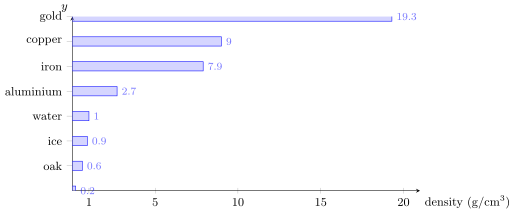
Mass from volume: what does of iron () weigh? — nearly two kilograms in a coffee-mug’s bulk. Volume from mass: what room does of oak () take? . Sanity partner: iron answers should be heavy-and-small, wood answers light-and-large — the density table is the judging step’s best friend.
Example 46.8 (Alloys and in-betweens)
Blend two substances and the blend’s density lands between their signatures — nearer the more generous ingredient. Bronze (copper with a little tin) signs near ; the crown’s gold-and-silver blend signed between and ; sea water, salt dissolved in water, edges up to about . Between-ness is itself a clue: a reading of from a “pure gold” bar is a confession of company.