Primary & Middle School Physics · Grades 1–9
46Volume, Mass, Density
Last year you unmasked a fraudulent goldsmith by dividing grams by cubic centimetres. This year, your mathematics course has handed you a new power: letters that stand for numbers. Density is the perfect place to spend it — one short formula that packs three recipes, a detective’s toolkit, and the whole floating rule into five symbols.
46.1 The formula
Definition 46.1 (Density, by formula)
The density (the Greek letter rho) of a substance is its mass per unit of volume: for a sample of mass and volume ,
With in grams and in cubic centimetres, comes out in grams per cubic centimetre () — last year’s “mass of one cubic centimetre”, now wearing its uniform. Water’s density: . And since a litre is cubic centimetres, the same number doubles as kilograms per litre: water is per litre.
Example 46.2 (Reading the letters)
A formula is a sentence in shorthand. reads: “to find the density, divide the sample’s mass by its volume.” The letters are placeholders — for this pebble, becomes and becomes :
Same division as last year — but the formula remembers the recipe for every pebble to come.
Proposition 46.3 (Three recipes in one formula)
Because density ties mass and volume in proportion, one formula serves three needs:
- find a density: — divide mass by volume;
- find a mass: — each cubic centimetre carries grams, and there are of them;
- find a volume: — share the mass out in helpings of grams; the number of helpings is the number of cubic centimetres.
Example 46.4 (The recipes at work)
Mass from volume: what does of iron () weigh? — nearly two kilograms in a coffee-mug’s bulk. Volume from mass: what room does of oak () take? . Sanity partner: iron answers should be heavy-and-small, wood answers light-and-large — the density table is the judging step’s best friend.
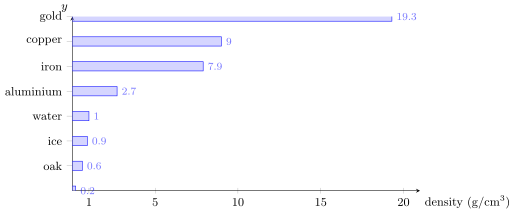
46.2 Measuring densities
Method 46.5 (Density of a liquid)
Liquids will not sit on a balance pan alone — so borrow the tare trick:
Example 46.6 (Density of a solid, start to finish)
A medal claims to be silver (). Balance: . Cylinder: the water climbs from to , so . Then — the signature matches: silver it may well be. (A cheaper metal dressed in silver plating would have betrayed itself here — unless chosen with cunning, as the weekend problem will show.)
Remark 46.7 (Units in formulas)
A formula is honest only if its units agree. With in grams and in , speaks ; feed it kilograms and litres and it answers — happily, the same number for any substance. But mix grams with litres and the formula, uncomplaining, delivers nonsense. Rule of the professionals: before computing, parade the units; after computing, write them into the answer.
46.3 Density thinking
Example 46.8 (Alloys and in-betweens)
Blend two substances and the blend’s density lands between their signatures — nearer the more generous ingredient. Bronze (copper with a little tin) signs near ; the crown’s gold-and-silver blend signed between and ; sea water, salt dissolved in water, edges up to about . Between-ness is itself a clue: a reading of from a “pure gold” bar is a confession of company.
Example 46.9 (Density decides the floating world)
The floating rule, now in uniform: an object floats in a liquid when . Oak () on water (): floats. Ice () in oil (): sinks — check the table, not your instincts. A swimmer () in the famous ultra-salty lakes (): floats like a cork, newspaper in hand. One inequality, the whole harbor.
Remark 46.10 (Mind the crowd, not the parcel)
describes substances; ships and swollen life-jackets are parcels — substance plus trapped air — and it is the parcel’s overall that faces the floating rule. The formula handles both, if you feed it the right and : the steel’s own density for the substance, the whole hull’s mass over the whole hull’s volume for the parcel. Most floating “paradoxes” are just the two bookkeepings confused.
46.4 Exercises
Exercise 46.1 ★
Write the density formula, name each letter, and give the unit that goes with grams and cubic centimetres.
Solution
Solution of Exercise 46.1.
: the density, the sample’s mass, its volume. With grams and cubic centimetres, comes out in .
Exercise 46.2 ★
Compute the density: , . Which metal of the skyline chart is this?
Solution
Solution of Exercise 46.2.
: aluminium.
Exercise 46.3 ★
Use the right recipe: the mass of of copper (); the volume of of gold ().
Solution
Solution of Exercise 46.3.
of copper. of gold — the crown case’s own number.
Exercise 46.4 ★
In Method 46.5, why is the cylinder tared first? What two readings then feed the formula?
Exercise 46.5 ★
A liquid: , . Its density? Does an ice cube () float or sink in it?
Exercise 46.6 ★
Why is water’s density the same number in and in kilograms per litre? What warning does Remark 46.7 attach to mixing grams with litres?
Exercise 46.7 ★
A bracelet marked “pure gold” has and . Compute its density and give your verdict, with the table as witness.
Solution
Solution of Exercise 46.7.
— near lead’s , nowhere near gold’s . Verdict: not pure gold; likely a lead-hearted impostor in gold clothing.
Exercise 46.8 ★★
One cubic metre is a cube of centimetres. How many is that — and what is the mass of a cubic metre of water, in kilograms? (The answer explains why waterbeds worry landlords.)
Solution
Solution of Exercise 46.8.
— a million. At each, that is : a full tonne per cubic metre of water — and why a large waterbed is furniture for the ground floor.
Exercise 46.9 ★★
A “silver” trophy: , water rise from to . Density? Between which two table substances does it fall — and what does between-ness whisper?
Solution
Solution of Exercise 46.9.
; — between aluminium () and iron (), closest below iron. Between-ness whispers: a blend or a plated impostor, certainly not silver’s .
Exercise 46.10 ★★
An empty bottle weighs ; filled to its mark with a mystery liquid it weighs . Find the liquid’s density in and propose its identity.
Exercise 46.11 ★★
A hollow aluminium buoy has a total volume of and a total mass of . Compute the parcel’s density and predict float or sink — then explain, with Remark 46.10, why aluminium’s own was the wrong number to consult.
Exercise 46.12 ★★★
Design a complete protocol to decide whether a chain is pure copper: list every measurement, the recipe applied, the expected number for purity, and two honest reasons your verdict could still be wrong (think of hollow links, and of cunning blends whose density lands near copper’s). What extra test would tighten the case?
Solution
Solution of Exercise 46.12.
Protocol: weigh the chain (); measure its volume by the rise method, fully submerged, no bubbles (); compute ; purity expects about . Honest doubts: hollow links trap air and swell , faking a low density; and a cunning blend (or a plated core) can land near while containing no pure copper at all. Tightening test: repeat the volume measurement after flooding the links (shake out bubbles), and add an independent signature — for instance the magnet (a steel core betrays itself instantly) or, in a workshop, a measured melting behavior.
46.5 Problem: The Scrapyard Detective
Problem 46.1
Weekend problem — an afternoon with the scrapyard’s metal detective; four mystery lots, one impostor ingot; the limits of the density test
The scrapyard buys metal by what it is, not what it looks like, and the yard’s detective works with a balance, a big graduated vessel, and the skyline table. You are the apprentice. (Table extract: aluminium ; iron ; copper ; lead ; gold ; tungsten .)
Part I — Four lots.
- Lot A, a gray ingot: , displacement . Density and identity?
- Lot B, a coil of wire: , . Density and identity?
- Lot C, a dull heavy plate: , . Density and identity — and why must lot C be handled with gloves and respect?
- Lot D, a sack of mixed pale scrap: , . Show that lot D’s density lands between two table metals, and say what the sack most likely contains.
Part II — Prices and predictions. The yard pays by mass but plans transport by volume.
- A buyer wants of aluminium cut from lot A. What volume of ingot is that?
- The copper coil of lot B is to be melted into cubes of each. What is the mass of one cube, and how many full cubes does the coil yield?
- A crate can carry at most . How many of those copper cubes may it legally hold?
- The truck’s tank-well holds more of iron scrap. What extra mass, in kilograms, is the detective allowed to load?
Part III — The impostor. A seller arrives with a gleaming “gold” ingot: , displacement .
- Compute the ingot’s density. Does it match gold’s signature?
- The detective, unmoved, consults the table’s last line and sighs. Which cheaper metal wears exactly gold’s density — and what does this teach about the density test’s limits?
- Which of the yard’s two instruments has been defeated here: the balance, the vessel, both, or neither? Say precisely what the density test did honestly establish about the ingot.
- Suggest a further physical test from earlier years of this course that tells gold from its double without harming the ingot. (Their melting points differ enormously — gold near , the double far above every furnace here — but no yard melts a maybe-treasure: find gentler evidence, perhaps the magnet’s verdict on iron cores, or the ring of a struck bar, and defend your choice honestly.)
Part IV — The detective’s craft.
- Write the detective’s three-line creed: what density can prove, what it can only suggest, and what it can never do alone.
Solution
Solution of Problem 46.1.
1. : aluminium. 2. : copper. 3. : lead — dense, soft, and poisonous to handle carelessly: gloves. 4. — between aluminium () and iron (): a mixed sack of the two, roughly half and half by volume. 5. . 6. One cube: . The coil’s yield full cubes. 7. ; : cubes. 8. . 9. — a perfect match for gold. 10. Tungsten — density , the same signature to the decimal. The density test identifies candidates; it cannot distinguish substances that happen to share a signature. 11. Neither instrument failed: mass and volume are correct, and so is the division. The test honestly established that the ingot is either gold or something of gold’s exact density — it narrowed the suspects to two. 12. Defensible choices: the struck bar’s ring and feel (tungsten is far harder — a file or hardness test on a hidden corner tells them apart quickly), or an accepted expert measure of how the bar conducts heat or current (gold is among the best conductors, tungsten far behind) — gentler than any furnace, and decisive together with density. 13. For example: “Density can prove a substance is not what it claims. It can only suggest what it is — signatures narrow the suspects. And alone it can never convict: identity wants two independent witnesses.”