সব বই

পেশাদার

1 Markets I: The Ecosystem and Exchange-Traded Marketsবাজার অনলাইন 2 Markets II: Rates, FX and Creditবাজার অনলাইন 3 Markets III: Commodities, Energy and Cryptoবাজার অনলাইন 4 Quantitative Methodsপদ্ধতি অনলাইন 5 Derivatives and Volatilityডেরিভেটিভস অনলাইন 6 Rates, Credit, XVA and Riskসুদহার, ঋণ ও ঝুঁকি অনলাইন 7 Research Craft: Predictors, Backtests, Measurement, Portfoliosগবেষণা অনলাইন 8 Strategies I: Equities and Futuresকৌশল অনলাইন 9 Strategies II: Volatility, Relative Value, Macro and the Bank Desksকৌশল অনলাইন 10 Microstructure and Executionএক্সিকিউশন অনলাইন 11 Market Making and High-Frequency Tradingমার্কেট মেকিং অনলাইন 12 Machine Learning for Marketsমেশিন লার্নিং অনলাইন 13 Low-Latency Softwareপ্রযুক্তি অনলাইন 14 Networks, Hardware and Trading Infrastructureপ্রযুক্তি অনলাইন 15 Research, Data and Risk Platformsপ্রযুক্তি অনলাইন 16 The Desk and the Firmপ্রতিষ্ঠান অনলাইন 17 The Industry: Firms, Roles and Careersক্যারিয়ার অনলাইন 18 Interviews I: Maths, Probability and Speedক্যারিয়ার অনলাইন 19 Interviews II: Markets, Trading Games and the Final Roundক্যারিয়ার অনলাইন 20 Interviews III: Codeক্যারিয়ার অনলাইন
অ্যাপ পরিচিতি Coach সাইন ইন পড়া শুরু করো

বইগুলো এখনো বাংলা ভাষায় পাওয়া যায় না — ইংরেজি সংস্করণ দেখানো হচ্ছে।

Physics · পরিভাষা

Density, by formula কী?

অন্য নাম: density

Definition 46.1 Primary & Middle School Physics · অধ্যায় 46 — Volume, Mass, Density

The density ρ\rho (the Greek letter rho) of a substance is its mass per unit of volume: for a sample of mass mm and volume VV,

ρ=mV.\rho = \frac{m}{V}.

With mm in grams and VV in cubic centimetres, ρ\rho comes out in grams per cubic centimetre (g/cm3\mathrm{g}/\mathrm{cm}^{3}) — last year’s “mass of one cubic centimetre”, now wearing its uniform. Water’s density: ρ=1.0 g/cm3\rho = 1.0\,\mathrm{g}/\mathrm{cm}^{3}. And since a litre is 10001000 cubic centimetres, the same number doubles as kilograms per litre: water is 1.0 kg1.0\,\mathrm{kg} per litre.

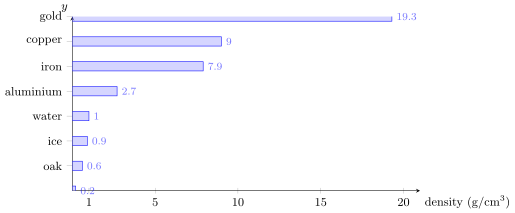
The density table as a skyline: from cork’s feather-light 0.2 to gold’s monumental 19.3. Water’s 1.0 is the floating frontier.
The density table as a skyline: from cork’s feather-light 0.20.2 to gold’s monumental 19.319.3. Water’s 1.01.0 is the floating frontier.

উদাহরণ

Example 46.2 (Reading the letters)

A formula is a sentence in shorthand. ρ=m/V\rho = m/V reads: “to find the density, divide the sample’s mass by its volume.” The letters are placeholders — for this pebble, mm becomes 75 g75\,\mathrm{g} and VV becomes 30 cm330\,\mathrm{cm}^{3}:

ρ=mV=7530=2.5 g/cm3.\rho = \frac{m}{V} = \frac{75}{30} = 2.5\,\mathrm{g}/\mathrm{cm}^{3}.

Same division as last year — but the formula remembers the recipe for every pebble to come.

Example 46.4 (The recipes at work)

Mass from volume: what does 250 cm3250\,\mathrm{cm}^{3} of iron (ρ=7.9\rho = 7.9) weigh? m=7.9×250=1975 gm = 7.9 \times 250 = 1975\,\mathrm{g} — nearly two kilograms in a coffee-mug’s bulk. Volume from mass: what room does 540 g540\,\mathrm{g} of oak (ρ=0.6\rho = 0.6) take? V=540÷0.6=900 cm3V = 540 \div 0.6 = 900\,\mathrm{cm}^{3}. Sanity partner: iron answers should be heavy-and-small, wood answers light-and-large — the density table is the judging step’s best friend.

Example 46.8 (Alloys and in-betweens)

Blend two substances and the blend’s density lands between their signatures — nearer the more generous ingredient. Bronze (copper 9.09.0 with a little tin) signs near 8.88.8; the crown’s gold-and-silver blend signed between 10.510.5 and 19.319.3; sea water, salt dissolved in water, edges up to about 1.031.03. Between-ness is itself a clue: a reading of 1212 from a “pure gold” bar is a confession of company.

প্রসঙ্গসহ পড়ো →