6Waves on Strings and Rods: the d’Alembert Equation
Pluck a guitar string and a shape runs along it, bounces off the bridge, comes back, and settles into the standing pattern whose frequency you hear as a note. Put your ear to a railway rail and you hear the train long before it arrives: a compression runs down the steel at five kilometres per second. The Year 1 volume described such waves — travelling, standing, superposed — without saying why they exist. This chapter derives the equation that governs them, the d’Alembert wave equation, first for the transverse motion of a string, then for the longitudinal motion of a rod built, atom by atom, from masses and springs; it computes the energy a wave carries and the impedance that decides what happens when it meets a change of medium.
6.1 The vibrating string
Theorem 6.1(Wave equation of a string)
A string of linear mass density μ, stretched with tension T, makes small transverse displacements y(x,t) (slopes ∣∂xy∣≪1). Then
∂t2∂2y=c2∂x2∂2y,c=μT,
the d’Alembert equation, whose general solution is y=f(x−ct)+g(x+ct): the superposition of a shape travelling to the right and one travelling to the left at the speed c, undeformed.
Proof. Isolate the element between x and x+dx, of mass μdx. Its neighbours pull it along the string’s tangent with the tension T: horizontally Tcosθ≈T at both ends (no horizontal motion, so T is the same all along), vertically Tsinθ≈T∂xy, which gives the net force T[∂xy(x+dx)−∂xy(x)]=T∂x2ydx. Newton: μdx∂t2y=T∂x2ydx. For the solution, put u=x−ct, v=x+ct: the equation becomes ∂u∂vy=0 (chain rule), so ∂vy depends on v only, and y=f(u)+g(v); conversely any such y satisfies it. Gravity, neglected, is legitimate when T≫μgL. ∎
Left: the forces on an element of string — the two tensions are not parallel when the string is curved, and their resultant is transverse. Right: a shape f(x−ct) travels to the right at c without deforming.
Example 6.2(Guitar, piano, cable)
The low E string of a guitar (μ=5.5g/m, length 0.65m, 82.4Hz) vibrates in its fundamental with λ=2L: c=2Lf=107m/s and T=μc2=63N. A piano’s A4 string (steel, 1mm, μ=6.1g/m, 0.38m, 440Hz): c=334m/s, T=680N — and there are some 230 strings in a piano, twenty tonnes of tension on a cast-iron frame. A 1kg/m cable at 10kN: 100m/s.
6.2 Standing waves and modes
Proposition 6.3(Modes of a string fixed at both ends)
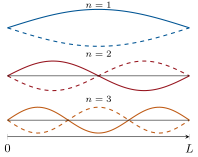
A string fixed at x=0 and x=L admits the sinusoidal standing-wave solutions (normal modes)
— the fundamental f1=c/2L and its harmonics. Mode n has n−1 nodes between the ends. Any motion of the string is a superposition y=∑nyn, the amplitudes and phases being fixed by the initial shape and velocity (a Fourier series, as the mathematics volume of this year establishes): the mixture of harmonics is the timbre of the note.
Proof. Seek y=F(x)cos(ωt−φ): F′′+(ω/c)2F=0, F(0)=0 gives F=Asin(ωx/c), and F(L)=0 requires ωL/c=nπ. Each mode is also the sum of two travelling waves: sinkxcosωt=21[sin(kx−ωt)+sin(kx+ωt)] — the wave and its reflection. The completeness of the sines is the Fourier theorem. ∎
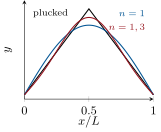
Left: the first three modes of a string fixed at both ends (fn=nc/2L). Right: a string plucked at its middle (triangle) and the first terms of its Fourier series — only odd harmonics appear, with amplitudes falling as 1/n2.
Example 6.4(Melde’s experiment)
A string driven at one end by a vibrator at frequency f, the other end passing over a pulley to a hanging mass m (so T=mg): a large standing wave appears whenever f equals one of the fn=(n/2L)mg/μ — resonance of mode n. For L=1.2m, μ=1.0g/m and f=50Hz, the masses giving n=1,2,3 loops are mn=4L2f2μ/n2g=1.47/n2 kg: 1.47kg, 367g, 163g. Pressing a guitar string at the twelfth fret halves L and doubles f1: the octave; touching it lightly at the middle without pressing kills the odd modes and leaves the second harmonic — the flageolet.
6.3 Energy, power and impedance
Proposition 6.5(Energy of a string wave)
A string carries the energy per unit length and the power (energy flux toward +x)
e=21μ(∂t∂y)2+21T(∂x∂y)2,P=−T∂x∂y∂t∂y,
which obey the local balance ∂te+∂xP=0. For a progressive wave y=f(x−ct), the kinetic and potential densities are equal and P=Z(∂ty)2 with
Z=Tμ=μc=cT,
the impedance of the string (kg/s): the ratio of the transverse force −T∂xy exerted by the string on what lies ahead to the transverse velocity ∂ty. A sinusoidal wave of amplitude A carries the mean power ⟨P⟩=21Zω2A2.
Proof. The potential term is the work of the tension stretching the element: its length is
dx1+(∂xy)2≈dx(1+21(∂xy)2),
so the excess length times T gives 21T(∂xy)2dx. The power transmitted across x toward +x is the transverse force exerted by the left part on the right part, −T∂xy, times the velocity ∂ty. Balance:
equal by the wave equation. For f(x−ct): ∂xy=−∂ty/c, so P=(T/c)(∂ty)2 and both densities equal 21μ(∂ty)2. ∎
Proposition 6.6(Reflection and transmission at a junction)
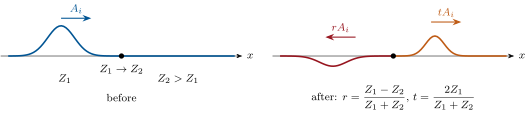
A wave of amplitude Ai arrives from a string of impedance Z1 on a string of impedance Z2 joined at x=0. Continuity of the displacement and of the transverse force at the junction gives the amplitude coefficients
r=AiAr=Z1+Z2Z1−Z2,t=AiAt=Z1+Z22Z1,
and the energy fractions R=r2, T=4Z1Z2/(Z1+Z2)2, with R+T=1. A fixed end (Z2→∞) reflects with r=−1 (the pulse comes back inverted), a free end (Z2=0) with r=+1; equal impedances transmit everything.
Proof. Sinusoidal waves y1=Aicos(ωt−k1x)+Arcos(ωt+k1x) for x<0, y2=Atcos(ωt−k2x) for x>0, the same ω on both sides. At x=0: y1=y2 gives Ai+Ar=At; the force −T∂xy continuous (a massless junction) gives Z1(Ai−Ar)=Z2At (using T1k1=Z1ω). Solve. Energies: the mean powers 21Zω2A2. ∎
A pulse meets a junction with a heavier string (Z2=4Z1): part is transmitted, slower and narrower, part is reflected inverted.
6.4 From the chain of atoms to the elastic rod
Proposition 6.7(The chain of atoms; Young’s modulus)
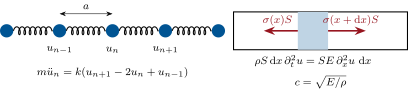
A line of identical masses m spaced by a and linked by springs of stiffness k: if un(t) is the displacement of mass n along the line,
When the displacement varies slowly from one mass to the next (over wavelengths λ≫a), un(t)→u(x,t) with un±1−un≈±a∂xu+21a2∂x2u, and the chain obeys the d’Alembert equation
∂t2∂2u=c2∂x2∂2u,c=amk=ρE,
with ρ=m/a3 the density of a solid made of such chains in a cubic array and E=k/a its Young’s modulus: the stiffness of a rod of section S and length ℓ is kS/a2⋅a/ℓ=ES/ℓ, i.e. Hooke’s lawF/S=EΔℓ/ℓ (stress σ=Eε).
Proof. Each spring is stretched by the difference of the displacements of its ends. Insert the Taylor expansions: m∂t2u=ka2∂x2u. A cube of side a per atom gives ρ=m/a3; a rod of section S contains S/a2 parallel chains of ℓ/a springs in series, of total stiffness (S/a2)(ka/ℓ)=(k/a)S/ℓ. ∎
Proposition 6.8(Longitudinal waves in a rod)
Directly on the continuum: an element of a rod between x and x+dx, displaced by u(x,t), is strained by ε=∂xu and pulled by the stress σ=E∂xu on each face; Newton gives ρ∂t2u=E∂x2u: longitudinal (compression) waves travel at c=E/ρ — 5100m/s in steel (E=200GPa), 5000m/s in aluminium, 3700m/s in granite, 3500m/s in wood along the grain. The impedance is Z=ρc=Eρ per unit area, and the same junction formulas apply — which is how ultrasound finds a crack in a rail.
Proof. Net force on the element: S[σ(x+dx)−σ(x)]=SE∂x2udx; mass ρSdx. ∎
Left: the chain of masses and springs — each mass feels the two springs around it, and the continuum limit is the wave equation with c=ak/m. Right: an element of an elastic rod pulled by the stress on its two faces.
Remark 6.9(What the chain knows that the rod does not)
Seeking un=Acos(ωt−kna) in the exact chain equation gives ω=2k/m∣sin(ka/2)∣: for ka≪1 this is ω=ck, the non-dispersive wave equation, but as the wavelength approaches 2a the frequency saturates at 2k/m and the phase and group velocities differ — the first dispersion relation of this volume, the subject of Chapter 8. For a=0.25nm and c=5km/s the cut-off lies at ωmax=2c/a=4×1013rad/s (6THz): the solid cannot vibrate faster than its atoms’ springs allow.
6.5 Exercises
Exercise 6.1★
A guitar’s A string (110Hz, L=65cm, μ=3.0g/m): wave speed, tension, wavelength of the fundamental on the string and of the sound in air; frequency when the string is pressed at the fifth fret (L reduced by a factor 2−5/12).
Solution
Solution of Exercise 6.1.
c=2Lf=143m/s; T=μc2=61N; λ=2L=1.3m on the string, 340/110=3.1m in air; fifth fret: 110×25/12=147Hz.
Exercise 6.2★
Speed of longitudinal waves in steel (E=200GPa, ρ=7800kg/m3), aluminium (70GPa, 2700kg/m3) and lead (16GPa, 11300kg/m3). Time for a sound to travel 1.0km along a rail and through the air (340m/s); what a listener with an ear on the rail hears.
Solution
Solution of Exercise 6.2.
E/ρ: steel 5.1km/s, aluminium 5.1km/s, lead 1.2km/s. 1km: 0.20s in the rail, 2.9s in air — two sounds, the rail’s first, 2.7s apart.
Exercise 6.3★
A string of fundamental 200Hz: frequencies and number of nodes of modes 2, 3, 4; positions of the nodes of mode 3; frequency of the fundamental if the tension is doubled, if the length is halved, if the string is replaced by one three times heavier per metre.
Solution
Solution of Exercise 6.3.
400, 600, 800 Hz with 1, 2, 3 interior nodes; mode 3 nodes at L/3 and 2L/3. T×2: 2002=283Hz; L/2: 400Hz; μ×3: 200/3=115Hz.
Exercise 6.4★
A 12m rope (μ=0.20kg/m) is pulled with 45N; one end is fixed to a wall. A pulse is sent from the other end. Speed; time to reach the wall and come back; shape of the returning pulse; the same if the far end is tied to a light ring sliding freely on a pole.
Solution
Solution of Exercise 6.4.
c=45/0.2=15m/s; 24m in 1.6s; the pulse comes back inverted (r=−1); with the free ring, upright (r=+1).
Exercise 6.5★★
A piano string for 440Hz: steel (ρ=7800kg/m3), diameter 1.0mm, speaking length 38cm. (a) μ, wave speed, tension. (b) Stress in the wire; compare with the strength of piano wire, about 2GPa. (c) The same note with a 0.5mm wire: tension and stress. (d) Why are bass strings wound with copper rather than made longer or thicker?
Solution
Solution of Exercise 6.5.
(a) μ=ρπd2/4=6.1g/m; c=2Lf=334m/s; T=μc2=690N. (b) σ=T/A=ρc2=0.87GPa, margin 2.3. (c) T/4=170N, the same stress (it depends only on ρc2). (d) A long string does not fit the case; a thick plain wire is too stiff (strongly inharmonic) and hard to bend over the bridge; copper winding adds mass without stiffness.
Exercise 6.6★★
Melde. A 1.5m string (μ=2.0g/m) is driven at 60Hz; its tension is set by a hanging mass. (a) Masses giving 1, 2, 3 and 4 loops. (b) With 0.50kg: is there resonance? The nearest mode. (c) The driven end is in fact a node or an antinode? (d) Why do the loops grow so large at resonance, and what limits them?
Solution
Solution of Exercise 6.6.
(a) mn=4L2f2μ/n2g=6.6/n2 kg: 6.6, 1.65, 0.73, 0.41kg. (b) n2=13.2, n=3.6: no resonance, between modes 3 and 4 (nearest: 4, 0.41kg). (c) Practically a node: the driver’s amplitude is tiny compared with the loops. (d) Energy is fed in phase at each period and accumulates; damping (air, internal friction, leakage through the pulley) caps the amplitude.
Exercise 6.7★★
A wave y=Acos(ωt−kx) with A=2.0mm, f=100Hz travels on a string (T=100N, μ=10g/m). Speed, k, wavelength; maximum transverse velocity and acceleration of a point; maximum slope; impedance; mean power carried; energy contained in one wavelength.
A string of μ1=2.0g/m is tied to one of μ2=8.0g/m, both under 20N. (a) Speeds and impedances. (b) Amplitude reflection and transmission coefficients for a wave coming from the light string; from the heavy string. (c) Energy fractions in both cases; check they sum to one. (d) A 1cm pulse of 10cm width arrives from the light string: height and width of the transmitted and reflected pulses.
Solution
Solution of Exercise 6.8.
(a) c1=100m/s, c2=50m/s; Z1=0.20kg/s, Z2=0.40kg/s. (b) From the light string: r=−1/3, t=2/3; from the heavy one: r=+1/3, t=4/3. (c) R=1/9, T=4×0.08/0.36=8/9 in both cases. (d) Transmitted: 0.67cm high, 5cm wide (same duration, half the speed); reflected: −0.33cm, 10cm.
Exercise 6.9★★
A 2.0m steel wire of diameter 1.0mm stretches by 1.0mm under 80N. (a) Young’s modulus. (b) Speed of longitudinal waves. (c) Fundamental frequency of the wire’s longitudinal vibration when it is clamped at both ends, and of its transverse vibration under that tension; why are they so different? (d) Stiffness k and mass m of an "atom" in the chain model, for a=0.25nm.
Solution
Solution of Exercise 6.9.
(a) E=Fℓ/AΔℓ=80×2/(7.85×10−7×10−3)=2.0×1011Pa. (b) c=5.1km/s. (c) Longitudinal: c/2ℓ=1.3kHz; transverse: T/μ=114m/s, f=29Hz — the tension stresses the wire to 100MPa, 5×10⁻⁴ of E, so the transverse speed is 5×10⁻⁴ of the longitudinal one. (d) k=Ea=50N/m; m=ρa3=1.2×10⁻²⁵kg (about 70 atomic mass units).
Exercise 6.10★★★
The plucked string. A string fixed at 0 and L is pulled aside at x=L/2 to a height h (triangular shape) and released at rest. (a) Write the solution as ∑nbnsin(nπx/L)cos(ωnt) and show that bn=n2π28hsin2nπ. (b) Which harmonics are absent and why? (c) Energy of mode n (En=41μLωn2bn2); fraction of the total in the fundamental. (d) The string is plucked at L/5 instead: which harmonics vanish? Why does a guitarist pluck near the bridge for a brighter sound?
Solution
Solution of Exercise 6.10.
(a) bn=L2∫0Ly(x,0)sin(nπx/L)dx with the triangle y=2hx/L on [0,L/2] (and symmetric): integrate by parts, bn=8hsin(nπ/2)/n2π2. (b) Even n vanish: the midpoint, a node of every even mode, is the point pulled. (c) En=41μLωn2bn2∝n2/n4=1/n2 (odd n): the fundamental has 1/∑oddn−2=8/π2=81%. (d) bn∝sin(nπ/5)/n2: n=5,10,… vanish. Near the bridge the factor sin(nπx0/L) is small for the low modes and keeps growing for the higher ones: relatively more high harmonics, a brighter sound.
Exercise 6.11★★★
Dispersion of the chain. (a) Insert un=Acos(ωt−kna) in the chain equation and derive ω(k)=2ω0∣sin(ka/2)∣, ω0=k/m. (b) Phase velocity ω/k and group velocity dω/dk; their common limit for ka→0; their values at ka=π. (c) What does the wave look like at ka=π? Why is there no wave of wavelength shorter than 2a? (d) For steel (c=5.1km/s, a=0.25nm): ω0, the maximum frequency, and the wavelength of a 1MHz ultrasound — is it dispersive?
Solution
Solution of Exercise 6.11.
(a) −mω2=k(2coska−2)=−4ksin2(ka/2). (b) vφ=2ω0sin(ka/2)/k, vg=ω0acos(ka/2); both →ω0a=c as ka→0; at ka=π: vφ=2c/π, vg=0. (c) Neighbours move in antiphase: a standing wave that transports nothing; a k beyond π/a gives the same set of displacements as some k′=k−2π/a — no new wave. (d) ω0=c/a=2.0×1013rad/s, fmax=ω0/π=6.5THz; 1MHz: λ=5.1mm=2×10⁷a, ka∼3×10⁻⁷: perfectly non-dispersive.
Exercise 6.12★★★
Hanging rope, cracking whip. (a) A uniform rope of length L hangs from the ceiling: tension at height x above the free end; local wave speed c(x). (b) Time for a pulse to travel from the bottom to the top; number for L=10m; why the pulse’s shape changes. (c) A whip tapers, μ decreasing toward the tip, at (nearly) constant tension during the stroke: how does the speed change along it? (d) Admitting that the energy of the pulse is conserved and that its duration stays constant, show that its transverse velocity amplitude grows as μ−1/4, and estimate the tip speed of a whip whose μ falls by a factor 104 from handle to tip if the hand gives 10m/s. (The crack is a sonic boom.)
Solution
Solution of Exercise 6.12.
(a) T(x)=μgx, c=gx. (b) t=∫0Ldx/gx=2L/g=2.0s; the upper part of a pulse moves faster than the lower: it stretches. (c) c=T/μ grows toward the tip. (d) Energy ≈Pτ=ZV2τ=TμV2τ constant: V∝μ−1/4; a factor 104 in μ gives ×10: 100m/s — a real whip gains the rest from the unrolling loop, which concentrates the energy further, and the tip passes the speed of sound.
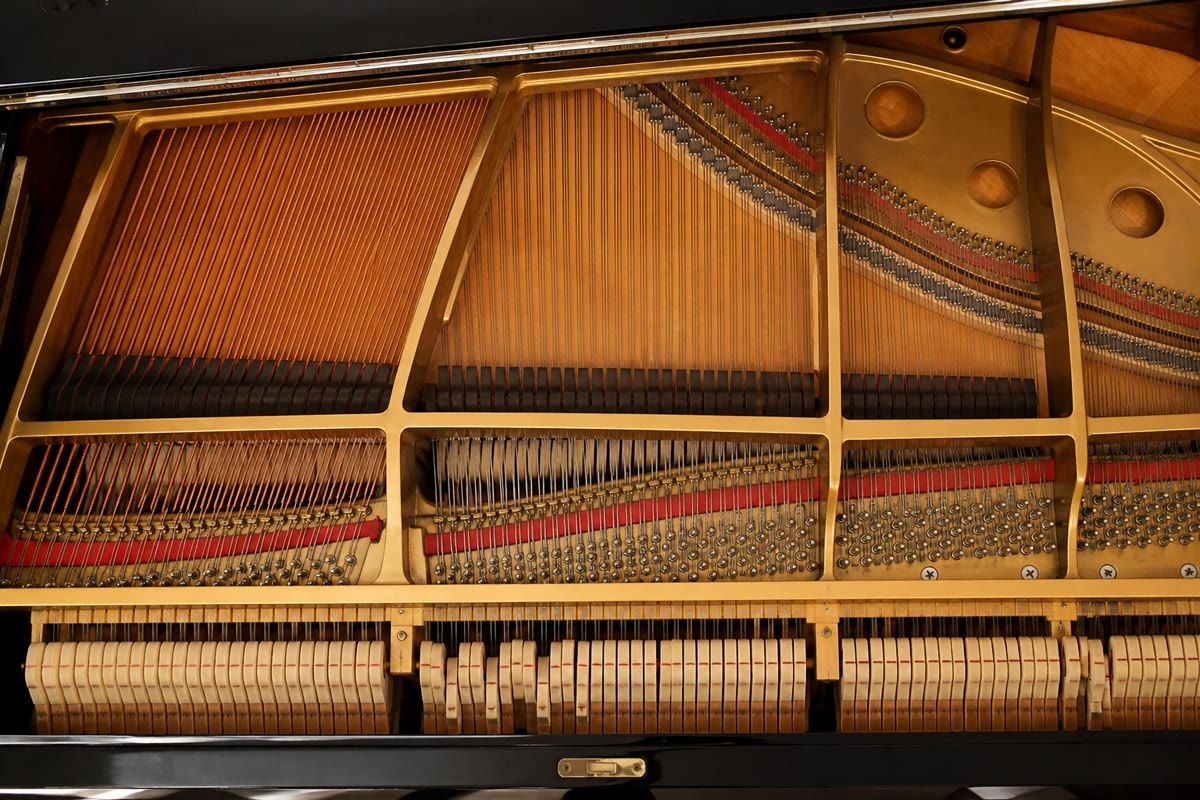
Inside a grand piano: some two hundred steel strings of graded length and thickness, each tuned by its tension to a fundamental c/2L; the bass strings are wound with copper for mass.
6.6 Problem: The piano, from the hammer to the soundboard
Problem 6.1
Weekend problem — a piano string taken apart: its tension and stiffness, the hammer’s blow and the harmonics it makes, the bridge that leaks its energy to the soundboard, and a rail that carries the same equation
Part I — The string. The A4 string of a piano (440Hz): steel, E=200GPa, ρ=7800kg/m3, diameter d=1.0mm, speaking length L=38cm. Each note above the bass has three such strings; the piano has 230 strings.
Linear mass density, wave speed and tension of the string.
Tensile stress in the wire; the wire breaks at 2.0GPa: the safety margin, and why the tuner’s last turn is the dangerous one.
Estimate the total tension on the frame, taking all strings at the same tension.
The lowest string (A0, 27.5Hz) is 1.9m long; if it were a plain steel wire at the same tension, what μ and what diameter would it need? It is in fact a steel core wound with copper: explain.
Modes of the A4 string: frequencies of the first eight harmonics; which ones lie at a consonant interval with the fundamental (octave, fifth, fourth, major third) and which do not?
The string vibrates in its fundamental with an amplitude of 0.50mm at the antinode: energy stored (the energy of a mode is 41μLω2A2).
Write the fundamental as the sum of two travelling waves; give their amplitude and the mean power each carries.
Part II — The hammer. The hammer strikes the string at x0=L/8, giving it, at t=0, a velocity v0 over a short segment of width w around x0 and no displacement.
Write the general solution y=∑nBnsin(nπx/L)sin(ωnt) and show, using the orthogonality of the sines, that Bn=Lωn2∫0Ly˙(x,0)sinLnπxdx.
For a narrow strike (w≪L/n), show Bn≈Lωn2v0wsinLnπx0.
Which harmonics are absent for x0=L/8? Why do piano makers strike near L/7 to L/8 (look at question 5)?
Describe the motion in the travelling-wave picture: what leaves the struck point, what happens at the ends, and after what time the initial state recurs.
A real string is slightly stiff: its modes are fn=nf11+Bn2 with B=π3Ed4/(64TL2) (admitted). Compute B and the sharpening of the eighth harmonic, in percent and in cents (1cent = a frequency ratio 21/1200).
Why do piano tuners "stretch" the octaves (tune high notes slightly sharp)?
Part III — The bridge and the soundboard. The string crosses a bridge glued to the soundboard; the soundboard behaves, at the bridge, like a string of impedance Zb=2000kg/s.
Impedance Zs of the string; amplitude reflection coefficient at the bridge.
Fraction of the wave’s energy transmitted to the soundboard at each reflection.
Number of reflections per second at the bridge; deduce the time constant of the energy decay and the time for the sound to fall by 60dB (a factor 106 in energy).
Power leaking into the soundboard just after the strike of question 6; compare with the power of a quiet conversation, about 1×10⁻⁵W of sound.
Why is a string alone almost inaudible, and what does the soundboard do about it? (Think of the impedance of air, ρc≈400kgm−2s−1, seen through a small surface against a large one.)
With the damper lifted, the A3 string (220Hz) starts to sound when A4 is played: why?
A piano maker wants a longer sustain: should Zb be raised or lowered, and what is lost?
Part IV — The rail. A steel rail (E=200GPa, ρ=7800kg/m3, section 70cm2).
Speed of compression waves; time for the sound of a train to travel 5km along the rail and through the air.
A hammer blow sends a compression pulse down a 25m rail section with a free end: time for the echo; is the echo a compression or a rarefaction?
An ultrasonic 2MHz probe looks for cracks: wavelength in steel; amplitude reflection coefficient at a steel–air crack (impedance of air 400kgm−2s−1); why a thin crack is seen so well.
Earthquakes: in rock, compression (P) waves travel at 6.0km/s and shear (S) waves at 3.5km/s. A station records the S wave 20s after the P wave: distance to the source.
In one table, collect the five wave speeds of this problem (string, rail, rock P, rock S, air) with the stiffness and inertia that set each one.
Solution
Solution of Problem 6.1.
1.μ=ρπd2/4=6.1g/m; c=2Lf=334m/s; T=μc2=685N.
2.σ=ρc2=0.87GPa: margin 2.3. T∝f2: a semitone sharp adds 12%, an octave too high quadruples it, 3.5GPa — it snaps.
3.230×685≈160kN, sixteen tonnes.
4.c=2Lf=105m/s; at 685N: μ=T/c2=63g/m, i.e. a steel rod of 3.2mm — far too stiff to vibrate harmonically or to bend over the bridge; a thin core wound with copper gives the mass without the stiffness.
5.440, 880, 1320, 1760, 2200, 2640, 3080, 3520Hz: 2, 4, 8 are octaves; 3, 6 a fifth above an octave; 5 a just major third above two octaves; 7 (3080/1760=1.75) is a flat minor seventh — dissonant.
7.Asinkxcosωt=21A[sin(kx−ωt)+sin(kx+ωt)]: two waves of amplitude 0.25mm; Z=μc=2.0kg/s; each carries 21Zω2(A/2)2=0.49W.
8.y˙(x,0)=∑nBnωnsin(nπx/L); multiply by sin(mπx/L) and integrate, using ∫0Lsinsin=2Lδmn.
9. The integrand is v0sin(nπx/L) over a width w around x0, where the sine is nearly constant.
10.sin(nπ/8)=0 for n=8,16,…; and since Bn/B1=sin(nπ/8)/(nsin(π/8)), the seventh harmonic is reduced to 1/7 of the first while the consonant 2 to 6 keep 0.9 to 0.3: the dissonant seventh is tamed.
11. Two velocity pulses leave the struck point in opposite directions, reflect inverted at the ends, cross and recombine; the initial state recurs after 2L/c=1/f1=2.3ms.
13. The harmonics of a low note are sharp of the exact multiples; to make them coincide with the fundamentals of the higher notes (and avoid beats), the high notes are tuned slightly sharp.
14.Zs=μc=2.0kg/s; r=(2−2000)/2002=−0.998.
15.1−r2≈4Zs/Zb=4×10−3.
16.c/2L=440 reflections per second: decay rate 440×4×10−3=1.8s−1, τ=0.56s; ln106/1.8=7.7s for 60dB.
17.1.1mJ×1.8s−1=2mW — two hundred times a quiet conversation; it is what you hear.
18. A 1mm wire pushes almost no air: the air slips round it and its radiated power is negligible. The soundboard takes the string’s energy through the bridge and moves air over a square metre: an impedance match by area.
19.440Hz is the second harmonic of A3: the bridge drives that string at one of its modes — sympathetic resonance.
20. Raise Zb: less energy leaks per reflection, the note lasts longer — and is quieter.
21.c=5.1km/s: 1.0s in the rail, 15s in air.
22.50/5064=10ms; the stress must vanish at a free end: a compression returns as a rarefaction.
23.λ=2.5mm; Zsteel=ρc=4×10⁷kgm−2s−1 against 400: r≈−1, total reflection: any open crack, however thin, returns an echo.
24.Δt=d(1/3.5−1/6)=d×0.119s/km: d=170km.
25. String 334m/s (T, μ); rail 5.1km/s (E, ρ); rock P 6km/s (compression modulus, ρ); rock S 3.5km/s (shear modulus, ρ); air 340m/s (γP, ρ — next chapter).