
সব বই

পেশাদার

1 Markets I: The Ecosystem and Exchange-Traded Marketsবাজার অনলাইন 2 Markets II: Rates, FX and Creditবাজার অনলাইন 3 Markets III: Commodities, Energy and Cryptoবাজার অনলাইন 4 Quantitative Methodsপদ্ধতি অনলাইন 5 Derivatives and Volatilityডেরিভেটিভস অনলাইন 6 Rates, Credit, XVA and Riskসুদহার, ঋণ ও ঝুঁকি অনলাইন 7 Research Craft: Predictors, Backtests, Measurement, Portfoliosগবেষণা অনলাইন 8 Strategies I: Equities and Futuresকৌশল অনলাইন 9 Strategies II: Volatility, Relative Value, Macro and the Bank Desksকৌশল অনলাইন 10 Microstructure and Executionএক্সিকিউশন অনলাইন 11 Market Making and High-Frequency Tradingমার্কেট মেকিং অনলাইন 12 Machine Learning for Marketsমেশিন লার্নিং অনলাইন 13 Low-Latency Softwareপ্রযুক্তি অনলাইন 14 Networks, Hardware and Trading Infrastructureপ্রযুক্তি অনলাইন 15 Research, Data and Risk Platformsপ্রযুক্তি অনলাইন 16 The Desk and the Firmপ্রতিষ্ঠান অনলাইন 17 The Industry: Firms, Roles and Careersক্যারিয়ার অনলাইন 18 Interviews I: Maths, Probability and Speedক্যারিয়ার অনলাইন 19 Interviews II: Markets, Trading Games and the Final Roundক্যারিয়ার অনলাইন 20 Interviews III: Codeক্যারিয়ার অনলাইন
অ্যাপ পরিচিতি Coach সাইন ইন পড়া শুরু করো

বইগুলো এখনো বাংলা ভাষায় পাওয়া যায় না — ইংরেজি সংস্করণ দেখানো হচ্ছে।

Physics · পরিভাষা

Lattice and basis কী?

Definition 23.1 University Physics — Year 3 · অধ্যায় 23 — Crystalline Solids

A crystal is a repeating arrangement: a lattice (the grid of mathematical points r→=n1a→1+n2a→2+n3a→3\vect r = n_1\vect a_1 + n_2\vect a_2 + n_3\vect a_3, integers nin_i) decorated by a basis (the atom or group hung identically on every point). The parallelepiped spanned by a→1,a→2,a→3\vect a_1, \vect a_2, \vect a_3 is a unit cell; its edge aa is the lattice constant, a few A˚\text{Å}. Three cubic stackings carry most of this course: simple cubic (points at cube corners — rare: one atom per cell); body-centred cubic (bcc: corners ++ centre, 2 atoms per cell — iron, chromium); face-centred cubic (fcc: corners ++ face centres, 4 atoms per cell — copper, aluminium, silver, gold: the densest cubic packing, filling 74 % of space). Diamond is fcc with a two-atom basis; rock salt is fcc with an Na–Cl pair.
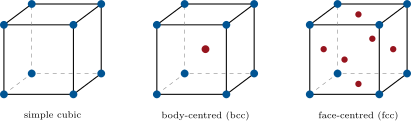
The three cubic lattices. Corner atoms are shared among eight cells, face atoms between two, the body centre by one: count them and the cells hold 1, 2 and 4 atoms respectively — the bookkeeping behind every density calculation in this chapter.

উদাহরণ

Example 23.2 (Weighing a unit cell)

Copper is fcc with a=3.61 A˚a = 3.61\,\text{Å}. Its cell holds 4 atoms of molar mass 63.5 g/mol63.5\,\mathrm{g}/\mathrm{mol}, so

ρ=4M/NAa3=4×1.055×10−25 kg4.71×10−29 m3≈8960 kg/m3,\rho = \frac{4M/N_{\text{A}}}{a^3} = \frac{4\times1.055 \times 10^{-25}\,\mathrm{kg}}{4.71 \times 10^{-29}\,\mathrm{m}^{3}} \approx 8960\,\mathrm{kg}/\mathrm{m}^{3} ,

the handbook value. Run backwards, the same arithmetic turns a measured aa and a bench-top density into NAN_{\text{A}} — the route by which X-rays first counted atoms (Exercise 23.6).

প্রসঙ্গসহ পড়ো →