University Physics — Year 3 · Bachelor Year 3
23Crystalline Solids
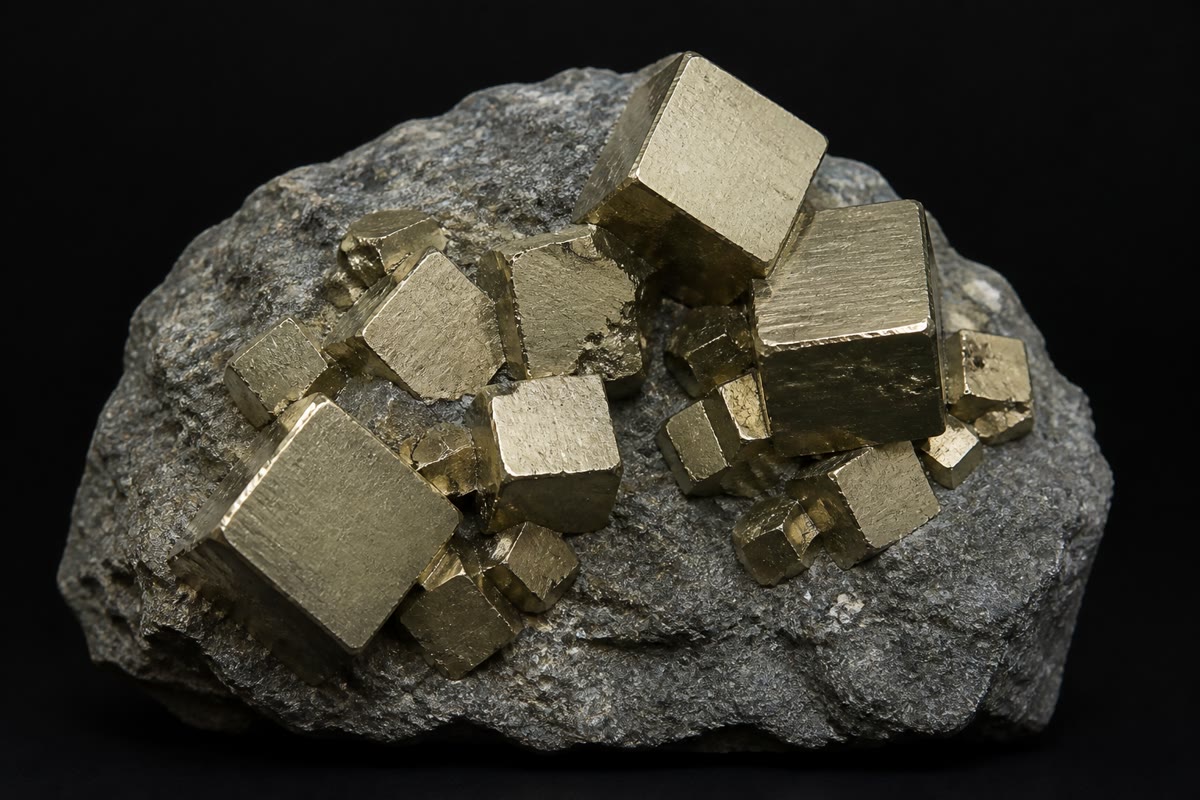
Salt grains are tiny cubes. Snowflakes insist on six branches. A jeweller can split a diamond cleanly along certain planes and no others. All three confess the same secret: beneath their surfaces, atoms are stacked in ranks that repeat, identically, billions of times over — a crystal. This chapter learns to read that order. X-rays measure it (and measured Avogadro’s number on the way); simple electrostatics and the quantum bonds of Chapter 14 explain why the stack holds together; and setting the stack vibrating recovers, from first principles, the sound waves of the Year 2 volume and the phonons of Chapter 20. The next chapter will pour electrons into this scaffolding; here we build it.
23.1 Lattices, cells, and structures
Definition 23.1 (Lattice and basis)
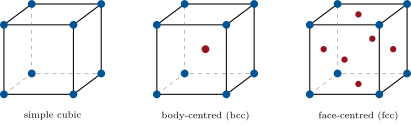
A crystal is a repeating arrangement: a lattice (the grid of mathematical points , integers ) decorated by a basis (the atom or group hung identically on every point). The parallelepiped spanned by is a unit cell; its edge is the lattice constant, a few . Three cubic stackings carry most of this course: simple cubic (points at cube corners — rare: one atom per cell); body-centred cubic (bcc: corners centre, 2 atoms per cell — iron, chromium); face-centred cubic (fcc: corners face centres, 4 atoms per cell — copper, aluminium, silver, gold: the densest cubic packing, filling 74 % of space). Diamond is fcc with a two-atom basis; rock salt is fcc with an Na–Cl pair.
Example 23.2 (Weighing a unit cell)
Copper is fcc with . Its cell holds 4 atoms of molar mass , so
the handbook value. Run backwards, the same arithmetic turns a measured and a bench-top density into — the route by which X-rays first counted atoms (Exercise 23.6).
23.2 Seeing the stack: X-ray diffraction
Proposition 23.3 (Bragg’s law)
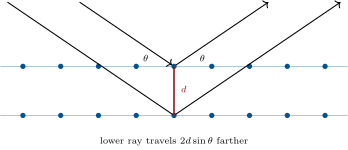
A crystal contains families of parallel atomic planes. A monochromatic X-ray beam of wavelength , striking a family of spacing at grazing angle , reflects strongly only when the waves from successive planes step in phase:
In a cubic crystal the family whose Miller indices are — planes chopping the cell edges into , , parts — has spacing , so the pattern of reflection angles fingerprints both the lattice type and its constant: crystallography in two formulas.
Proof. The ray reflecting off the lower plane travels an extra path (two grazing legs of the right triangle of depth ). Constructive interference requires it be a whole number of wavelengths. The spacing formula for cubic families is plane geometry: successive planes cut the cube edge at intervals along , etc., giving the stated . ∎
23.3 What holds it together
Proposition 23.4 (Ionic cohesion: the Madelung sum)
The cohesive energy is what it costs to take a crystal apart into far-away atoms (or ions). In rock salt each ion of charge sits among alternating neighbours; summing the whole lattice’s Coulomb energy per ion pair gives
with the nearest-neighbour distance and the Madelung constant — the geometry of the entire crystal compressed into one number (the series must be summed in expanding neutral shells; term-by-term it diverges). With this gives per pair; quantum hard-core repulsion returns , landing within a few percent of the measured (Exercise 23.7).
Proof. Admitted at this level. ∎
Remark 23.5 (The bonding quartet)
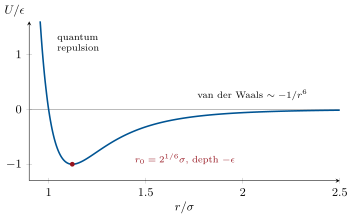
Four glues build all crystals. Ionic (NaCl): electron transfer, then Madelung electrostatics — hard, brittle, transparent insulators. Covalent (diamond, silicon): shared pairs in the directional bonds of Chapter 14 — the stiffest of all. Metallic (copper): ions bathed in delocalised electrons — the next chapter’s subject, ductile because the glue does not care which ion is where. Van der Waals (solid argon, molecular crystals): fluctuating-dipole attraction against quantum hard-core repulsion, packaged in the Lennard-Jones potential — weak (), hence noble-gas solids melt tens of kelvin above absolute zero (Exercise 23.8).
23.4 The stack vibrates: dispersion
Theorem 23.6 (Dispersion of the monatomic chain)
Model a crystal row as masses at spacing , joined by springs (the bond stiffness — the curvature of the figures above). Seeking waves in Newton’s law gives
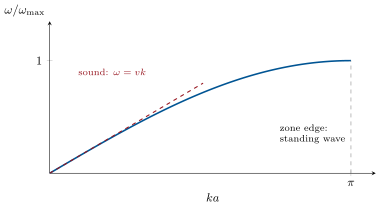
At long wavelength () this is sound, with — kilometres per second from atomic springs. But the curve bends: at the zone edge (wavelength , neighbours in antiphase) the group velocity vanishes — the wave Bragg-reflects off the very lattice carrying it — and no higher frequency propagates at all: a crystal is a low-pass filter with a terahertz cutoff. These quantised waves are the phonons whose statistics Chapter 20 already counted; the linear part of this curve is exactly what the Debye model kept.
Proof. Substituting the wave into the equation of motion: . ∎
23.5 Exercises
Exercise 23.1 ★
Cell bookkeeping. (a) Verify the atom counts: sc 1, bcc 2, fcc 4. (b) In bcc, atoms touch along the cube diagonal: express the atomic radius in terms of . (c) Same for fcc, where they touch along a face diagonal. (d) Compute the packing fractions ( and ) and state which structure metals prefer when bonding is direction-blind.
Solution
Solution of Exercise 23.1.
(a) sc: ; bcc: ; fcc: . (b) Diagonal : . (c) Face diagonal : . (d) and : direction-blind metallic bonding wants maximal packing, hence the fcc (or the equally dense hexagonal) structures of copper, aluminium, silver, gold.
Exercise 23.2 ★
Copper by the numbers. Fcc, , . Compute (a) the nearest-neighbour distance; (b) the number of nearest neighbours; (c) the density; (d) the number of atoms in a cube of interconnect wire.
Solution
Solution of Exercise 23.2.
(a) . (b) 12 — the close-packing coordination. (c) (Example 23.2). (d) , so a cubic micrometre holds atoms — why chip metallurgy is statistics, not carpentry.
Exercise 23.3 ★
First Bragg angles. Copper K X-rays () strike NaCl planes of spacing . (a) Find the first-order angle . (b) How many orders exist? (c) Why must for any reflection — and why is visible light hopeless? (d) What happens to if the crystal is warmed so that dilates by 1 %?
Solution
Solution of Exercise 23.3.
(a) : . (b) : three orders. (c) forces ; visible light’s is a thousand times too long — no crystal plane spacing can diffract it. (d) falls 1 %: . A diffractometer is a fine thermometer — and this shift is how thermal expansion is measured at the atomic scale.
Exercise 23.4 ★
Miller spacings. For a cubic crystal of constant : (a) rank the families (100), (110), (111) by spacing using . (b) Which reflects at the smallest Bragg angle? (c) Diamond cleaves along its widest-spaced, most weakly linked planes: which family? (d) Why does a powder sample (many random grains) turn Bragg spots into cones?
Solution
Solution of Exercise 23.4.
(a) . (b) Largest , smallest angle: (100). (c) The octahedral (111) family — in the diamond structure its sheets pair into strongly bonded double layers with wide, sparsely bonded gaps between: the cleaver’s plane. (d) Each grain reflects at the same but in a random azimuth: the reflected rays fan into cones of half-angle , cutting the detector in rings.
Exercise 23.5 ★★
Choosing the probe. (a) Why must any diffraction probe have ? (b) X-ray photons: what energy is that? (c) Electrons: using from the Year 2 volume’s matter waves, what accelerating voltage gives ? (d) Thermal neutrons at : show , and give one reason neutron beams see what X-rays miss (hint: X-rays scatter off electrons).
Solution
Solution of Exercise 23.5.
(a) Interference needs path differences of order ; spacings are ångströms, so must be too. (b) . (c) , (relativity shaves a few percent) — an electron microscope’s working voltage. (d) : room-temperature neutrons are born diffraction-ready. They scatter off nuclei, not electron clouds — so they see hydrogen clearly and carry a magnetic moment that maps magnetic order, both nearly invisible to X-rays.
Exercise 23.6 ★★
Counting atoms with a ruler. NaCl: density , molar mass , measured lattice constant (4 Na–Cl pairs per cell). (a) Write . (b) Solve for and evaluate. (c) Propagate a 0.1 % error in : how big an error in ? (d) Comment: the kilogram was redefined in 2019 partly through this crystal route (a silicon sphere) — why does the method demand a nearly perfect crystal?
Solution
Solution of Exercise 23.6.
(a) Four pairs per cell of volume . (b) . (c) : a 0.1 % error in is 0.3 % in . (d) The method counts atoms by assuming every cell is full and identical: vacancies, impurities and mosaic boundaries all miscount — hence the fanatically perfect silicon spheres of the kilogram redefinition.
Exercise 23.7 ★★
The Madelung ledger. (a) For the infinite NaCl row of alternating charges at spacing , show the energy per ion is — so the one-dimensional Madelung constant is . (b) With and , evaluate . (c) The Born repulsion scales as : minimising shows the net binding is — redo the estimate. (d) Compare with the measured per pair and comment on what a two-term model earned.
Solution
Solution of Exercise 23.7.
(a) Each ion sees in units of (factor 2: both sides), attractive. (b) ; . (c) Minimising kills of the attraction: . (d) Within one percent of : a point-charge lattice plus one stiffness exponent explains an ionic solid’s entire budget — the quantum mechanics hides inside and the exponent.
Exercise 23.8 ★★
Lennard-Jones argon. , . (a) Locate the minimum and compare with solid argon’s measured . (b) Estimate the melting temperature from and compare with . (c) Why do helium’s tiny mass and shallow well keep it liquid at absolute zero (Chapter 19)? (d) Why are van der Waals solids soft and volatile while diamond, with bonds three hundred times deeper, scratches everything?
Solution
Solution of Exercise 23.8.
(a) , 1.5 % above the measured (each atom also feels its twelve neighbours, tightening the well). (b) : the right scale for . (c) Helium’s zero-point energy in so shallow a well rivals the well itself: the crystal shakes itself apart, and helium stays liquid at unless squeezed. (d) Depth versus covalent per bond: three hundredfold in energy is the whole distance from frost to diamond.
Exercise 23.9 ★★
Springs from sound. (a) From Theorem 23.6, derive the sound speed . (b) A bond spring is roughly with Young’s modulus: justify by dimensional analysis of a stretched cell. (c) For copper (, interatomic, ): estimate and , and compare with the measured . (d) Why do stiff, light crystals (diamond) carry both the fastest sound and the highest Debye temperatures?
Solution
Solution of Exercise 23.9.
(a) : . (b) Stretch a cell by : stress , strain , so , i.e. . (c) , — the measured within 10 %, from a spring guessed off Young’s modulus. (d) : stiff bonds up, light atoms up — diamond maxes both, hence sound and .
Exercise 23.10 ★★★
Life at the zone edge. (a) Show the group velocity vanishes at . (b) Write the atomic displacements there () and describe the motion. (c) Interpret: the wavelength satisfies Bragg’s condition on the chain itself — the wave is its own diffraction experiment. (d) Evaluate the cutoff frequency for the copper numbers of Exercise 23.9 and place it on the electromagnetic spectrum’s scale.
Solution
Solution of Exercise 23.10.
(a) at . (b) : every atom in antiphase with both neighbours — a standing wave, energy sloshing in place. (c) With , waves scattered backwards by successive atoms differ in path by exactly one wavelength: Bragg’s condition along the chain itself. The lattice reflects its own vibration, forward and backward waves lock into the standing pattern, and the travelling wave cannot proceed. (d) , i.e. : the far infrared — lattice vibrations and infrared light meet in the same octave, the fact behind the next exercise.
Exercise 23.11 ★★★
Two atoms per cell. In a diatomic chain (masses ), the dispersion splits into an acoustic branch (neighbours in step: sound) and an optical branch (the two sublattices beating against each other), separated by a forbidden gap. (a) Why can the optical mode, in an ionic crystal, couple directly to light? (b) Estimate its frequency for NaCl (, reduced mass of the Na–Cl pair) and the corresponding wavelength. (c) Hence explain why salt, transparent in the visible, is opaque in the far infrared (reststrahlen). (d) Why does no such gap exist for the monatomic chain?
Solution
Solution of Exercise 23.11.
(a) In the optical mode the and sublattices move opposite ways: an oscillating electric dipole, exactly what a light wave grips. (b) with : , — the far infrared (salt’s measured reststrahlen band sits at : right octave from a two-spring model). (c) At that band the crystal’s own resonance absorbs and re-reflects the wave: transparent salt turns mirror-opaque. (d) One atom per cell means no second sublattice to beat against: a single branch, no gap.
Exercise 23.12 ★★★
Rebuilding Debye. The Debye model of Chapter 20 kept only up to a cutoff fitting the mode count: . (a) Justify the mode count: atoms, modes. (b) For copper (, mean sound speed ), compute and ; compare with the calorimetric . (c) Which real-dispersion feature (this chapter’s figure) does Debye’s straight line miss, and at which temperatures does that matter? (d) Explain in one sentence why and the zone-edge cutoff of Exercise 23.10 are the same physics in two outfits.
Solution
Solution of Exercise 23.12.
(a) atoms 3 displacement directions = oscillators, so the linear spectrum is cut off once it has counted modes: that defines . (b) , — the calorimetric , from a sound speed and a density. (c) The straight line misses the flattening at the zone edge: Debye over-counts high frequencies, so the fit strains at intermediate temperatures; the law (long waves only) is safe. (d) Both say the spectrum ends when the wavelength reaches the atomic spacing — one mode per atom, dressed either as a cutoff wavevector or a cutoff temperature.
23.6 Problem: The museum filing
Problem 23.1
The museum filing. A maritime museum recovers a corroded ingot from an eighteenth-century wreck and sends your laboratory a few milligrams of filings: precious metal, but which? Your powder diffractometer uses copper K X-rays, . The detector, sweeping the deflection angle , finds strong rings at , , and .
Part I — Reading the rings.
- State Bragg’s law and explain, in one sentence each, the roles of monochromatic light and of the powder’s randomly oriented grains.
- Convert the four rings to and compute for each.
- For a cubic crystal, show Bragg’s law gives .
- Divide your four values by the smallest: show the ratios are close to , i.e. over 3.
- Fcc crystals reflect only when are all even or all odd: check that , , , — sums 3, 4, 8, 11 — fit, and that the missing sums (1, 2, 5, 6, 7) confirm fcc against simple cubic.
- Why does a bcc metal (allowed sums 2, 4, 6, 8, …) show a different fingerprint — and why is this parity game, rather than absolute angles, the robust identifier?
- Explain why the rings sharpen as grains grow: what does a five-atom-wide crystallite do to a Bragg reflection?
Part II — Naming the metal.
- From each ring, compute the lattice constant via .
- Average your four values and give to three significant figures.
- With 4 atoms per fcc cell, express the density in terms of and the molar mass .
- The precious fcc candidates: silver (, ), gold (, ), platinum (, ). Compute the density your predicts for each candidate and identify the ingot.
- Gold’s lattice constant is — nearly identical to silver’s. Which single measurement in this problem separates them anyway, and why is it immune to the coincidence?
- The museum asks for a non-destructive check on the whole ingot. Propose one (density by Archimedes counts) and reconcile it with your microscopic answer.
Part III — The crystal in motion.
- Warm silver vibrates: each atom rattles around its site with (equipartition on the bond springs). Why does this not broaden the Bragg rings?
- It does weaken them: waves scattered from displaced atoms lose synchrony. State qualitatively how the intensity should behave as rises (the Debye–Waller effect).
- Estimate silver’s bond spring: with , nearest-neighbour.
- With , compute the sound-speed scale and compare with silver’s measured .
- Estimate the rms thermal displacement at from and compare it with the bond length: what fraction is it?
- Lindemann’s rule melts a crystal when that fraction reaches : check the consistency with silver melting at .
Part IV — Beyond the ingot.
- Chromium is bcc with : predict the of its first ring (family (110)) under the same X-rays.
- Why do electron microscopes diffract from surfaces and thin foils while X-rays and neutrons probe bulk? (One sentence on how strongly each couples to matter.)
- In 1952 a diffraction photograph of a pulled fibre — an X-shaped pattern of smeared spots — revealed a repeat of stacked along a helix: which molecule, and why did diffraction succeed where microscopes could not?
- The foundry melts a test piece: describe what the sharp rings become in the liquid’s diffraction pattern, and what that says about the order a liquid keeps.
- A quasicrystal diffracts sharp spots with fivefold symmetry — impossible for any repeating lattice. What does its sharp pattern nevertheless certify about its order?
- Summarise the identification in three lines: ring ratios fcc; density silver; and the crystal’s own vibrations why the museum should not ask you to X-ray it molten.
Solution
Solution of Problem 23.1.
1. . Monochromatic: one makes each ring angle map to one spacing. Powder: among random grains, some are always oriented to reflect — every family speaks at once. 2. ; . 3. Insert into Bragg (): . 4. Ratios ; times 3: . 5. All-odd and all-even , , give exactly 3, 4, 8, 11; the absent 1, 2, 5, 6, 7 rule out simple cubic, whose pattern would show them. 6. Bcc’s allowed even sums give ratios — a different rhythm. Ratios survive not knowing , wavelength drift, and sample misalignment: parity is geometry, not calibration. 7. Few planes make a blunt interference maximum, like a grating with five slits: ring width inverse crystallite size (the Scherrer relation) — sharp rings certify well-grown grains. 8. . 9. . 10. . 11. : silver (matches silver’s handbook value), gold (matches gold’s!), platinum (contradicts platinum’s 21.4 — its true is ). Platinum is out; silver and gold both survive, because their lattice constants coincide almost exactly. 12. A mass-based measurement: density (or simply molar mass). Silver and gold share to 0.2 %, but their atomic masses differ by a factor 1.8 — no lattice coincidence can bridge that. 13. Archimedes on the ingot: near silver, consistent with the corrosion (silver tarnishes; gold would have come up gleaming). Microscopic cell mass and macroscopic weighing agree — the same read in both directions. 14. The atoms rattle about unmoved average positions: the mean lattice, which fixes ring angles, is intact; random displacements only redistribute intensity. 15. Intensity falls smoothly with (a -type Debye–Waller factor), the lost light reappearing as diffuse background between rings. 16. . 17. — the measured to 20 %. 18. : rms , about 8 % of the bond length already at room temperature. 19. The 10 % mark extrapolates to against the real : right order, factor two-ish out — our single-spring is too soft, and Lindemann is a scaling rule, not a law. The lesson stands: melting is when thermal rattle rivals the lattice itself. 20. : , . 21. Coupling strength: electrons (charged) scatter in nanometres — surfaces and foils; X-rays in micrometres — bulk powder; neutrons in centimetres — whole engine parts. 22. The rings collapse into one or two broad halos: the liquid keeps short-range order (preferred neighbour distance) but no long-range register — nothing periodic left to interfere sharply. 23. DNA — Photo 51. Diffraction reads repeat distances far below any light microscope’s reach; the X pattern betrayed a helix, the smear its stacked rungs. 24. That the structure is deterministically ordered (quasiperiodic — ordered without repeating): sharp spots need long-range phase coherence, not periodicity — the discovery that widened crystallography’s own definition of a crystal. 25. Ratios fcc; density silver, not gold or platinum; and since heating fades rings and melting erases them, X-ray the ingot cold — the museum’s silver, certified by interference.