 Coach
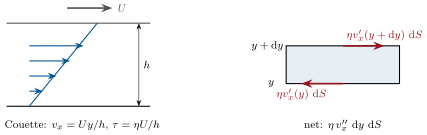
CoachIn a plane shear flow , the fluid above a surface const exerts on the fluid below it (through a surface element ) the tangential force
dragging the slower layer forward and being dragged back in return. The shear stress is ; the coefficient (unit ) is the dynamic viscosity of the fluid, and () its kinematic viscosity. A fluid for which does not depend on the shear rate is Newtonian: water, air, oils, alcohol; blood, paint, ketchup and polymer melts are not. Orders of magnitude at : air (), water (), olive oil , glycerol , honey . Liquids get thinner when heated, gases thicker.
Examples
Example 4.4 (Shear stress on a table)
A film of oil () between a plate and a table, the plate sliding at : , a force of on a tenth of a square metre — the principle of the lubricated bearing, where the viscous drag replaces dry friction a hundred times larger. Honey on a spoon, , thick, draining at : , exactly the weight of a millimetre of honey per unit area — which is why it drains at that speed.