Tip a jar of honey and it pours in a slow, thick ribbon; tip a jar of water and it is gone. Drag a spoon through each: the honey resists, and keeps resisting at any speed; the water barely notices until you move fast, and then it swirls. The difference is viscosity — the internal friction of a fluid — and the fight between viscosity and inertia, summed up in one number, Reynolds’, decides whether a flow creeps in orderly layers or tumbles into turbulence. This chapter adds the viscous force to Euler’s equation, solves the two laminar flows every engineer uses, and explains why, at high Reynolds number, viscosity hides in a thin layer at the wall and yet still costs every car, ship and aircraft most of its fuel.
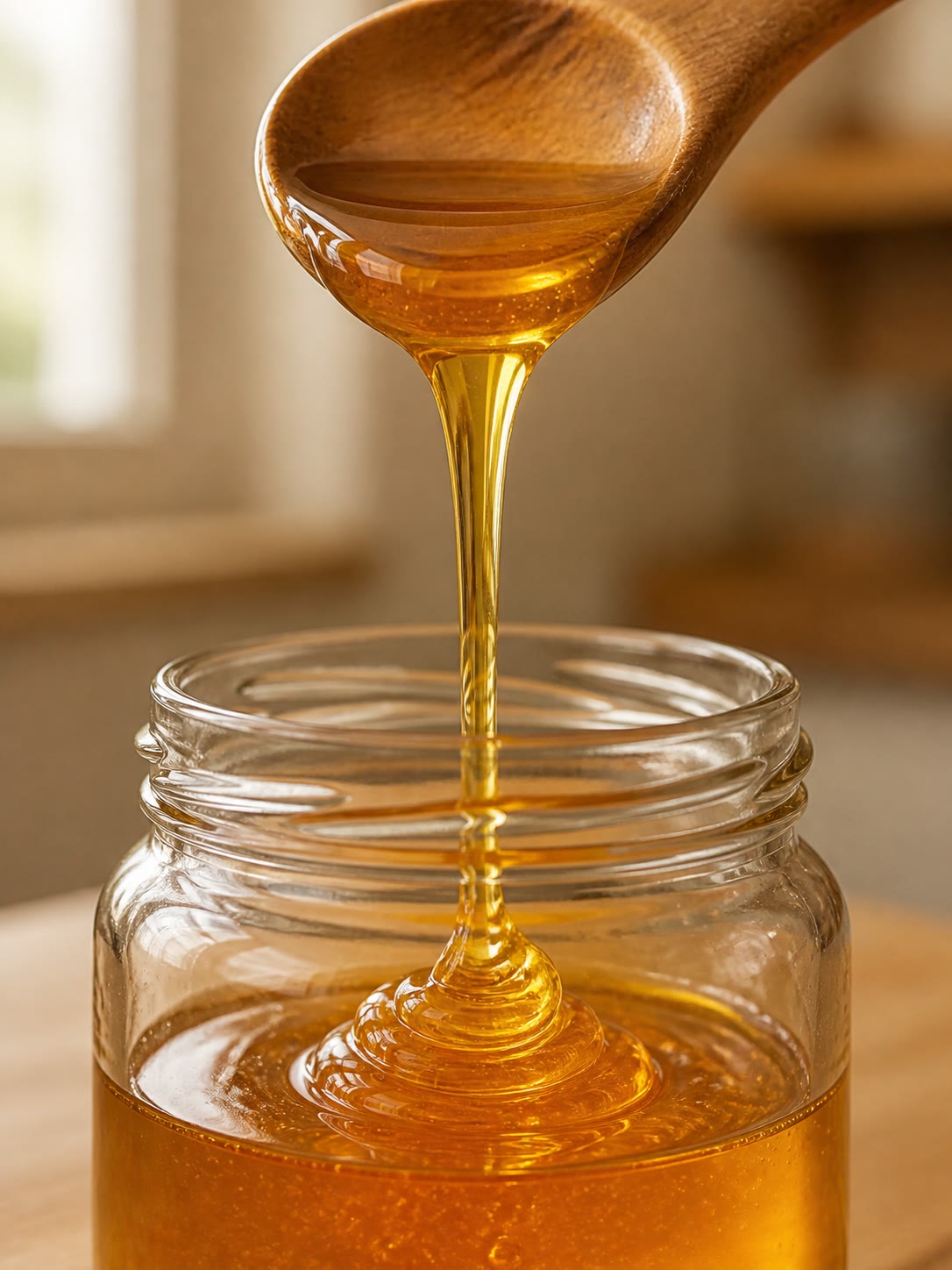
Honey pours in a thin, steady ribbon that coils as it lands: a viscosity ten thousand times that of water makes inertia irrelevant — a creeping flow.
4.1 Viscosity and the Navier–Stokes equation
Definition 4.1(Newtonian viscosity)
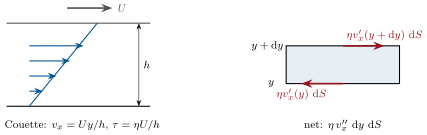
In a plane shear flow v=vx(y)ex, the fluid above a surface y= const exerts on the fluid below it (through a surface element dS) the tangential force
dF=ηdydvxdSex,
dragging the slower layer forward and being dragged back in return. The shear stress is τ=ηdvx/dy; the coefficient η (unit Pas) is the dynamic viscosity of the fluid, and ν=η/ρ (m2/s) its kinematic viscosity. A fluid for which η does not depend on the shear rate is Newtonian: water, air, oils, alcohol; blood, paint, ketchup and polymer melts are not. Orders of magnitude at 20∘C: air η=1.8×10⁻⁵Pas (ν=1.5×10⁻⁵m2/s), water 1.0×10⁻³Pas (ν=1.0×10⁻⁶m2/s), olive oil 0.08Pas, glycerol 1.5Pas, honey ∼10Pas. Liquids get thinner when heated, gases thicker.
Proposition 4.2(Viscous force density; no-slip condition)
In the plane shear flow, the net viscous force on a slab of fluid between y and y+dy is, per unit volume, ηd2vx/dy2: viscosity acts as a volume force density ηΔv (the Laplacian taken component by component), a result that holds for any incompressible flow. At a solid wall the fluid sticks: its velocity equals the wall’s (the no-slip condition), which is why dust stays on a fan blade and why a wall feels a viscous drag.
Proof. The slab is pulled by ηvx′(y+dy)dS from above and by −ηvx′(y)dS from below: net ηvx′′dydS. The general form is admitted (it follows from writing the stress as a symmetric linear function of the velocity gradients). The no-slip condition is experimental. ∎
Left: plane Couette flow between a fixed plate and a plate moving at U — a linear profile, the same shear stress on every layer. Right: the viscous forces on a slab of fluid; they cancel unless the velocity profile is curved.
Example 4.4(Shear stress on a table)
A 0.1mm film of oil (η=0.1Pas) between a plate and a table, the plate sliding at 1m/s: τ=ηU/h=1kPa, a force of 100N on a tenth of a square metre — the principle of the lubricated bearing, where the viscous drag replaces dry friction a hundred times larger. Honey on a spoon, 10Pas, 1mm thick, draining at 1mm/s: τ=10Pa, exactly the weight of a millimetre of honey per unit area — which is why it drains at that speed.
4.2 The Reynolds number
Definition 4.5(Reynolds number)
For a flow of characteristic speed U and length L, the Reynolds number
Re=ηρUL=νUL
is the ratio of the orders of magnitude of the inertial term ρ(v⋅grad)v∼ρU2/L and the viscous term ηΔv∼ηU/L2 in the Navier–Stokes equation. At Re≪1 inertia is negligible and the flow is creeping (viscous, reversible, smooth); at Re≫1viscosity is negligible except near walls and the flow is that of a perfect fluid — until, beyond a threshold of order 103 (about 2000 to 3000 in a pipe, based on the diameter), it becomes turbulent: unsteady, chaotic, full of eddies at every scale. Between the two, a flow is laminar: steady and layered.
Example 4.6(Reynolds numbers of everyday flows)
A bacterium (1µm, 30µm/s, water): Re=3×10⁻⁵ — it lives in a world without inertia, where stopping its flagellum stops it within an atomic diameter. Blood in a capillary: 10−3; a falling dust grain: 10−2; a goldfish: 103; a swimmer: 106; a car at 30m/s (4m): 8×10⁶; an airliner: 108; the Gulf Stream: 1011. Two flows with the same geometry and the same Reynolds number are similar: this is what allows a 1m model of a ship to be tested in a towing tank, or an aircraft in a wind tunnel.
4.3 Laminar flows: Couette, Poiseuille, Stokes
Proposition 4.7(Poiseuille flow in a pipe)
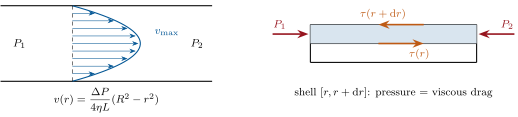
In a horizontal cylindrical pipe of radius R and length L, driven by the pressure difference ΔP=P1−P2 between its ends, the steady laminar flow is
v(r)=4ηLΔP(R2−r2),DV=8ηLπR4ΔP:
a parabolic profile, maximal on the axis, with a mean speed ⟨v⟩=vmax/2. The flow rate is proportional to the pressure drop (Poiseuille’s law) with the hydraulic resistanceRh=ΔP/DV=8ηL/πR4 — and to the fourth power of the radius. The wall shear stress is τw=ΔPR/2L=4η⟨v⟩/R. Valid while Re=2R⟨v⟩/ν≲2000.
Proof. Steady, v=v(r)ez (so the convective term vanishes: v⋅grad acts along z, along which nothing varies). Navier–Stokes along z: 0=−∂zP+ηΔv, and radially ∂rP=0: P depends on z only, Δv on r only, so both sides equal a constant, ∂zP=−ΔP/L. In cylindrical coordinates Δv=r1drd(rdrdv) (stated; it is the balance of viscous forces on a cylindrical shell, 2πrLηv′ at r and at r+dr). Integrating twice with v finite on the axis and v(R)=0 gives the parabola; DV=∫0Rv2πrdr. The wall stress is −ηv′(R); equivalently, the pressure force πR2ΔP balances the wall friction 2πRLτw. ∎
Left: Poiseuille flow — the parabolic profile in a pipe, driven by the pressure drop P1−P2. Right: the force balance on a cylindrical shell of fluid: the pressure difference on its ends is balanced by the viscous stresses on its inner and outer surfaces.
Example 4.8(The fourth power)
A syringe needle of inner diameter 0.4mm and length 3cm, water, thumb pressure 20kPa: DV=π(2×10⁻⁴)4×2×104/(8×10−3×0.03)=0.42mL/s; a needle twice as wide gives sixteen times more. An artery narrowed by a plaque to 70% of its radius offers (1/0.7)4=4.2 times its resistance: the body compensates by raising the pressure upstream, which is part of why atherosclerosis and hypertension go together.
Proposition 4.9(Stokes’ drag)
A sphere of radius R moving at speed v through a fluid at Re=2ρvR/η≪1 feels the drag
F=6πηRv,
opposite to its velocity. A sphere of density ρs falling in a fluid of density ρ reaches the terminal velocityv∞=9η2R2(ρs−ρ)g — the law of sedimentation, centrifuges, and Millikan’s oil drops.
Proof. The drag is admitted (it is the exact solution of the creeping-flow equations around a sphere, two thirds of it viscous friction, one third pressure). Terminal speed: weight minus buoyancy, 34πR3(ρs−ρ)g, equals the drag; always check Re≪1 afterwards. ∎
Example 4.10(Fog, rain and dust)
A fog droplet of 10µm diameter in air falls at 2×(5×10−6)2×10⁴/(9×1.8×10−5)=3mm/s (Re=2×10⁻³): the slightest updraft keeps it aloft, which is why clouds float. A 1mm raindrop would give 30m/s and Re≈2000: Stokes no longer applies, and the quadratic drag of the next section gives the observed 4m/s. A 10µm dust grain (ρs=2500kg/m3) settles at 8mm/s, a metre in two minutes — finer dust hangs for hours.
4.4 High Reynolds number: boundary layers and drag
Proposition 4.11(The boundary layer)
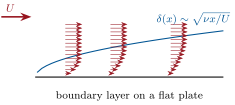
At high Reynolds number the flow around a body is that of a perfect fluid everywhere except in a thin boundary layer along the wall, in which the velocity falls from its outer value U to zero (no slip). Along a flat plate its thickness grows as
δ(x)∼Uνx=Rexx,Rex=νUx,
with x the distance from the leading edge; the layer itself turns turbulent beyond Rex∼5×10⁵. The viscous friction on the wall, and the separation of the layer behind a blunt body (which leaves a turbulent wake of low pressure), are the two sources of drag.
Proof. Order of magnitude: a fluid particle spends the time x/U travelling along the plate, during which the wall’s influence diffuses into the fluid — the viscous term ν∂2v/∂y2 is a diffusion of momentum with diffusivity ν, reaching the distance νt in the time t (Chapter 24). Hence δ∼νx/U. The full (Prandtl) theory is admitted. ∎
Proposition 4.12(Drag at high Reynolds number)
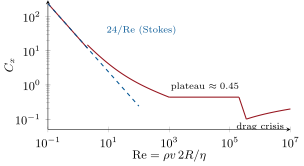
The drag on a body of frontal area S moving at v through a fluid is written
F=21ρv2SCx,
where the drag coefficientCx depends on the shape and on Re. For a sphere, Cx=24/Re at Re≪1 (Stokes, with Re based on the diameter), then about 0.4–0.5, nearly constant, from Re≈103 to 2×10⁵, where it drops suddenly to about 0.1 (the drag crisis: the boundary layer turns turbulent, sticks longer to the surface and the wake shrinks — the dimples on a golf ball trigger it early). Streamlined bodies have Cx≈0.05; a car 0.3; a cyclist 0.9; a flat plate facing the flow 1.2. The power needed to move at v is Fv∝v3.
A cyclist (SCx=0.35m2) at 10m/s: F=0.5×1.2×100×0.35=21N, P=210W — a sustained effort; at 15m/s (54km/h) it would take 710W, which is why sprinters draft. A car (SCx=0.7m2) at 130km/h: 550N, 20kW against air alone — the fuel consumption at motorway speed is mostly drag.
Remark 4.14(Surface tension)
A second force lives at the boundaries of a liquid: its free surface behaves like a stretched membrane of tension γ (N/m; water 0.072N/m), because surface molecules lack half their neighbours. The pressure inside a drop of radius R exceeds the outside pressure by the Laplace pressure2γ/R (1.4kPa in a 0.1mm drop, 14bar in a 10nm one); surface tension beats gravity below the capillary lengthγ/ρg=2.7mm for water — the size of dew drops, of the meniscus in a glass, of the rise in a capillary tube (h=2γ/ρgr, Jurin). It is why small insects walk on water, why a paintbrush’s hairs cling together when wet, and why a liquid jet breaks into drops.
Method 4.15(Which regime?)
Before any viscous-flow calculation, compute Re. Re≪1: Stokes and creeping flow, drag ∝v, pressure drops ∝ flow rate. Re up to ∼2000 in a pipe: laminar, Poiseuille. Above: turbulent — Poiseuille underestimates the loss badly; use the empirical law ΔP=λ(L/D)21ρ⟨v⟩2 with λ≈0.3/Re1/4 for smooth pipes, and F=21ρv2SCx for bodies. In every case, check afterwards that the Re computed from the answer agrees with the regime assumed.
4.5 Exercises
Exercise 4.1★
A 0.50m2 plate slides at 2.0m/s on a 0.20mm film of oil (η=0.25Pas). Shear stress, force on the plate, power dissipated; compare with dry friction (f=0.3) if the plate weighs 10kg.
Solution
Solution of Exercise 4.1.
τ=ηU/h=0.25×2/2×10−4=2.5kPa; F=1.25kN; P=Fv=2.5kW. Dry friction: 0.3×98=29N — here the thin, fast-sheared film resists far more; the viscous drag grows as U/h, so lubrication pays at lower speeds and with thicker films (and it never seizes).
Exercise 4.2★
Reynolds numbers of: (a) a 2µm bacterium at 30µm/s in water; (b) a swimmer (1.8m, 1.5m/s); (c) a car (4m, 30m/s) in air; (d) blood in the aorta (2.5cm, 0.33m/s, ν=3.3×10⁻⁶m2/s); (e) oil (η=0.1Pas, ρ=900kg/m3) at 0.5m/s in a 1cm pipe. Regime of each.
Water is pushed through a 0.40mm (inner diameter), 3.0cm needle by 20kPa. Flow rate; time to inject 5mL; maximum speed and Reynolds number; wall shear stress. With a 0.80mm needle?
Solution
Solution of Exercise 4.3.
DV=πR4ΔP/8ηL=π(2×10−4)4×2×104/(8×10−3×0.03)=0.42mL/s; 12s for 5mL. vmax=ΔPR2/4ηL=6.7m/s, ⟨v⟩=3.3m/s, Re=2R⟨v⟩/ν=1300: laminar. τw=ΔPR/2L=67Pa. At 0.8mm: sixteen times the flow, 6.7mL/s — but Re≈104: the flow turns turbulent and the gain is less.
Exercise 4.4★
Terminal speeds in air (η=1.8×10⁻⁵Pas) of (a) a 20µm pollen grain (ρs=1100kg/m3), (b) a 2µm smoke particle (ρs=2000kg/m3), (c) a 0.2mm drizzle drop. Check Re in each case; time to fall 1m.
Solution
Solution of Exercise 4.4.
v∞=2R2Δρg/9η. (a) 1.3cm/s, Re=0.02, 75s per metre. (b) 0.24mm/s, Re=3×10⁻⁵, 70min per metre. (c) 1.2m/s but Re=16: Stokes overestimates (real speed about 0.7m/s), about a second per metre.
Exercise 4.5★★
A water main of diameter 30cm carries 0.10m3/s over 1.0km. (a) Mean speed and Reynolds number. (b) Pressure drop if Poiseuille’s law applied. (c) Actual drop with λ=0.3/Re1/4; ratio to (b); pumping power. (d) The same flow in two parallel 21cm mains (same total section): drop and power.
Solution
Solution of Exercise 4.5.
(a) ⟨v⟩=0.1/0.0707=1.4m/s, Re=4.2×10⁵. (b) 8ηLDV/πR4=500Pa. (c) λ=0.3/25.5=0.0118, ΔP=0.0118×3333×1000=39kPa: 80 times more; P=ΔPDV=3.9kW. (d) Same speed, Re=3×10⁵, λ=0.0128, ΔP=0.0128×4717×1000=60kPa, 6kW: more wall per unit flow, more loss.
Exercise 4.6★★
Cells of diameter 10µm and density 1050kg/m3 in water. (a) Sedimentation speed under gravity; time to settle 5cm. (b) In a centrifuge at 1000g. (c) Minimum rotation rate for 1000g at 10cm radius. (d) Why can the largest particles be separated first?
Solution
Solution of Exercise 4.6.
(a) v=2×25×10−12×50×9.81/(9×10−3)=2.7µm/s; 5cm in 1.8×10⁴ s, five hours. (b) 2.7mm/s, 18s. (c) Ω=1000g/r=313rad/s=3000rpm. (d) v∝R2: large particles pellet first; successive spins at increasing speed separate sizes.
Exercise 4.7★★
A cyclist (SCx=0.35m2, rolling resistance 4N) rides at 12m/s. (a) Drag and total power. (b) At 15m/s. (c) Into a 5m/s headwind at 12m/s ground speed. (d) Drafting reduces Cx by 30%: power saved. (e) Descending a 5% slope with no pedalling (mass 80kg): terminal speed.
Quadratic drag. (a) Terminal speed of a golf ball (46g, 43mm, Cx=0.25) and of a skydiver (80kg, SCx=0.7m2, then 25m2 with the parachute open). (b) Equation of motion for a fall from rest with quadratic drag; show v=v∞tanh(gt/v∞). (c) Time and distance for the skydiver to reach 90% of v∞.
Solution
Solution of Exercise 4.8.
(a) Golf: 21ρCxS=2.2×10⁻⁴kg/m, v∞=0.45/2.2×10−4=45m/s; skydiver 785/0.42=43m/s; parachute 785/15=7.2m/s. (b) mv˙=mg−kv2, i.e. v˙=g(1−v2/v∞2), whose solution from rest is v∞tanh(gt/v∞). (c) tanhx=0.9 at x=1.47: t=1.47×43/9.81=6.5s; z=(v∞2/g)lncoshx=190×0.83=160m.
Exercise 4.9★★
Couette viscometer. A cylinder of radius 5.0cm and height 10cm rotates at 10rad/s inside a fixed cylinder, the gap 1.0mm being filled with the liquid to test; the torque needed is 2.0×10⁻²Nm. (a) Treating the gap as plane Couette flow, shear rate and shear stress. (b) Viscosity. (c) Reynolds number of the gap flow; is the flow laminar? (d) Why is the gap made thin?
Solution
Solution of Exercise 4.9.
(a) Shear rate ΩR/e=0.5/10−3=500s−1; Γ=τ⋅2πRh⋅R: τ=0.02/(2π×2.5×10−3×0.1)=12.7Pa. (b) η=12.7/500=2.5×10−2Pas. (c) Re=ρUe/η≈1000×0.5×10−3/0.025=20: laminar. (d) A thin gap makes the shear rate uniform (the plane approximation) and keeps the flow laminar.
Exercise 4.10★★★
A vascular network. Blood (η=3.5mPas) flows at 5.0L/min. (a) Hydraulic resistance of the aorta (radius 1.25cm, length 40cm) and pressure drop along it. (b) The 1010 capillaries (radius 4µm, length 1mm) are in parallel: resistance of one, of all, and the pressure drop across the capillary bed. (c) The arterioles (108, radius 10µm, length 2mm): same questions; where is the resistance of the circulation? (d) The total drop is 13kPa: power of the heart’s left ventricle, and what fraction of the body’s 100W. (e) A drug dilates the arterioles by 10%: effect on the total resistance.
Solution
Solution of Exercise 4.10.
DV=8.3×10⁻⁵m3/s. (a) Rh=8ηL/πR4=8×3.5×10−3×0.4/(π×2.4×10−8)=1.5×105Pas/m3, ΔP=12Pa. (b) One capillary 3.5×10¹⁶Pas/m3; 1010 in parallel: 3.5×10⁶Pas/m3; ΔP=290Pa (2mmHg). (c) One arteriole 8×3.5×10−3×2×10−3/(π×10−20)=1.8×1015Pas/m3; the set: 1.8×10⁷Pas/m3; ΔP=1.5kPa: the arterioles dominate the two (the small vessels, not the large ones, are where the pressure falls). (d) P=13000×8.3×10−5=1.1W, about 1%. (e) (1/1.1)4=0.68: a third of the arteriolar resistance removed — vasodilators lower the blood pressure this way.
Exercise 4.11★★★
Boundary layer and friction drag. A flat plate of length L and width b moves edge-on at U. In the laminar regime the wall shear stress is τw=0.332ρU2/Rex (Blasius). (a) Show that the friction force on one face is F=0.664ρU2bL/ReL. (b) Boundary-layer thickness at the trailing edge of a 1m plate in water at 0.3m/s, and the force on a 1m2 plate (both faces). (c) At 10m/s: ReL, and why the formula no longer applies. (d) A ship’s hull (100m, 10m/s): boundary-layer thickness estimate at the stern assuming the turbulent law δ≈0.37x/Rex1/5.
Solution
Solution of Exercise 4.11.
(a) F=b∫0Lτwdx=0.332ρU2bν/U∫0Ldx/x=0.664ρU2bνL/U=0.664ρU2bL/ReL. (b) ReL=3×10⁵ (laminar); δ≈5νL/U=9mm; F=0.664×1000×0.09×1/548=0.11N per face, 0.22N. (c) ReL=107: the layer is turbulent beyond the first few centimetres, the laminar formula fails (the real drag is several times larger). (d) Rex=109: δ≈0.37×100/63=0.6m.
Exercise 4.12★★★
A falling film. A liquid film of thickness h flows down a vertical wall under gravity, steadily, the air exerting no stress on its free surface. (a) Write Navier–Stokes for v=v(y)ez (y the distance from the wall, z downward) and the boundary conditions. (b) Show v(y)=2ηρg(2hy−y2) and compute the flow rate per unit width q=ρgh3/3η. (c) A fresh coat of paint (η=0.5Pas, ρ=1200kg/m3) 0.2mm thick: surface speed and flow rate; how far does the surface move in 10min? Why does paint sag when applied too thick? (d) Honey (η=10Pas) 2mm thick on a vertical spoon: surface speed.
Solution
Solution of Exercise 4.12.
(a) 0=ρg+ηv′′(y), v(0)=0 (no slip), v′(h)=0 (no stress at the free surface). (b) Integrate twice: v=(ρg/2η)(2hy−y2); q=∫0hvdy=ρgh3/3η. (c) vs=ρgh2/2η=1200×9.81×4×10−8/1=0.47mm/s; q=6.3×10⁻⁸m2/s; 28cm in ten minutes — a Newtonian paint of that thickness would run off; real paints are shear-thinning and thixotropic, and sag anyway when too thick because vs∝h2. (d) 1400×9.81×4×10−6/20=2.7mm/s.
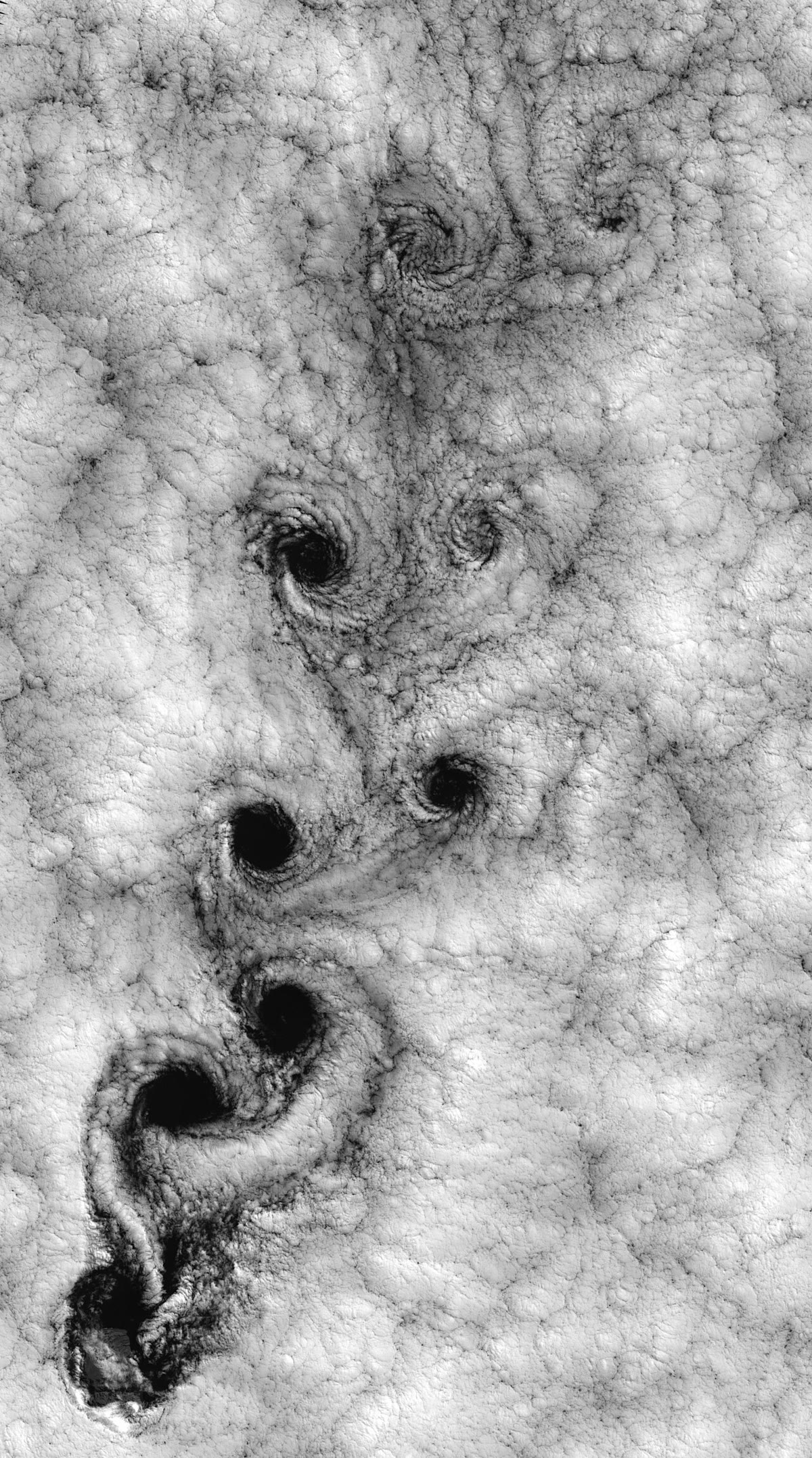
A von Kármán vortex street in the clouds downstream of an island, seen from space: the wake of a cylinder at a Reynolds number of a few hundred, drawn on the scale of a hundred kilometres (NASA).
4.6 Problem: Blood, crude oil and rain
Problem 4.1
Weekend problem — the same viscous laws in an artery, in a thousand-kilometre pipeline, and in a falling drop
Part I — Blood. Blood: ρ=1060kg/m3, η=3.5×10⁻³Pas (treated as Newtonian); cardiac output DV=5.0L/min.
If the flow in the aorta were Poiseuille’s, what would be the maximum speed and the wall shear stress? (The endothelium senses stresses of order 1Pa.)
A capillary, radius 4.0µm, carries blood at 0.30mm/s: Reynolds number; pressure drop over its 1.0mm length, in pascals and in millimetres of mercury (1mmHg = 133Pa).
Time for a red cell to cross the capillary; why is this the right order for gas exchange?
Arterioles (radius 10µm, length 2.0mm, 108 in parallel): resistance of the set and the pressure drop across it at full cardiac output.
The total arterial-to-venous drop is 13kPa: mechanical power delivered by the left ventricle. Compare with a 100W body.
A stenosis reduces the radius of a coronary artery by 40% over a short length: factor by which its resistance rises; why the heart muscle downstream may still be supplied at rest but not during effort.
During a hard effort the cardiac output reaches 25L/min: Reynolds number in the aorta, and regime.
Blood is not Newtonian: its apparent viscosity falls at high shear rate and rises at low. Which of the vessels above is most affected, and in which direction?
Part II — The pipeline. A crude-oil pipeline: diameter D=1.2m, length L=1300km, flow DV=3.0m3/s; oil ρ=850kg/m3, η=2.0×10⁻²Pas when kept warm. Turbulent friction: ΔP=λ(L/D)21ρ⟨v⟩2, λ=0.316/Re1/4.
Pressure drop per kilometre and over the whole line.
The pipe tolerates 80bar: minimum number of pump stations along the line.
Total pumping power; energy per cubic metre of oil delivered, compared with the energy content of the oil (36GJ/m3).
What drop would Poiseuille’s law predict? Comment on the cost of turbulence (and on why polymer additives that delay turbulence are injected in some pipelines).
In winter the unheated oil would reach η=2.0Pas: new Reynolds number and regime; pressure drop over the line with the appropriate law. Conclusion for the design (the real line is insulated and the oil kept warm).
Transit time of the oil from one end to the other.
Wall shear stress in the warm, turbulent case, from the pressure drop; total friction force on the pipe wall.
The same flow in a 1.0m pipe: by what factor does the turbulent pressure drop change?
A 0.10mm grain of sand (ρs=2650kg/m3) is carried in the warm oil: Stokes settling speed, Reynolds number of the grain, time to settle across the pipe. Compare with the turbulent velocity fluctuations, a few percent of ⟨v⟩: does sand settle in the running pipeline? In a stopped one?
Part III — Drops. Air: ρ=1.2kg/m3, η=1.8×10⁻⁵Pas; water ρw=1000kg/m3, γ=0.072N/m.
Cloud droplet, diameter 10µm: Stokes terminal speed, Reynolds number, time to fall 1km; why the cloud stays.
Drizzle, 0.20mm: Stokes speed and Reynolds number; is Stokes still reliable?
Raindrop, 2.0mm: show Stokes fails, and find the terminal speed with Cx=0.5. Time to fall from 1km.
In an updraft of 1cm/s, does the cloud droplet rise or fall? What updraft would hold the drizzle drop?
Laplace pressure inside the three drops; compare with the dynamic pressure21ρv∞2 for each, and explain why large raindrops flatten and break up above about 5mm.
In one table, give for the eight flows of this problem the Reynolds number and the law that governs it.
Solution
Solution of Problem 4.1.
1.S=4.9cm2, ⟨v⟩=83/4.9=0.17m/s; Re=1060×0.17×0.025/3.5×10−3=1300: laminar (pulsatile peaks reach ∼5000).
4.1/0.3=3.3s: long enough for oxygen to diffuse the few micrometres to the tissue (Chapter 24).
5. One arteriole 8ηL/πR4=1.8×1015Pas/m3; 108 in parallel: 1.8×10⁷Pas/m3; ΔP=1.8×107×8.3×10−5=1.5kPa=11mmHg.
6.P=ΔPDV=13000×8.3×10−5=1.1W, about 1% of the body’s power.
7.(1/0.6)4=7.7. At rest the vessels downstream dilate and compensate; during effort the demand rises four- or fivefold and the narrowed artery cannot deliver it: angina.
8. Five times the speed: Re≈6500, turbulent — the murmurs a stethoscope hears during exercise.
9. In the slow, low-shear flow of small veins and capillaries the red cells aggregate and the apparent viscosity rises (the opposite in the fast aorta); all the pressure-drop estimates for small vessels are lower bounds.
11.λ=0.316/19.2=0.0165; ΔP/L=(0.0165/1.2)×21×850×7.0=41Pa/m=41kPa/km; 534bar over the line.
12.534/80=6.7: at least seven stations.
13.P=ΔPDV=5.34×107×3=160MW; 53MJ/m3, 0.15% of the oil’s energy.
14.ΔP=32ηL⟨v⟩/D2=32×0.02×1.3×106×2.65/1.44=15bar: thirty-five times less. Turbulence is expensive; a few parts per million of long polymers delay it and cut the drop by tens of percent.
15.Re=1350: laminar; Poiseuille: ΔP=32×2×1.3×106×2.65/1.44=1500bar — impossible; the oil must be kept warm, hence the insulation and heating.
16.1.3×106/2.65=4.9×105s=5.7days.
17.τw=(ΔP/L)D/4=41×0.3=12Pa; F=τwπDL=6×10⁷N.
18.ΔP∝λ⟨v⟩2/D∝D−4.75: 1.24.75=2.4.
19.v=2R2Δρg/9η=2×2.5×10−9×1800×9.81/0.18=0.49mm/s; Re=2×10⁻³; 41min to cross 1.2m. Turbulent fluctuations of a few centimetres per second keep it suspended while the oil runs; in a stopped line it settles in under an hour.
20.v=2×2.5×10−11×1000×9.81/1.62×10−4=3.0mm/s; Re=2×10⁻³; 1km in 3.3×10⁵ s, four days: any updraft above a few millimetres per second holds it.
21.1.2m/s, Re=16: Stokes overestimates by about a factor two (real: 0.7m/s).
22. Stokes would give 120m/s and Re∼104: absurd. Quadratic drag, 34πR3ρwg=21ρv2πR2Cx: v=8Rρwg/3ρCx=6.6m/s (Re=900, consistent); 150s from 1km.
23.1cm/s>3mm/s: the droplet rises; the drizzle drop needs about 1m/s, which convective clouds provide.
24.2γ/R: 29kPa, 1.4kPa, 144Pa; dynamic pressures21ρv2: 5×10⁻⁶, 0.3 and 26Pa. The ratio reaches 0.2 at 2mm; at 5mm (v≈9m/s, 21ρv2=49Pa against 58Pa) the aerodynamic pressure flattens the drop and breaks it: no raindrop exceeds about 5mm.