Physics · Glossary

What is Phase portrait?

Definition 13.14 University Physics — Year 1 · Chapter 13 — Work, Energy, and Potential Energy

The phase portrait of a one-dimensional motion is the family of curves traced by the point (x,x˙)(x, \dot x) in the phase plane. For a conservative system each curve is a level line 12mx˙2+Ep(x)=Em\tfrac12 m\dot x^2 + E_p(x) = E_m: closed curves around stable equilibria (oscillations), open curves for free motion, and, through unstable equilibria, the separatrices that divide the two. Curves are traversed clockwise (x˙>0\dot x > 0 means xx increasing) and never cross.

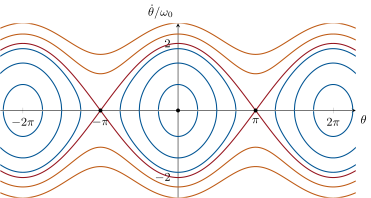
Phase portrait of the simple pendulum, 1/2 2 + _02(1 - ) = const. Closed curves (blue): swings about the stable equilibrium = 0; open curves (orange): full rotations; between them the separatrix (red) through the unstable equilibria = ±π, the motion that just reaches the top.
Phase portrait of the simple pendulum, 12θ˙2+ω02(1cosθ)=const\tfrac12\dot\theta^2 + \omega_0^2(1 - \cos\theta) = \text{const}. Closed curves (blue): swings about the stable equilibrium θ=0\theta = 0; open curves (orange): full rotations; between them the separatrix (red) through the unstable equilibria θ=±π\theta = \pm\pi, the motion that just reaches the top.

Examples

Example 13.15 (The pendulum’s landscape)

Ep=mgcosθE_p = -mg\ell\cos\theta: minimum at θ=0\theta = 0, Ep=mgE_p'' = mg\ell, so ω02=g/(m2)=g/\omega_0^2 = g\ell/(m\ell^2) = g/\ell — the small-oscillation result of Example 12.12 read off the well’s curvature; maximum at θ=π\theta = \pi, the inverted pendulum, unstable. Energy Em<mgE_m < mg\ell: oscillation between ±θmax\pm\theta_{\max}; Em>mgE_m > mg\ell: it goes over the top and rotates; Em=mgE_m = mg\ell: the separatrix, an infinitely slow approach to the top.

Read in context →