 Coach
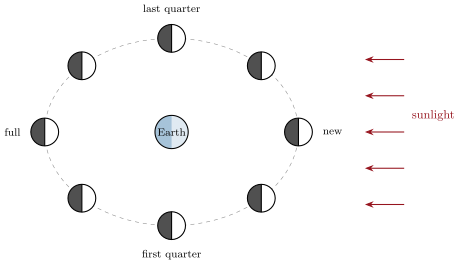
CoachThe phases of the Moon are its apparent shapes through the month: new moon (day side turned fully away — we see nothing), crescent, first quarter (half the disc lit), gibbous (more than half), full moon (day side turned fully toward us), then gibbous, last quarter and crescent again, closing the cycle in about days. From new to full the lit part grows night by night: the Moon is waxing; from full back to new it shrinks: waning.
Examples
Example 51.5 (Eclipse versus phase)
Keep the two Moon-darkenings in separate drawers. Phase: the slow monthly cycle, the Moon’s own night side turning toward us — no shadow of ours involved. Lunar eclipse: a rare hour when the full Moon crosses our umbra — the Earth’s shadow genuinely falling on it, coppery and swift. The diary’s rhythm is a view; the eclipse is a visit.
Example 51.6 (Where the phases keep their hours)
The diagram fixes each phase to a position — and each position to a schedule. The full Moon stands opposite the Sun: it must rise at sunset, reign all night, and set at sunrise. The new Moon travels with the Sun: up all day, lost in glare — which is why nobody “sees” a new moon. First quarter trails the Sun by a quarter turn: it rises near midday and sets near midnight — the after-dinner Moon. The old daytime-Moon surprise of your childhood is now a timetable: any Moon not new nor full shares part of its shift with the Sun.
Example 51.7 (Which way does the crescent point?)
The lit side of any phase faces the Sun — the crescent is a bow aimed at its archer. Evening crescent in the west: horns pointing up-and-away from the sunset glow beneath the horizon. The sky never draws it wrong; painters often do. A crescent with its horns toward the Sun is astronomy’s favorite spot-the-error.