Primary & Middle School Physics · Grades 1–9
51Phases of the Moon
Years ago you kept a Moon diary and watched the silver shape march from crescent to full and back, promised the “why” for later. Later is now. You own everything the explanation needs: a Moon that orbits monthly, sunlight in straight lines, and a sphere that is always — always — half lit.
51.1 The one fact underneath
Proposition 51.1 (Half-lit, always)
The Sun lights one half of the Moon at every moment — the half facing it — exactly as it lights half the Earth. The Moon has no changing shape, no growing and shrinking: it is a stone ball wearing a permanent day side and a permanent night side, the boundary sliding as it orbits. Everything we call a “phase” is merely the view: how much of the day side happens to face the Earth.
Definition 51.2 (Phases)
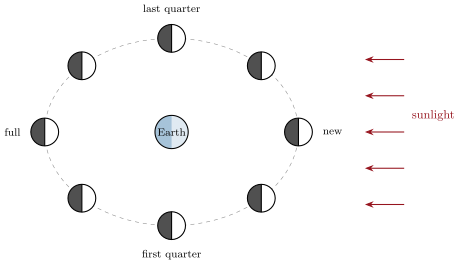
The phases of the Moon are its apparent shapes through the month: new moon (day side turned fully away — we see nothing), crescent, first quarter (half the disc lit), gibbous (more than half), full moon (day side turned fully toward us), then gibbous, last quarter and crescent again, closing the cycle in about days. From new to full the lit part grows night by night: the Moon is waxing; from full back to new it shrinks: waning.
Method 51.3 (Be the Earth, hold the Moon)
The explanation, performed in one minute:
- in a dark room, a single bare lamp is the Sun; you are the Earth; a white ball on your outstretched hand is the Moon;
- face the lamp, ball toward it: the ball’s lit half faces away from you — you see its dark side: new moon;
- turn slowly on the spot (the ball orbiting you): a lit sliver appears at the ball’s edge — waxing crescent; after a quarter turn, half the ball shows lit: first quarter;
- keep turning: gibbous — then, lamp at your back, ball fully lit before you: full moon; complete the turn through waning half and crescent to new.
One turn of yourself replays one month of sky.
51.2 The misconception, retired
Proposition 51.4 (Phases are not the Earth’s shadow)
The most popular wrong answer in astronomy: “the phases are the Earth’s shadow on the Moon.” Geometry refutes it three ways. The Earth’s shadow points away from the Sun — it can only touch a Moon standing opposite the Sun, which happens solely at full moon (and then only at rare eclipses). A crescent Moon stands sunward of us, nowhere near our shadow. And the shadow’s edge on the Moon is always part of a large circle — it could never carve the gibbous shape’s double-curved boundary. The phases need no shadow: a half-lit ball, seen from different sides, does everything.
Example 51.5 (Eclipse versus phase)
Keep the two Moon-darkenings in separate drawers. Phase: the slow monthly cycle, the Moon’s own night side turning toward us — no shadow of ours involved. Lunar eclipse: a rare hour when the full Moon crosses our umbra — the Earth’s shadow genuinely falling on it, coppery and swift. The diary’s rhythm is a view; the eclipse is a visit.
51.3 Reading the sky like a clock
Example 51.6 (Where the phases keep their hours)
The diagram fixes each phase to a position — and each position to a schedule. The full Moon stands opposite the Sun: it must rise at sunset, reign all night, and set at sunrise. The new Moon travels with the Sun: up all day, lost in glare — which is why nobody “sees” a new moon. First quarter trails the Sun by a quarter turn: it rises near midday and sets near midnight — the after-dinner Moon. The old daytime-Moon surprise of your childhood is now a timetable: any Moon not new nor full shares part of its shift with the Sun.
Example 51.7 (Which way does the crescent point?)
The lit side of any phase faces the Sun — the crescent is a bow aimed at its archer. Evening crescent in the west: horns pointing up-and-away from the sunset glow beneath the horizon. The sky never draws it wrong; painters often do. A crescent with its horns toward the Sun is astronomy’s favorite spot-the-error.
Remark 51.8 (The face that never turns away)
One more diary observation, finally honored: the Moon’s dark patches form the same face every night, phase after phase, year after year. The Moon turns exactly once on its axis per orbit — so the same half faces the Earth forever. No one saw the far side until a space probe flew around with a camera within living memory of your grandparents. Why the turning and the orbiting agree so perfectly is a deep story of tides, kept for the university years of this course.
51.4 Exercises
Exercise 51.1 ★
What fraction of the Moon is sunlit at any moment? What, then, is a “phase”?
Solution
Solution of Exercise 51.1.
Exactly half, always — the sunward half. A phase is only the view: the fraction of that lit half which happens to face the Earth.
Exercise 51.2 ★
Recite the phases in order from new moon, and give the cycle’s length. Which half of the cycle is “waxing”?
Exercise 51.3 ★
In the orbit-walk method, where are lamp, ball and you at new moon? At full moon?
Solution
Solution of Exercise 51.3.
New moon: you face the lamp with the ball toward it — its lit half turned away from you. Full moon: lamp at your back, ball before you — its lit half turned fully toward you.
Exercise 51.4 ★
Give two of the three geometric refutations of “the phases are the Earth’s shadow”.
Exercise 51.5 ★
What is the difference between the new moon’s darkness and a lunar eclipse’s darkness?
Solution
Solution of Exercise 51.5.
The new moon is dark to us because its own night side faces us — no shadow of ours involved, and the far side is in full sunshine. The lunar eclipse is the full Moon crossing the Earth’s real umbra: our shadow genuinely falling on it, briefly.
Exercise 51.6 ★
Why does the full Moon always rise near sunset? Argue from its position in the diagram.
Exercise 51.7 ★
Why does nobody ever “see the new moon rise at midnight”? Where is the new moon at midnight?
Solution
Solution of Exercise 51.7.
The new moon travels with the Sun: at midnight both stand under your feet, on the far side of the Earth. A new moon at midnight is as impossible as the Sun at midnight.
Exercise 51.8 ★
An evening crescent hangs in the west. Which way do its horns point relative to the vanished Sun — and why can a crescent never aim its horns at the Sun?
Exercise 51.9 ★★
Tonight the Moon is waxing gibbous. Where in its orbit does it stand? Roughly when did it rise, and what phase — and what schedule — comes five nights later?
Exercise 51.10 ★★
A solar eclipse can only happen at one phase, a lunar eclipse only at another. Name both, justify with the alignment geometry, and explain why eclipses are nevertheless rare at those phases.
Solution
Solution of Exercise 51.10.
Solar eclipse: only at new moon — Sun–Moon–Earth in line. Lunar: only at full moon — Sun–Earth–Moon in line. Rare even then, because the Moon’s tilted orbit usually carries it above or below the exact line: phase is necessary, alignment is not guaranteed.
Exercise 51.11 ★★
Astronauts on the near side of the Moon look up at the Earth. Describe what “Earth-phases” they see through a month, and what phase the Earth shows them when we see a new moon. (Run the geometry both ways.)
Exercise 51.12 ★★★
The old crescent’s secret: on clear evenings, the crescent Moon’s dark part glows faintly — “the old moon in the new moon’s arms”. Your grade-two self met this as a riddle; solve it now completely: trace the light’s path, explain why earthshine is brightest precisely at crescent phases (what phase does the Earth show the Moon then?), and why it fades toward full moon.
Solution
Solution of Exercise 51.12.
Path: sunlight strikes the Earth, the bright Earth diffuses it moonward, the Moon’s night side diffuses a little back to our eyes — sunlight twice forwarded. At our crescent phases the Moon sees a nearly full Earth (the opposite-phase rule): the night side is floodlit by the brightest Earth possible — strongest earthshine. Toward our full moon the Moon sees a thin crescent Earth: the floodlight dwindles, and full-phase glare drowns what remains.
51.5 Problem: A Month with the Moon
Problem 51.1
Weekend problem — the observatory’s open month; thirty nights of Moon, one wall-chart; the docent’s quiz
The town observatory runs a public “Month with the Moon”. As junior docent, you keep the wall-chart and answer the visitors.
Part I — Setting up the chart.
- Night 0 is new moon. Fill the chart’s milestones: on about which nights fall first quarter, full moon, and last quarter?
- Beside each milestone, the chart wants rise-times. Match: rises at sunset; rises near midday; rises near midnight; rises and sets with the Sun.
- A visitor asks why the chart shows the crescent low in the western evening sky but the full moon climbing from the east at dusk. Explain with orbit positions.
- Another visitor swears they saw the Moon at ten in the morning. Which chart phases make a morning Moon possible?
Part II — The docent’s demonstrations.
- You perform the lamp-and-ball walk for a school group. A pupil freezes you mid-turn: the ball shows three-quarters lit. Name the phase, and locate lamp, Earth-you and ball for the group.
- “So the Earth’s shadow makes the phases?” asks the pupil, pointing at your dark-sided ball. Give the demonstration’s own refutation: whose night side are they seeing, and where would the Earth’s shadow actually be?
- The group asks why they always see “the rabbit” (or “the face”) in the Moon, never its back. Answer with the same-face fact.
- A skeptical parent: “If the Moon spins, as you claim, shouldn’t we see it turn?” Resolve the apparent contradiction: how can the Moon spin exactly once per orbit and thereby hide its spin from us?
Part III — Quiz night.
- Quiz card A: “Tonight’s Moon rose at midnight and shows its left half lit (as seen going toward morning). Waxing or waning — and which quarter?”
- Quiz card B: “An artist’s poster shows a crescent Moon at midnight, high overhead, horns pointing straight down at the sunset colors on the horizon.” List every astronomical error on the poster.
- Quiz card C: “During tonight’s full moon, could visitors also witness a solar eclipse somewhere on Earth?” Settle it with phase geometry.
- Closing speech: in three sentences, give the month’s one underlying fact, the misconception the month buried, and the schedule trick visitors should carry home (what any phase tells about its rising hour).
Solution
Solution of Problem 51.1.
1. First quarter near night ; full moon near night ; last quarter near night (the cycle closing near night –). 2. Full moon: rises at sunset. First quarter: rises near midday. Last quarter: rises near midnight. New moon: rises and sets with the Sun. 3. The young crescent stands only a little behind the Sun on the orbit: it hangs in the west after sunset and soon follows the Sun down. The full moon stands opposite: as the Sun sets in the west, opposite means rising in the east. 4. Any phase sharing part of the Sun’s shift: the waxing gibbous through afternoon, and above all the waning phases — last quarter and waning crescent ride high in morning skies. 5. Waxing gibbous: the ball three-quarters lit means you stand between first quarter and full — lamp behind your shoulder, ball ahead and to the side. 6. They are seeing the ball’s own night side — the half turned from the lamp. The Earth-you casts a shadow too, but it stretches behind you, away from the lamp; the ball is nowhere in it except at the full-moon position — and then only if exactly aligned: an eclipse, not a phase. 7. The Moon turns exactly once per orbit, so the same half faces the Earth forever — rabbit, face and all; the far side waited for a camera to fly around. 8. Spin and orbit keep perfect step: as the Moon advances along its path, it turns just enough to keep the same face pointed at us — like a dancer circling a partner while always facing them: truly spinning (the room sees every side), yet showing the partner one face only. 9. Rising at midnight is the last-quarter schedule — the waning side: last quarter (the lit half faces the morning Sun’s direction). 10. Errors: a crescent stands near the Sun, so it can never ride high at midnight; horns point away from the Sun, never at it; and sunset colors at midnight are their own impossibility. Three strikes. 11. No: a solar eclipse requires the Moon between Sun and Earth — the new-moon position. Tonight’s Moon stands at full, on the opposite side: the two events cannot share a night. 12. For example: “One fact runs the month: the Moon is always half lit, and we circle-watch that half from changing sides. Buried this month: the Earth’s shadow has nothing to do with phases — it visits only at rare eclipses. And take the clock home: every phase keeps its own rising hour — full at sunset, quarters at midday and midnight — so the Moon’s shape tells you its schedule.”