Coach
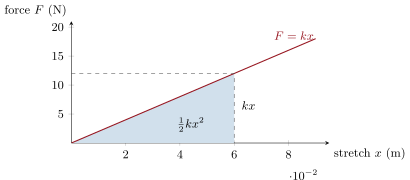
CoachTo every conservative force one attaches a potential energy , a number depending on position alone, defined by : work delivered is potential energy spent. Fixing at a chosen reference point fixes it everywhere; the choice shifts all values by a constant that cancels from every difference. For the weight this gives back last year’s , now valid along any path. Friction can own no : a route-dependent bill is no difference of endpoint numbers — only conservative forces store retrievably, exactly what the name conserves.