High School Physics · Grades 10–12
29Work and Mechanical Energy
Tip a marble into a salad bowl: it dives, overshoots the bottom, climbs to its starting height, hesitates, turns back — and every reversal can be predicted from one curve (the bowl’s profile) and one horizontal line (the marble’s energy), no equation of motion solved. Last year priced forces on straight lines (Chapter 17) and balanced kinetic against potential energy (Chapter 18); this year the bookkeeping goes everywhere: curved paths, springs, landscapes at a glance.
29.1 Work along any path
Definition 29.1 (Work along a path)
Let a force act on a body moving along any path from to : cut the path into displacements so short that each is straight and barely changes along it. Each step earns the small work (Chapter 17), and the work along the path is their sum, — which on a straight path with constant force collapses to last year’s .
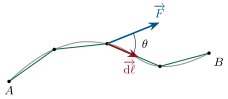
Proposition 29.2 (Work of the weight, any path)
Along any path from (altitude ) to (altitude ), the weight of a mass does the work : the drop enters, never the route.
Proof. Each short step contributes (last year’s straight-segment computation); the drops telescope to . The curved case, admitted then, is delivered. ∎
Definition 29.3 (Conservative and non-conservative forces)
A force is conservative if its work between two points is the same along every path (zero on every round trip), non-conservative otherwise. Weight and spring force (next section): conservative. Sliding friction is not: opposite the motion, it does on a path of length — a toll per metre, never refunded.
Example 29.4 (Two trails to the hut)
A hiker gains by a steep trail or of switchbacks. The weight charges on both; a friction force, on one, on the other. The weight refunds on the descent; friction’s bill is gone as heat, both ways.
29.2 Potential energy
Definition 29.5 (Potential energy)
To every conservative force one attaches a potential energy , a number depending on position alone, defined by : work delivered is potential energy spent. Fixing at a chosen reference point fixes it everywhere; the choice shifts all values by a constant that cancels from every difference. For the weight this gives back last year’s , now valid along any path. Friction can own no : a route-dependent bill is no difference of endpoint numbers — only conservative forces store retrievably, exactly what the name conserves.
Proposition 29.6 (Elastic potential energy)
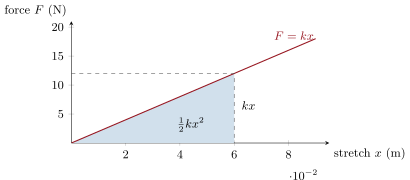
A spring of stiffness () stretched or compressed by pulls back with the force (Chapter 28); the work it delivers returning to rest — its elastic potential energy — is .
Proof. The restoring force acts along the motion, so is the area under the – graph: a triangle of base and height , area . The force at each stretch is the same out and back: work fixed by the endpoints, spring force conservative, well defined. ∎
29.3 The two energy theorems
Theorem 29.7 (Kinetic-energy theorem)
For any motion of a body of mass from to — curved, looped, three-dimensional —
the sum running over all forces acting on the body.
Proof. Since , the product rule of this year’s mathematics gives the derivative of as , so by Newton’s second law (Chapter 25). In a short the body moves : gains the small work of Definition 29.1; summing the steps sums the works — last year’s admitted statement, earned in full. ∎
Proposition 29.8 (Instantaneous power)
At every instant a force on a body of velocity delivers the power , and is the sum of the powers of all forces: last year’s constant-velocity formula, exact at each instant of any motion.
Proof. Read off the previous proof: each force feeds into during . ∎
Theorem 29.9 (Mechanical-energy theorem)
Let , where collects the potential energies of all the conservative forces at work. Then, along any path,
and is conserved whenever the non-conservative forces do no work.
Proof. Split the kinetic-energy theorem: ; move across. ∎
Example 29.10 (The pendulum, honestly this time)
A pendulum bob on a wire of length is released at rest at from the vertical. The tension, perpendicular to the motion, is powerless; the weight is conservative: is conserved on the curved arc, which last year could only be checked. The bob starts up, so at the bottom .
Method 29.11 (Energy audit of any motion)
- Choose the system and list the forces on it.
- Sort: perpendicular to the motion no work; conservative an in ; the rest (sliding friction: , = path length).
- Write between the data point and the question point; solve. Energy answers “how fast, how high”; only time and acceleration need Newton’s laws.
29.4 Energy diagrams
Definition 29.12 (Energy diagram, turning points)
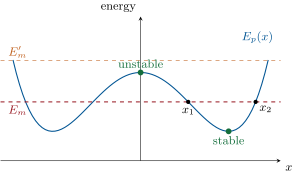
For a motion along one axis with conserved , the energy diagram plots the curve and the horizontal line . Since , the motion is confined to where the curve lies below the line; the gap between them is , read directly. At a turning point, where curve meets line, and the motion reverses.
Proposition 29.13 (Force from the landscape; equilibria)
The conservative force along is minus the slope of : — it points downhill on the diagram, and vanishes where the tangent is horizontal: an equilibrium. A minimum of is stable — the displaced body is pushed back, a ball in a valley; a maximum is unstable — it is pushed away, a ball on a hilltop.
Proof. On a small step the force works ; divide by . Downhill on either side of a valley points back in; around a hilltop, out. ∎
Remark 29.14 (Oscillations and escape)
The small oscillations of Chapter 28 live at the bottoms of valleys. And far from Earth gravity weakens: the curve climbs ever more slowly toward a finite ceiling (the area under the shrinking force-graph is finite). A rocket whose reaches the ceiling never meets a turning point: it escapes — about from the ground (Exercise 29.13); below that it is bound. The ceiling itself is computed in the Year 1 volume.
Example 29.15 (Loop-the-loop)
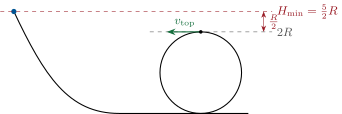
A marble released from height coasts into a vertical loop of radius . Circular dynamics (Chapter 25) demands at the top — the datum borrowed by last year’s roller-coaster problem, now ours. Conservation from rest at to the top (height ) gives , so : half a radius above the loop top, whatever the mass — a little more in the real, rubbing world.
29.5 Exercises
Exercise 29.1 ★
A spring of stiffness is stretched by . Compute the stored energy; what does it become if the stretch doubles? How much does the second cost?
Solution
Solution of Exercise 29.1.
. Doubled stretch: , i.e. . The second alone costs — the force is larger there.
Exercise 29.2 ★
A drone flies a wandering route from a terrace at to a balcony at . Work of its weight? Along the straight climb? On the round trip?
Solution
Solution of Exercise 29.2.
, whatever the route — the same on the straight climb. Round trip: (conservative force).
Exercise 29.3 ★
Conservative, non-conservative, or workless? Justify from paths: (a) the weight; (b) the spring force; (c) sliding friction; (d) the normal force on a sliding box; (e) air drag.
Solution
Solution of Exercise 29.3.
(a), (b) conservative: work fixed by the endpoints (drop of altitude; stretch). (c), (e) non-conservative: and drag charge per metre travelled. (d) workless: always perpendicular to the motion.
Exercise 29.4 ★
A pendulum of length is released at rest at from the vertical. Find its speed at the lowest point. Why does the wire’s tension never enter the balance?
Exercise 29.5 ★
A cyclist rides at on the flat, delivering : what total resistive force is she fighting? Climbing at with the same power: what force does she overcome?
Solution
Solution of Exercise 29.5.
. At : (mostly the slope’s gravity component).
Exercise 29.6 ★★
A toy launcher’s spring () is compressed by behind a dart. Find the stored energy, the launch speed, and the height reached if fired straight up (no air).
Solution
Solution of Exercise 29.6.
; ; .
Exercise 29.7 ★★
Stretching a rubber band, a student measures , , , , at , , , , . Estimate the stored energy by trapezoidal areas; compare with , taking at the end. Why do they differ?
Solution
Solution of Exercise 29.7.
Trapezoids ( steps): . Straight-line model: , . The measured curve sags below the straight line at small , so the true area is smaller.
Exercise 29.8 ★★
A sledder starts at rest, drops along a curved run, arrives at . Mechanical energy lost? Average friction force? Why is the run’s exact shape irrelevant?
Solution
Solution of Exercise 29.8.
; . Weight conservative, normal force workless: only the drop and the path length enter, not the shape.
Exercise 29.9 ★★
A marble track has a loop of radius . Find the minimum release height (from rest, no friction). Released from : speed at the loop top, and ratio ? Why must a real track be launched from higher still?
Exercise 29.10 ★★
A bead slides without friction along an axis, with (joules, in metres) and . Turning points? Maximum speed? What kind of motion is this?
Solution
Solution of Exercise 29.10.
Turning points: , . Maximum speed at : . A back-and-forth oscillation in a parabolic well — the mass-spring oscillator’s is exactly of this form.
Exercise 29.11 ★★
A car at is stopped by a bumper spring of stiffness . Find the maximum compression. At : why not four times as much, the energy quadrupling?
Solution
Solution of Exercise 29.11.
: . At : — double, not quadruple: the energy quadruples, but grows like , so only doubles.
Exercise 29.12 ★★★
A cart rolls on a track whose has a hilltop () and a valley (). (a) Arriving from the left with : does it pass? What instead? (b) With : speeds at hilltop and valley? (c) Equilibria?
Exercise 29.13 ★★★
Admitting that hauling a mass from the ground to arbitrarily far costs , (the finite area under the weakening-gravity graph), compute the escape speed from Earth. Why the same for probe and pebble? And a launch just below it?
Solution
Solution of Exercise 29.13.
: . Every term is proportional to : probe and pebble alike. Just below it, the launch still climbs enormously far, meets a turning point, and falls back: bound.
Exercise 29.14 ★★★
A glider oscillates on a spring () with amplitude (Chapter 28). Total energy? Maximum speed? Positions where ?
Solution
Solution of Exercise 29.14.
; ; where : .
Exercise 29.15 ★★★
A pole-vaulter sprints at . Estimate the height his centre of mass gains if the pole converts all his kinetic energy, and the bar cleared (centre of mass starting up). The record is about : what does the estimate catch, and leave out?
29.6 Problem: The ski jump
Problem 29.1
Weekend problem — the ski jump: an in-run audited by a speed gun, a free-fall flight, the gentle geometry of a steep landing, and the tower a designer must buy once friction bills
An Olympic ski jumper (, skis included) starts at rest from a gate above the takeoff table, slides of curved in-run, and leaves the table horizontally; a speed gun there reads . The landing point lies lower, on a slope. Parts II and III neglect air resistance.
Part I — The in-run.
- Predict the frictionless takeoff speed; why is the curve of the in-run irrelevant?
- Reference at the table: compute at the gate and at takeoff.
- Compute ; which theorem names the culprits, and who?
- Deduce the average resistive force (snow plus air) over the run.
- What fraction of is lost? Why wax the skis and crouch?
Part II — The flight.
- Only the weight acts in flight: which motion of Chapter 26 is this? Velocity components at landing?
- Landing speed, twice: from components, and from conservation. In ?
- Compute the flight time and the horizontal distance flown.
- Real jumpers ride the air like a wing, flying much farther: can air raise the landing speed? Argue with the mechanical-energy theorem.
Part III — The landing.
- Compute the angle of the landing velocity below the horizontal.
- Decompose it into components parallel and perpendicular to the slope.
- The legs absorb only the perpendicular part: compute that kinetic energy; compare it with the total.
- Flat ground would absorb the lot: to what vertical drop is each landing equivalent (, resp. )?
- One sentence: why are landing hills steep and curved?
Part IV — The designer’s tower. A smaller hill needs takeoff at only ; its straight in-run descends at , so gate height means track length ; same drag.
- Compute the gate height a frictionless designer would build.
- Write the mechanical-energy theorem, gate to table, for .
- Solve for .
- By what percentage did friction raise the tower?
- The mass no longer cancels: recompute for a jumper. Who needs the taller tower, and why?
- Punchline: the tower announced, and friction’s share of it.
Solution
Solution of Problem 29.1.
1. : weight conservative, normal force workless — the profile drops out.
2. Gate: . Takeoff: .
3. ; the mechanical-energy theorem charges it to the non-conservative forces: snow friction and air drag.
4. .
5. . Wax lowers , crouching lowers drag: both shrink , the only negotiable term.
6. Free fall with horizontal initial velocity — a projectile motion. ; .
7. ; energy: — identical. About .
8. ; .
9. No. Lift is perpendicular to the velocity (workless) and drag opposes it (negative work): , so the real landing speed can only be smaller — the air stretches the flight, it does not feed it.
10. below the horizontal.
11. Angle to the slope: . ; .
12. Absorbed: , against in total: about .
13. — a bold jump from a wall. Flat: — unsurvivable.
14. A slope parallel to the flight path keeps small, so the legs absorb metres, not the whole mountain of kinetic energy.
15. .
16. .
17. .
18. : a surcharge.
19. For : . The lighter jumper needs the taller tower: the friction bill is the same, but her energy budget is smaller.
20. Announce a tower for of takeoff — and confess that a quarter of it, some of concrete, is friction’s surcharge on the frictionless dream.