
Physics · Glossary

What is Power and work of a force?

Definition 13.1 University Physics — Year 1 · Chapter 13 — Work, Energy, and Potential Energy

The power of a force F\vect F acting on a point moving at velocity v\vect v is

P=Fv(watts),\mathcal P = \vect F\cdot\vect v \qquad (\text{watts}),

and its work between times t1t_1 and t2t_2 (positions AA and BB) is the accumulated power,

WAB=t1t2Fv ⁣dt=ABF ⁣d(joules),W_{A\to B} = \int_{t_1}^{t_2}\vect F\cdot\vect v\,\dd t = \int_A^B \vect F\cdot\dd\vect\ell \qquad (\text{joules}),

the sum of the elementary works δW=F ⁣d\delta W = \vect F\cdot\dd\vect\ell along the elementary displacements  ⁣d=v ⁣dt\dd\vect\ell = \vect v\,\dd t of the trajectory. Work is positive if the force pushes along the motion (motive), negative if against it (resistive), zero if perpendicular.
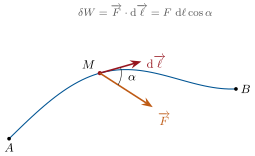
The elementary work of a force along a small displacement of its point of application: only the component of F along the motion works. Summed along the path from A to B, it gives W_A B.
The elementary work of a force along a small displacement of its point of application: only the component of F\vect F along the motion works. Summed along the path from AA to BB, it gives WABW_{A\to B}.

Examples

Example 13.10 (The loop’s speed law)

On the frictionless loop of Problem 11.1 the track’s reaction is normal to the motion and works not: EmE_m is conserved. With z=R(1cosθ)z = R(1 - \cos\theta) above the bottom, 12mv2+mgR(1cosθ)=12mv02\tfrac12 mv^2 + mgR(1 - \cos\theta) = \tfrac12 mv_0^2: the speed law v2=v022gR(1cosθ)v^2 = v_0^2 - 2gR(1 - \cos\theta) used there, now derived in one line. The minimum entry speed 5gR\sqrt{5gR} then follows from the top condition v2gRv^2 \geq gR of Example 12.16.

Read in context →