
Physics · Glossary

What is Redshift and blueshift?

Also known as: redshift · blueshift

Definition 23.13 High School Physics · Chapter 23 — The Doppler Effect

When the spectral lines of a source appear at wavelengths longer than in the laboratory, the spectrum is redshifted; when they appear shorter, it is blueshifted — shifted toward the red or the blue end of the visible spectrum.
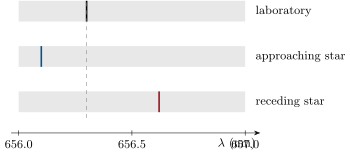
The same hydrogen line in three spectra: at 656.30\, nm in the laboratory, blueshifted for an approaching star, redshifted for a receding one. The shift, read against the dashed reference, gives the radial velocity.
The same hydrogen line in three spectra: at 656.30nm656.30\,\mathrm{nm} in the laboratory, blueshifted for an approaching star, redshifted for a receding one. The shift, read against the dashed reference, gives the radial velocity.

Examples

Example 23.16 (Weighing a star’s escape)

In the spectrum of the bright star Vega, the hydrogen line of laboratory wavelength 656.30nm656.30\,\mathrm{nm} is measured at 656.27nm656.27\,\mathrm{nm}: Δλ=0.03nm\Delta\lambda = -0.03\,\mathrm{nm}, a blueshift, so Vega approaches at vr=cΔλ/λ1.4×104m/sv_r = c\,|\Delta\lambda|/\lambda \approx 1.4 \times 10^{4}\,\mathrm{m}/\mathrm{s}14km/s14\,\mathrm{km}/\mathrm{s}, read off a shift of one part in twenty thousand.

Read in context →