High School Physics · Grades 10–12
23The Doppler Effect
An ambulance closes in, siren blazing, and sweeps past — and at that instant the note slides audibly downward, though the driver touched nothing. The siren is honest; the wave is not: motion squeezes it ahead and stretches it behind. This chapter measures the squeeze, then rides the same idea from sirens to radar guns, to blood in an artery, and out to a planet betrayed by a wobble in starlight.
23.1 The effect
Definition 23.1 (Doppler effect)
The Doppler effect is the change of the received frequency of a wave when source and receiver move relative to each other: the received frequency is higher than the emitted frequency while they approach, lower while they recede, and equal to only while their distance momentarily stops changing.
Remark 23.2 (Pitch, not loudness)
Two things change as the ambulance passes. The loudness swells and fades because the wave spreads with distance (Chapter 21); the pitch shifts because of the speed of approach or recession, and drops abruptly at the passing. Loudness says “how far”; pitch says “how fast”.
23.2 A moving source: crowded wavefronts
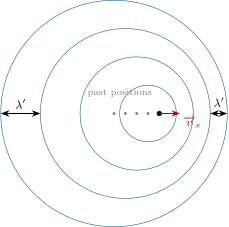
The key picture: once a crest leaves the source, the medium owns it. Each crest expands as a circle at the wave speed (Chapter 20), centered on the point where it was emitted — the medium neither knows nor cares that the source has moved on.
Proposition 23.3 (Moving source)
A source emits crests with period (frequency ) while moving in a straight line at speed through a medium in which the wave travels at speed . An observer at rest in the medium receives
the upper signs for a source approaching, the lower for one receding.
Proof. Between two crests the first advances while the source advances . Ahead, the second crest is therefore emitted closer to the first, ; behind, the same is added. The crests then sweep past a resting observer at the medium’s speed , one every seconds, so . ∎
Example 23.4 (The ambulance, in numbers)
A siren at approaches at ; take in air (Chapter 21). Approaching: ; receding: . The pass drops the pitch by — a ratio , about two and a half semitones, unmistakable to any ear.
Remark 23.5 (What motion does not change)
The wave still travels at : the medium alone sets the speed (Chapter 20). Motion of the source squeezes wavelengths, never speeds. And the squeeze has a limit: as the crests ahead pile onto each other and — the traffic jam of wavefronts a supersonic aircraft drags as a shock.
23.3 A moving observer, and the slow-motion shortcut
Proposition 23.6 (Moving observer)
An observer moves at speed straight toward (or away from) a source at rest in the medium. The received frequency is
Proof. The wave pattern itself is undisturbed: crests of spacing travel at . An observer running at them meets crests at the relative speed , one every seconds: . Running away, . ∎
Definition 23.7 (Radial velocity)
The radial velocity of a source relative to an observer is the component of their relative velocity along the line joining them — the rate at which the distance shrinks or grows. Only this component shifts the frequency; motion across the line of sight gives no shift at this order.
Proposition 23.8 (Slow motion: one formula for everybody)
When the radial speed is small, , it no longer matters who moves:
Proof. The observer formulas are already exactly . For the source, write : the identity shows that differs from by a term of order — for , a correction on a shift. To first order all four formulas collapse onto . ∎
Method 23.9 (Reading a pass)
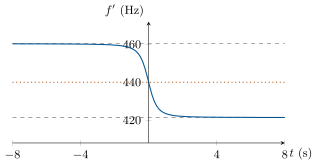
A recording of a passing source shows two plateaus: (approach) and (recession). Then
Indeed and : divide for , and compute for . Two frequency readings yield both the true pitch and the speed — no stopwatch, no ruler.
23.4 Echoes that measure speed
Bounce a wave off a moving target and the Doppler effect strikes twice.
Proposition 23.10 (Reflection doubles the shift)
A wave of frequency is sent at a reflector approaching head-on at speed . The echo returns with
Proof. Two shifts in series. As a moving observer the reflector receives ; re-emitting what it receives, it is now a moving source, so the echo arrives at for . ∎
Example 23.11 (The radar gun)
A traffic radar emits microwaves at () and superposes the echo on the outgoing wave; the beat (Chapter 21) directly sounds out per of car speed — a trivially measurable audio frequency carved out of a carrier. The factor is not optional: forgetting it flatters every driver by half.
Example 23.12 (Doppler ultrasound)
A medical probe sends ultrasound into an artery ( in tissue); red blood cells reflect it. Blood at returns — an audible beat: the cardiologist literally hears the blood accelerate at each heartbeat, then measures from .
23.5 Doppler in starlight
Light is a wave (Chapter 22), its spectrum striped with sharp lines at wavelengths fixed by each chemical element (Chapter 2) — a laboratory-calibrated ruler printed on every star.
Definition 23.13 (Redshift and blueshift)
When the spectral lines of a source appear at wavelengths longer than in the laboratory, the spectrum is redshifted; when they appear shorter, it is blueshifted — shifted toward the red or the blue end of the visible spectrum.
Proposition 23.14 (Doppler shift of light)
For a source receding at radial speed , every wavelength is observed stretched by
and compressed by the same amount, , for an approaching source (blueshift).
Proof. Admitted at this level. ∎
Remark 23.15 (Where the honest formula lives)
Light needs no medium, so the sound derivation cannot be copied — there is no “at rest in the medium”. The exact formula comes from special relativity, later this year (Chapter 35); the corrections are of order , negligible for planes, stars and nearby galaxies. Below we use the slow-motion formula with a clear conscience.
Example 23.16 (Weighing a star’s escape)
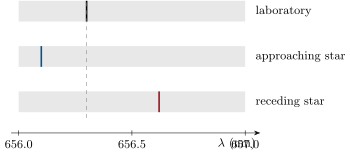
In the spectrum of the bright star Vega, the hydrogen line of laboratory wavelength is measured at : , a blueshift, so Vega approaches at — , read off a shift of one part in twenty thousand.
Example 23.17 (Wobbling stars: binaries and exoplanets)
When two stars orbit each other, their lines swing periodically blue and red — a spectroscopic binary, orbits measured without ever resolving the pair. A planet does the same to its star, faintly: both circle their common center of mass, so the star’s radial velocity oscillates by a few tens of — a shift . Detecting it is how the first planet around a Sun-like star was found; the weekend problem reruns that discovery, numbers and all.
Remark 23.18 (Galaxy redshifts)
The spectra of distant galaxies are all redshifted, and the more distant, the more shifted: the universe’s distances are stretching. For nearby galaxies reads off the recession speed; for the farthest, shifts outgrow what the slow-motion formula can honestly handle, and the accounting is taken up again from Chapter 35 onward, and in the university volumes.
23.6 Exercises
Exercise 23.1 ★
A fire-engine siren emits at and drives at (). Compute the frequency heard by a pedestrian (a) ahead of it; (b) behind it. (c) What does the driver hear?
Solution
Solution of Exercise 23.1.
(a) . (b) . (c) : driver and siren move together, their distance never changes.
Exercise 23.2 ★
A friend claims: “the pitch drops as the ambulance leaves because the sound gets weaker with distance.” Untangle the two effects being confused, and say what each depends on.
Solution
Solution of Exercise 23.2.
The loudness fades because the wave spreads out — it depends on the distance. The pitch drops from approach to recession — the Doppler effect, which depends on how fast the distance changes. Two independent effects.
Exercise 23.3 ★
A cyclist rides at straight toward a stationary siren emitting at . What frequency do they hear? And riding straight away? Which formula applies, and why not the moving-source one?
Solution
Solution of Exercise 23.3.
Moving observer: ; riding away, . The siren is at rest in the air, so the wave pattern is undisturbed; only the observer runs through it.
Exercise 23.4 ★
A train horn emits at while the train runs at . Compute the wavelength ahead of the train, behind it, and at rest. Which observer receives which?
Solution
Solution of Exercise 23.4.
Ahead: ; behind: ; at rest: . The short wavelength reaches whoever the train approaches, the long one whoever it leaves.
Exercise 23.5 ★
A phone playing a tone is carried by a runner at . Use the slow-motion formula to estimate the shift heard by someone the runner approaches. Compare it to a semitone (about in frequency): would a musician notice?
Solution
Solution of Exercise 23.5.
: , so about — a quarter of a semitone. A musician would just notice.
Exercise 23.6 ★★
A bat flies at straight at a wall, emitting at . Show that the echo it hears returns at , then compute and the shift. Why is this the radar-gun formula in disguise?
Solution
Solution of Exercise 23.6.
The wall receives (moving source); the bat, a moving observer closing on the echo, hears times that: , a shift of . It is the radar-gun double shift with emitter and reflector roles swapped: only the closing speed matters.
Exercise 23.7 ★★
A radar gun at measures a beat of from an approaching car. Find the car’s speed in and . What beat would a car at exactly give?
Solution
Solution of Exercise 23.7.
. At (): .
Exercise 23.8 ★★
A Doppler ultrasound probe aimed along an artery ( in tissue) hears a beat of . Find the blood speed. Why must the probe be angled along the flow rather than perpendicular to it?
Solution
Solution of Exercise 23.8.
. Perpendicular flow has zero radial velocity, hence no shift at all.
Exercise 23.9 ★★
Take , and a closing speed of . Compute exactly when (a) the source moves, (b) the observer moves. Compare both to the slow-motion prediction and explain the size of the disagreement.
Solution
Solution of Exercise 23.9.
(a) Source: . (b) Observer: . Slow motion predicts : exact for the observer, short for the source — the order- correction, of for .
Exercise 23.10 ★★
The recording of a scooter passing a microphone shows plateaus at and . Using Method 23.9, find the horn’s true frequency and the scooter’s speed in . Why is the true frequency not their average?
Exercise 23.11 ★★
In a star’s spectrum, the hydrogen line of laboratory wavelength is observed at . Redshift or blueshift? Compute the star’s radial velocity and direction.
Exercise 23.12 ★★★
A star wobbles at because of an unseen planet. Compute the amplitude of the wavelength swing of a line, as a length and as a fraction of . Order of magnitude: why did planet hunting have to wait for spectrographs stable to one part in ?
Solution
Solution of Exercise 23.12.
; . The whole signal is two parts in ten million: a spectrograph drifting by more than buries it.
Exercise 23.13 ★★★
Every line in a galaxy’s spectrum is found stretched by . Compute its recession speed. Astronomers find that such speeds grow in proportion to distance, for every direction of the sky: what picture does this suggest? Is the slow-motion formula still trustworthy here?
Solution
Solution of Exercise 23.13.
. Speeds proportional to distance, the same in every direction: all distances stretching uniformly — an expanding universe with no privileged center. At the corrections are of order : still trustworthy.
Exercise 23.14 ★★★
The Sun rotates: one edge of its disk approaches us at about while the other recedes equally fast. What does this do to the line in light from the whole disk — shift it or broaden it? Compute the effect in .
Solution
Solution of Exercise 23.14.
The two edges shift opposite ways, so the disk-averaged line is broadened, not shifted: full width (about ).
Exercise 23.15 ★★★
A police car at , siren at , chases a truck driving at in the same direction. (a) Justify for the truck driver. (b) Compute . (c) Show that if the truck matched the car’s speed the shift would vanish, and say why that is as it should be.
Solution
Solution of Exercise 23.15.
(a) Ahead of the car the crests are spaced ; the truck flees at and meets them at relative speed : . (b) . (c) gives : the separation is constant, and no change of distance means no Doppler shift, by definition.
23.7 Problem: The Hunt for an Exoplanet
Problem 23.1
Weekend problem — the hunt for an exoplanet: a train horn calibrates the ear, a radar gun rehearses the double shift, and by Sunday night a star’s spectrum, wobbling by one part in five million, has weighed a planet nobody has ever seen
An astronomy club spends a weekend on one idea — the Doppler shift — rehearsed on Earth, then aimed at a Sun-like star. Data: for sound in air, , ; the star has mass . Admitted, from the mechanics of circular orbits (Chapter 27): a planet of mass on a circular orbit of radius has period and speed given by and , and the star, circling the common center of mass, wobbles at speed .
Part I — Friday: the level crossing. A train passes at constant speed, horn on; a phone records while it approaches, after it passes.
- Explain, with the crowded-wavefront picture, why although the horn never changes.
- Write the two equations linking , to the true frequency and train speed .
- Show that and compute it in and .
- Show that and compute it. Why is slightly below the average of and ?
- Compute the wavelengths ahead of and behind the train, and the at-rest wavelength.
Part II — Saturday: the radar gun. A traffic patrol demonstrates its radar: , and the gun reads the beat between the outgoing wave and the echo.
- Explain why the echo of a moving car is shifted twice — name the role the car plays in each shift.
- Show that for a car at speed the beat is .
- A car returns : compute .
- Convert to and compare to the limit posted there.
- How many hertz of beat correspond to ? Comment: what makes such a tiny relative shift of a wave easy to measure?
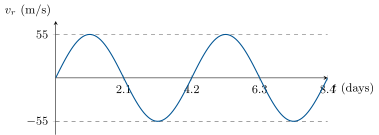
Part III — Sunday: the star that wobbles. The club downloads the measured radial velocity of a Sun-like star, night after night, plotted below.
- What is actually measured, night after night, in the star’s spectrum? State the relation used to turn it into .
- Read the amplitude and the period of the wobble off the curve.
- Compute the corresponding swing of a line, and . Compare with Part I: how much harder is this measurement than the train’s?
- Why does an unseen planet make the star wobble at all? What does the sinusoidal shape indicate about the orbit?
- Why does this method measure only the radial part of the star’s motion, and what would be seen if the orbit were face-on to us?
Part IV — Sunday night: weighing the invisible. Take the orbit circular and edge-on, so is the star’s full orbital speed.
- From and the admitted relation , compute the planet’s orbital radius . Compare it to the Earth–Sun distance, .
- Compute the planet’s orbital speed .
- From , compute the planet’s mass .
- Compare to Jupiter () and to Earth (), and to the Sun–Mercury distance (). What sort of world is this?
- If the orbit were tilted rather than edge-on, would the true mass be larger or smaller than your value? Conclude in one sentence: what did a periodic shift of one part in five million just deliver?
Solution
Solution of Problem 23.1.
1. Each crest expands from the point where it was emitted: crests bunch ahead of the moving horn and stretch behind it, so the approaching phone meets them faster () than the receding one ().
2. , .
3. and ; dividing, .
4. (the common factor cancels): — the harmonic mean, below the average because approach boosts more than recession cuts it.
5. Ahead: ; behind: ; at rest: .
6. Once as a moving observer receiving the wave, once as a moving source re-emitting what it received.
7. , so .
8. .
9. : just under the limit.
10. per . Beating the echo against the emitted wave leaves only the difference: an audio frequency, trivially counted, though it is a fraction of the carrier.
11. The wavelengths of known spectral lines, night after night; then .
12. , .
13. , — one part in five million, some times smaller than the train’s shift.
14. Star and planet attract each other equally, so both orbit their common center of mass: the star cannot stand still. A sinusoidal is uniform circular motion seen edge-on — a circular orbit.
15. Only the line-of-sight component changes the star–Earth distance, hence the wavelength. Face-on, at all times: no signal whatsoever.
16. : , so — about of the Earth–Sun distance.
17. .
18. .
19. About Jupiter masses ( Earths), orbiting times closer than Mercury: a gas giant roasting against its star — a “hot Jupiter”.
20. A tilt hides part of the motion: the measured is only the radial share, so the true mass is larger — is a minimum. A periodic shift of one part in five million just delivered the orbit, speed and minimum mass of a planet nobody has ever seen.