সব বই

পেশাদার

1 Markets I: The Ecosystem and Exchange-Traded Marketsবাজার অনলাইন 2 Markets II: Rates, FX and Creditবাজার অনলাইন 3 Markets III: Commodities, Energy and Cryptoবাজার অনলাইন 4 Quantitative Methodsপদ্ধতি অনলাইন 5 Derivatives and Volatilityডেরিভেটিভস অনলাইন 6 Rates, Credit, XVA and Riskসুদহার, ঋণ ও ঝুঁকি অনলাইন 7 Research Craft: Predictors, Backtests, Measurement, Portfoliosগবেষণা অনলাইন 8 Strategies I: Equities and Futuresকৌশল অনলাইন 9 Strategies II: Volatility, Relative Value, Macro and the Bank Desksকৌশল অনলাইন 10 Microstructure and Executionএক্সিকিউশন অনলাইন 11 Market Making and High-Frequency Tradingমার্কেট মেকিং অনলাইন 12 Machine Learning for Marketsমেশিন লার্নিং অনলাইন 13 Low-Latency Softwareপ্রযুক্তি অনলাইন 14 Networks, Hardware and Trading Infrastructureপ্রযুক্তি অনলাইন 15 Research, Data and Risk Platformsপ্রযুক্তি অনলাইন 16 The Desk and the Firmপ্রতিষ্ঠান অনলাইন 17 The Industry: Firms, Roles and Careersক্যারিয়ার অনলাইন 18 Interviews I: Maths, Probability and Speedক্যারিয়ার অনলাইন 19 Interviews II: Markets, Trading Games and the Final Roundক্যারিয়ার অনলাইন 20 Interviews III: Codeক্যারিয়ার অনলাইন
অ্যাপ পরিচিতি Coach সাইন ইন পড়া শুরু করো

বইগুলো এখনো বাংলা ভাষায় পাওয়া যায় না — ইংরেজি সংস্করণ দেখানো হচ্ছে।

Physics · পরিভাষা

Velocity and acceleration কী?

Definition 11.2 University Physics — Year 1 · অধ্যায় 11 — Kinematics of a Point

The velocity and acceleration of MM in the frame are

v→= ⁣dOM→ ⁣dt,a→= ⁣dv→ ⁣dt= ⁣d2OM→ ⁣dt2,\vect v = \frac{\dd\vect{OM}}{\dd t}, \qquad \vect a = \frac{\dd\vect v}{\dd t} = \frac{\dd^2\vect{OM}}{\dd t^2},

derivatives of vector functions: the derivative of a vector is obtained by differentiating its components in a basis that is fixed in the frame. The velocity is tangent to the trajectory and points along the motion; its norm vv is the speed. Units: m/s\mathrm{m}/\mathrm{s}, m/s2\mathrm{m}/\mathrm{s}^{2}.

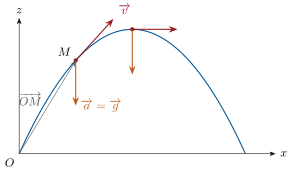
A projectile’s parabola: the velocity is tangent to the trajectory and turns, the acceleration g is constant. At the apex velocity and acceleration are perpendicular: the speed is momentarily stationary while the direction still changes.
A projectile’s parabola: the velocity is tangent to the trajectory and turns, the acceleration g→\vect g is constant. At the apex velocity and acceleration are perpendicular: the speed is momentarily stationary while the direction still changes.

উদাহরণ

Example 11.4 (Projectile)

Launched from OO at speed v0v_0 and angle α\alpha above the horizontal, a ball’s coordinates (dynamics, next chapter) are x=v0cos⁡α tx = v_0\cos\alpha\,t, z=v0sin⁡α t−12gt2z = v_0\sin\alpha\,t - \tfrac12 gt^2. Then v→=v0cos⁡α e→x+(v0sin⁡α−gt)e→z\vect v = v_0\cos\alpha\,\vect e_x + (v_0\sin\alpha - gt)\vect e_z, a→=−ge→z\vect a = -g\vect e_z: the acceleration is constant while the velocity turns; at the apex (z˙=0\dot z = 0, t=v0sin⁡α/gt = v_0\sin\alpha/g) the velocity is horizontal and the acceleration perpendicular to it. Eliminating tt: z=xtan⁡α−gx2/(2v02cos⁡2α)z = x\tan\alpha - gx^2/(2v_0^2\cos^2\alpha), a parabola.

প্রসঙ্গসহ পড়ো →