Physics · Glossary

What is Velocity potential; circulation?

Definition 2.14 University Physics — Year 2 · Chapter 2 — Fluid Kinematics

In an irrotational flow the velocity derives from a velocity potential: v=gradφ\vect v = \operatorname{\vect{grad}}\varphi (the circulation of v\vect v along a path then depends only on its ends, ABv ⁣dl=φ(B)φ(A)\int_A^B\vect v \cdot\dd\vect l = \varphi(B) - \varphi(A)). If the flow is also incompressible, Δφ=divgradφ=0\Delta\varphi = \operatorname{div}\operatorname{\vect{grad}} \varphi = 0: the potential obeys Laplace’s equation, exactly like the electrostatic potential in a charge-free region — a potential flow. The circulation of the velocity along a closed curve CC is Γ=Cv ⁣dl\Gamma = \oint_C\vect v\cdot\dd\vect l.

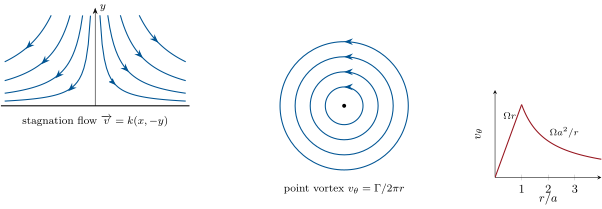
Three plane flows. Left: the stagnation flow, irrotational, with hyperbolic streamlines. Middle: the point vortex — circular streamlines, yet zero vorticity away from the centre. Right: the Rankine vortex profile, solid rotation in the core and a point vortex outside.

Examples

Example 2.15 (Three plane flows)

(i) Stagnation flow v=k(x,y)\vect v = k(x, -y): divv=0\operatorname{div}\vect v = 0, ω=0\vect\omega = \vect 0, φ=12k(x2y2)\varphi = \tfrac12k(x^2 - y^2); streamlines xy=xy = const, hyperbolas — a jet hitting a wall, near the axis. (ii) Point vortex v=Γ2πreθ\vect v = \dfrac{\Gamma}{2\pi r}\vect e_\theta (plane polar coordinates): incompressible and irrotational everywhere except at r=0r = 0, φ=Γθ/2π\varphi = \Gamma\theta/2\pi (multivalued), and the circulation on any circle around the centre is Γ\Gamma — the vorticity is concentrated on the axis. (iii) Rankine vortex: a core r<ar < a in solid rotation vθ=Ωrv_\theta = \Omega r (vorticity 2Ω2\Omega) matched to the point vortex vθ=Ωa2/rv_\theta = \Omega a^2/r outside: the model of a tornado, a bathtub swirl or the eddy behind the bridge pier — the velocity peaks at the edge of the core.

Read in context →