সব বই

পেশাদার

1 Markets I: The Ecosystem and Exchange-Traded Marketsবাজার অনলাইনইংরেজি 2 Markets II: Rates, FX and Creditবাজার অনলাইনইংরেজি 3 Markets III: Commodities, Energy and Cryptoবাজার অনলাইনইংরেজি 4 Quantitative Methodsপদ্ধতি অনলাইনইংরেজি 5 Derivatives and Volatilityডেরিভেটিভস অনলাইনইংরেজি 6 Rates, Credit, XVA and Riskসুদহার, ঋণ ও ঝুঁকি অনলাইনইংরেজি 7 Research Craft: Predictors, Backtests, Measurement, Portfoliosগবেষণা অনলাইনইংরেজি 8 Strategies I: Equities and Futuresকৌশল অনলাইনইংরেজি 9 Strategies II: Volatility, Relative Value, Macro and the Bank Desksকৌশল অনলাইনইংরেজি 10 Microstructure and Executionএক্সিকিউশন অনলাইনইংরেজি 11 Market Making and High-Frequency Tradingমার্কেট মেকিং অনলাইনইংরেজি 12 Machine Learning for Marketsমেশিন লার্নিং অনলাইনইংরেজি 13 Low-Latency Softwareপ্রযুক্তি অনলাইনইংরেজি 14 Networks, Hardware and Trading Infrastructureপ্রযুক্তি অনলাইনইংরেজি 15 Research, Data and Risk Platformsপ্রযুক্তি অনলাইনইংরেজি 16 The Desk and the Firmপ্রতিষ্ঠান অনলাইনইংরেজি 17 The Industry: Firms, Roles and Careersক্যারিয়ার অনলাইনইংরেজি 18 Interviews I: Maths, Probability and Speedক্যারিয়ার অনলাইনইংরেজি 19 Interviews II: Markets, Trading Games and the Final Roundক্যারিয়ার অনলাইনইংরেজি 20 Interviews III: Codeক্যারিয়ার অনলাইনইংরেজি
অ্যাপ পরিচিতি Coach সাইন ইন পড়া শুরু করো

বইগুলো এখনো বাংলা ভাষায় পাওয়া যায় না — Español সংস্করণ দেখানো হচ্ছে।

Física · পরিভাষা

Dipolo lineal, circuito lineal কী?

Definición 6.16 Física universitaria — primer año · অধ্যায় 6 — Circuitos en corriente continua: leyes de Kirchhoff y teoremas

Un dipolo es lineal si su característica es una recta (resistor, fuentes ideales y reales); un circuito formado solo por dipolos lineales es un circuito lineal. Sus incógnitas obedecen un sistema de ecuaciones lineales (las leyes de Kirchhoff más las características), cuya solución es única.

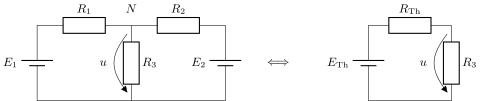
Dos fuentes que alimentan una carga común R_3. Vista desde los bornes de R_3, el resto del circuito es una fuente de Thévenin (E_ Th, R_ Th); el teorema de Millman da el potencial del nudo N en una línea.
Dos fuentes que alimentan una carga común R3R_3. Vista desde los bornes de R3R_3, el resto del circuito es una fuente de Thévenin (EThE_{\mathrm{Th}}, RThR_{\mathrm{Th}}); el teorema de Millman da el potencial del nudo NN en una línea.

উদাহরণ

Ejemplo 6.20 (Tres caminos hacia la misma respuesta)

En la figura, E1=10 VE_1 = 10\,\mathrm{V}, R1=1.0 kΩR_1 = 1.0\,\mathrm{k}\Omega, E2=5.0 VE_2 = 5.0\,\mathrm{V}, R2=2.0 kΩR_2 = 2.0\,\mathrm{k}\Omega, R3=2.0 kΩR_3 = 2.0\,\mathrm{k}\Omega. Millman: VN=(10/1+5/2+0/2)/(1+0.5+0.5)=12.5/2=6.25 VV_N = (10/1 + 5/2 + 0/2)/(1 + 0.5 + 0.5) = 12.5/2 = 6.25\,\mathrm{V}. Superposición: E1E_1 sola ve R2∥R3=1 kΩR_2 \parallel R_3 = 1\,\mathrm{k}\Omega, luego u=10×1/2=5 Vu = 10 \times 1/2 = 5\,\mathrm{V}; E2E_2 sola ve R1∥R3=0.667 kΩR_1 \parallel R_3 = 0.667\,\mathrm{k}\Omega, u=5×0.667/2.667=1.25 Vu = 5 \times 0.667/2.667 = 1.25\,\mathrm{V}; en total 6.25 V6.25\,\mathrm{V}. Thévenin visto desde R3R_3: EThE_{\mathrm{Th}} es la tensión en circuito abierto del divisor (E1,R1,R2,E2)(E_1, R_1, R_2, E_2): E2+(E1−E2)R2/(R1+R2)=5+5×2/3=8.33 VE_2 + (E_1 - E_2)R_2/(R_1 + R_2) = 5 + 5 \times 2/3 = 8.33\,\mathrm{V}; RTh=R1∥R2=0.667 kΩR_{\mathrm{Th}} = R_1 \parallel R_2 = 0.667\,\mathrm{k}\Omega; y entonces u=8.33×2/2.667=6.25 Vu = 8.33 \times 2/2.667 = 6.25\,\mathrm{V}.

প্রসঙ্গসহ পড়ো →