সব বই

পেশাদার

1 Markets I: The Ecosystem and Exchange-Traded Marketsবাজার অনলাইনইংরেজি 2 Markets II: Rates, FX and Creditবাজার অনলাইনইংরেজি 3 Markets III: Commodities, Energy and Cryptoবাজার অনলাইনইংরেজি 4 Quantitative Methodsপদ্ধতি অনলাইনইংরেজি 5 Derivatives and Volatilityডেরিভেটিভস অনলাইনইংরেজি 6 Rates, Credit, XVA and Riskসুদহার, ঋণ ও ঝুঁকি অনলাইনইংরেজি 7 Research Craft: Predictors, Backtests, Measurement, Portfoliosগবেষণা অনলাইনইংরেজি 8 Strategies I: Equities and Futuresকৌশল অনলাইনইংরেজি 9 Strategies II: Volatility, Relative Value, Macro and the Bank Desksকৌশল অনলাইনইংরেজি 10 Microstructure and Executionএক্সিকিউশন অনলাইনইংরেজি 11 Market Making and High-Frequency Tradingমার্কেট মেকিং অনলাইনইংরেজি 12 Machine Learning for Marketsমেশিন লার্নিং অনলাইনইংরেজি 13 Low-Latency Softwareপ্রযুক্তি অনলাইনইংরেজি 14 Networks, Hardware and Trading Infrastructureপ্রযুক্তি অনলাইনইংরেজি 15 Research, Data and Risk Platformsপ্রযুক্তি অনলাইনইংরেজি 16 The Desk and the Firmপ্রতিষ্ঠান অনলাইনইংরেজি 17 The Industry: Firms, Roles and Careersক্যারিয়ার অনলাইনইংরেজি 18 Interviews I: Maths, Probability and Speedক্যারিয়ার অনলাইনইংরেজি 19 Interviews II: Markets, Trading Games and the Final Roundক্যারিয়ার অনলাইনইংরেজি 20 Interviews III: Codeক্যারিয়ার অনলাইনইংরেজি
অ্যাপ পরিচিতি Coach সাইন ইন পড়া শুরু করো

বইগুলো এখনো বাংলা ভাষায় পাওয়া যায় না — Français সংস্করণ দেখানো হচ্ছে।

Physique · পরিভাষা

Dipôle linéaire, circuit linéaire কী?

Définition 6.16 Physique universitaire — 1re année · অধ্যায় 6 — Circuits en courant continu : lois de Kirchhoff et théorèmes

Un dipôle est linéaire si sa caractéristique est une droite (conducteur ohmique, sources idéales et réelles) ; un circuit formé de dipôles linéaires seulement est un circuit linéaire. Ses inconnues obéissent à un système d’équations linéaires (lois de Kirchhoff et caractéristiques), dont la solution est unique.

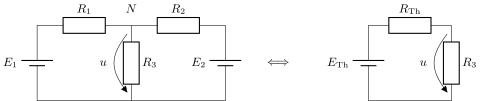
Deux sources alimentant une charge commune R_3. Vu des bornes de R_3, le reste du circuit est une source de Thévenin (E_ Th, R_ Th) ; le théorème de Millman donne le potentiel du nœud N en une ligne.
Deux sources alimentant une charge commune R3R_3. Vu des bornes de R3R_3, le reste du circuit est une source de Thévenin (EThE_{\mathrm{Th}}, RThR_{\mathrm{Th}}) ; le théorème de Millman donne le potentiel du nœud NN en une ligne.

উদাহরণ

Exemple 6.20 (Trois chemins vers la même réponse)

Sur la figure, E1=10 VE_1 = 10\,\mathrm{V}, R1=1.0 kΩR_1 = 1.0\,\mathrm{k}\Omega, E2=5.0 VE_2 = 5.0\,\mathrm{V}, R2=2.0 kΩR_2 = 2.0\,\mathrm{k}\Omega, R3=2.0 kΩR_3 = 2.0\,\mathrm{k}\Omega. Millman : VN=(10/1+5/2+0/2)/(1+0.5+0.5)=12.5/2=6.25 VV_N = (10/1 + 5/2 + 0/2)/(1 + 0.5 + 0.5) = 12.5/2 = 6.25\,\mathrm{V}. Superposition : E1E_1 seule voit R2∥R3=1 kΩR_2 \parallel R_3 = 1\,\mathrm{k}\Omega, donc u=10×1/2=5 Vu = 10 \times 1/2 = 5\,\mathrm{V} ; E2E_2 seule voit R1∥R3=0.667 kΩR_1 \parallel R_3 = 0.667\,\mathrm{k}\Omega, u=5×0.667/2.667=1.25 Vu = 5 \times 0.667/2.667 = 1.25\,\mathrm{V} ; au total 6.25 V6.25\,\mathrm{V}. Thévenin vu de R3R_3 : EThE_{\mathrm{Th}} est la tension à vide du diviseur (E1,R1,R2,E2)(E_1, R_1, R_2, E_2) : E2+(E1−E2)R2/(R1+R2)=5+5×2/3=8.33 VE_2 + (E_1 - E_2)R_2/(R_1 + R_2) = 5 + 5 \times 2/3 = 8.33\,\mathrm{V} ; RTh=R1∥R2=0.667 kΩR_{\mathrm{Th}} = R_1 \parallel R_2 = 0.667\,\mathrm{k}\Omega ; puis u=8.33×2/2.667=6.25 Vu = 8.33 \times 2/2.667 = 6.25\,\mathrm{V}.

প্রসঙ্গসহ পড়ো →