Market Making and High-Frequency Trading · Market making
12ETF Market Making
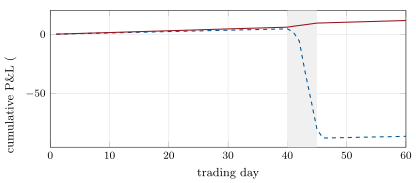
An exchange-traded fund of bonds trades all day on a stock exchange while most of its bonds have not traded for hours. The market maker who quotes it is, for those hours, the price. In this chapter’s simulated fund, a five-day freeze in the bond market leaves the official net asset value 5.6% above what the bonds are worth; a market maker quoting around that number loses $70 million in five days, about 530 days of its normal income. One that prices the fund from a basket moved by a liquid proxy earns $3.2 to 3.6 million over the same days, and the 5.3% “discount” it quotes to the net asset value is almost entirely the net asset value’s own staleness.
12.1 Pricing an ETF from its basket
Book 1, chapter 14 describes the structure: the fund issues and redeems shares only in creation units, against a basket, to authorised participants; everyone else trades the shares on the exchange, where market makers quote them. A market maker’s first problem is a fair price for the shares (chapter 2) when the fund’s own published values lag.
Definition 12.1 (Pricing basket)
A pricing basket is the set of instruments, weights and adjustments a market maker uses to compute an ETF’s fair value in real time: the fund’s holdings where they trade, a model price where they do not (the last price moved by a liquid proxy), the currency, the cash and accrued income, less the fund’s fees.
The published indicative value uses the holdings’ last prices. For a fund whose holdings all trade every second, that is enough. For a fund of bonds, or of stocks whose market is closed, it is not: each stale price is a guess made at the time of the last trade. The pricing basket replaces each stale price , last traded at , by
where is a liquid proxy (an index future, a credit index, a Treasury future) and the holding’s sensitivity to it. For a fund whose underlying market is closed the same formula applies to every holding at once, with the currency’s move: a Japanese equity fund quoted in New York is worth its Tokyo close times one plus the move of a Nikkei future trading overnight, times one plus the yen’s move.
Petajisto measured how far ETF prices stray from their net asset values: typically within a band of about 200 basis points, more in funds of international or illiquid securities. Controlling for stale prices with the prices of similar funds, the band was still about 100 basis points.
12.2 The primary market: creation and redemption
The primary market is where a market maker’s inventory can go when the secondary market will not take it. An authorised participant (or a market maker trading through one) delivers the creation basket and receives a creation unit, or the reverse. Two features matter for a market maker.
Definition 12.2 (Creation fee)
A creation fee is the charge a fund makes on each creation or redemption of a creation unit: a fixed transaction fee per order, and, when the fund accepts or pays cash instead of securities, a variable charge up to a stated percentage of the unit’s value to cover the fund’s trading costs.
Definition 12.3 (Custom basket)
A custom basket is a creation or redemption basket that is not a pro-rata slice of the fund’s portfolio, or that differs from the basket published for the day, agreed between the fund and the authorised participant under the fund’s written policies.
As of September 2026 — Creation fees, unit sizes and custom baskets
In its statement of additional information dated 31 July 2020 (revised 27 November 2020), the iShares Core S&P 500 ETF listed 50 000 shares per creation unit, worth about $14.6 million on 30 April 2020, a standard creation transaction fee of $1 250 and the same for redemptions, with maximum additional charges of 3.0% for creations and 2.0% for redemptions; the iShares Europe ETF’s standard fee was $10 000. The SEC’s Rule 6c-11, adopted in September 2019, lets an ETF that relies on it use custom baskets if it adopts written policies and procedures for their construction and acceptance, and requires daily portfolio transparency on its website. Flow Traders reported € 1 940 billion of exchange-traded-product value traded in 2025.
A fixed fee of $1 250 on $14.6 million is under one basis point: in a large equity fund the fee is not the constraint, the basket is. For a bond fund the basket may hold bonds that cannot be bought today, and the fund’s choice of basket (One Quant Book 9, chapter 19) decides which bonds an authorised participant must deliver or will receive. Redeeming in kind hands the market maker bonds that it must then sell, at the bond market’s spread; the create-redeem decision compares the gap between the shares’ price and the basket’s value with the fee and the cost of trading the basket:
with shares per unit, the fee and the basket’s cost per dollar. Settlement lags add financing to both sides.
12.3 Hedging an ETF book
A market maker’s inventory in the shares can be hedged in the basket (exact, dear), in a subset of it, in a future on the index, in another fund on the same index, or by creating or redeeming. Chapter 11’s arithmetic applies: the future removes the index risk cheaply and leaves the tracking difference. The hedge that is special to ETFs is the offsetting position in a similar fund: two S&P 500 funds, or a fund and its future, hedge each other almost perfectly, and the market maker in both earns two spreads on one risk.
12.4 When the underlying is closed or illiquid
When the underlying cannot be traded, the market maker’s quote is the market. Two kinds of fund live in this state: funds whose holdings trade in a market that is closed (international equities quoted in New York) and funds whose holdings rarely trade (corporate bonds, municipal bonds, loans). The market maker quotes from its pricing basket and hedges in the proxy; the creation-redemption arbitrage waits for the underlying to open, and until then the gap between the shares and the published net asset value is not an arbitrage but a forecast.
hf_etf.market, hf_etf.run.12.5 Stress: discounts, stale NAVs and who absorbs them
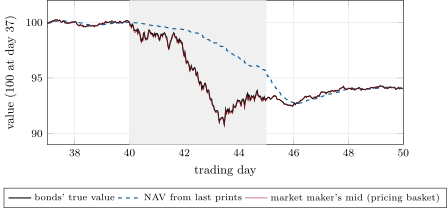
In a stress the published net asset value of an illiquid fund is stale by construction: the bonds that would move it are not trading. The shares trade at a “discount” that is, in part, the net asset value’s error, and in part the price of selling to someone whose balance sheet is filling up. One Quant Book 9, chapter 19 separates the two for a bond fund in a daily simulation and follows the March 2020 discounts; here the question is the market maker’s. At the worst close of the simulated freeze (Figure 12.1), the market maker quoting from its pricing basket stood 532 basis points below the net asset value. Of that, 557 was the net asset value’s staleness (the net asset value stood 557 basis points above the bonds’ true value) and 5 was the market maker’s own discount to the true value, its price for taking the panic sellers’ shares with a balance sheet that could hold them. A market maker that quoted the net asset value would have stood 557 basis points above what it was buying.
12.6 Strategy files
Strategy file 12.1 — Basket-hedged equity ETF quoting
Who pays you, and why. Investors who trade fund shares on the exchange and want immediacy in a size the basket’s own spreads would make dear.
Instruments and venues. A domestic equity fund on its listing exchange and other venues; its constituents; creation and redemption through an authorised participant.
Signal. The pricing basket from the constituents’ live prices (chapter 2’s fair price), with dividends, cash and fees.
Sizing and execution. Quote the shares around the basket’s value with an inventory skew (chapters 3–4); hedge beyond a band in the constituents or in a future (chapter 11); create or redeem when the inventory reaches a unit and the gap pays the fee.
Costs. Spreads and fees on the hedge, the creation fee (under one basis point in a large fund), settlement financing.
How it dies. Competition: many market makers quote the same funds against the same baskets, and the spread goes to the fastest pricing and cheapest hedging.
Horizon, capacity, infrastructure. Seconds to a day; capacity from the fund’s volume; real-time baskets for hundreds of funds.
Backtest honestly. Constituent prices at the time of each quote, not the close; the creation cutoff time and fee of the day.
Sources. Book 1, chapter 14; the iShares statement of additional information (dated box).
Strategy file 12.2 — Creation-redemption arbitrage
Who pays you, and why. Investors whose buying or selling pushes the shares away from the basket’s value faster than market makers’ inventory can absorb.
Instruments and venues. The shares, the basket’s securities, the fund’s primary market.
Signal. The gap between the shares’ price and the basket’s executable value, net of the fee and the basket’s trading cost.
Sizing and execution. Buy the cheap side and sell the dear in creation-unit sizes; create or redeem at the cutoff.
Costs. Fixed and variable creation fees, the basket’s spreads, settlement financing, custom-basket negotiation.
How it dies. It is the mechanism that keeps the gap small; in liquid funds the gap is inside the costs almost all the time.
Horizon, capacity, infrastructure. A day; capacity limited by the gap and by the authorised participant’s balance sheet.
Backtest honestly. Executable basket prices, not the indicative value; the cutoff time; the fund’s right to refuse or charge cash.
Sources. Book 1, chapter 14; One Quant Book 9, chapter 19; Rule 6c-11 (dated box).
Strategy file 12.3 — Fixed-income ETF quoting on a stale NAV
Who pays you, and why. Investors who want bond exposure with an exchange’s immediacy, and who pay most when the bond market is least liquid.
Instruments and venues. A bond fund on the exchange; a liquid proxy (Treasury future, credit index); the bonds through dealers and platforms.
Signal. A pricing basket: each bond’s last trade moved by the proxy since, times its sensitivity; the published net asset value is an input, not the answer.
Sizing and execution. Quote around the basket’s value, skew with inventory, widen with the proxy’s volatility, hedge the rate and credit exposure in the proxy; redeem in kind only when the bonds’ spread is not too wide.
Costs. The proxy’s spread, the bonds’ spreads on redemption (six times wider in the tutorial’s freeze), and basis risk between proxy and bonds.
How it dies. Quoting the stale value: in the tutorial a quoter around the net asset value loses $70 million in a five-day freeze against $3.2 to 3.6 million earned by the basket quoter.
Horizon, capacity, infrastructure. Minutes to days; balance sheet is the limit; a bond pricing service.
Backtest honestly. Bond prints as they were known at the time, the proxy’s basis, and redemption at executable bond prices.
Sources. Petajisto (2017); One Quant Book 9, chapter 19; this chapter.
Strategy file 12.4 — International ETF quoting while the underlying is closed
Who pays you, and why. Investors trading foreign markets during their own hours, when those markets are closed.
Instruments and venues. A fund of foreign stocks listed at home; index futures that trade overnight; the currency.
Signal. The foreign close times one plus the future’s move since, times one plus the currency’s move (firm.etfmm.closed_fair).
Sizing and execution. Quote around that value, hedge in the future and the currency; keep inventory until the foreign market opens, then hedge in or create and redeem against the basket.
Costs. Futures and currency spreads, the gap between the future and the basket at the open, fees.
How it dies. News specific to a few stocks, which the future does not carry, and a gap between the future’s overnight move and the market’s open.
Horizon, capacity, infrastructure. The hours of non-overlap; capacity from the futures’ depth overnight.
Backtest honestly. The future’s price at each quote time; the foreign open, not the close, as the exit.
Sources. Petajisto (2017): larger deviations in international funds.
Strategy file 12.5 — Futures-hedged ETF quoting
Who pays you, and why. As in the basket-hedged strategy, but for funds whose baskets are dear or slow to trade.
Instruments and venues. An index fund and the future on the same index, or two funds on one index.
Signal. The future’s price through the fair basis (dividends, financing) to fund units; the two funds’ relative price.
Sizing and execution. Hedge the inventory in the future each time it moves a contract (or beyond a band); quote both funds and net the risk.
Costs. The future’s spread and roll; the tracking difference between future and fund.
How it dies. Basis moves: dividends, financing, the roll; and a fund that tracks its index less well than the future does.
Horizon, capacity, infrastructure. Seconds to days; the future’s depth; the fair-basis model.
Backtest honestly. The roll dates and costs; dividends as announced at the time.
Sources. Chapter 8 (the future leads the fund); chapter 11 (hedging).
12.7 Tutorial: quoting a bond fund through a freeze
Goal. Quote a synthetic bond fund from its net asset value or from a pricing basket, hedge or not, flatten or not, and measure what each choice earns in normal days and in a freeze. End state: the table below and Figures 12.1 and 12.2.
The market.
firm.etfmm.Market: 100 bonds with betas 0.6–1.4 to a factor of 0.4% daily volatility and 0.3% of their own, each printing once every two hours on average at its value plus or minus a 0.1% half-spread; a proxy follows the factor with a basis that wanders by 0.1% a day. Days 40 to 44 of 60 are a freeze. The net asset value and the pricing basket come from the prints.p = np.where(self.stress, p_print / freeze_print, p_print) prints = rng.random((m, n)) < p[:, None] prints[0] = True self.hb = np.where(self.stress, hb * stress_hb, hb) px = self.V * (1.0 + self.hb[:, None] * rng.choice([-1.0, 1.0], (m, n))) idx = np.where(prints, np.arange(m)[:, None], 0) self.t_last = np.maximum.accumulate(idx, axis=0) self.last = np.take_along_axis(px, self.t_last, axis=0) self.nav = self.last.mean(axis=1) self.basket = np.mean(self.last * (1.0 + self.beta * (self.G[:, None] - self.G[self.t_last])), axis=1) self.age = (np.arange(m)[:, None] - self.t_last).mean(axis=1)Listing 12.1. Prints, the net asset value from the last prints, and the pricing basket moved by the proxy. code/firm/etfmm/firm_etfmm.py The market maker quotes every minute five basis points either side (fifteen in the freeze), skews two basis points a lot of $1 million and ten more past forty lots. Clients trade half a lot a minute each way, more when the quote is closer to the true value; in the freeze, panic sellers add twice that and care little about price; an arbitrageur takes any quote five basis points through the true value.
        x = inv / lot
        over = math.copysign(max(abs(x) - limit, 0.0), x)
        c = fair[t] * (1.0 - 1e-4 * (skew_bp * x + limit_bp * over))
        mid[t] = c
        bid, ask = c - h, c + h
        hb0 = h_bp * 1e-4 * T
        eb = elastic_bp * 1e-4 * T
        nb = rng.poisson(lam * math.exp(min(-((ask - T) - hb0) / eb, 3.0)))
        ns = rng.poisson(lam * math.exp(min(-((T - bid) - hb0) / eb, 3.0)))
        if mk.stress[t]:
            pe = panic_elastic_bp * 1e-4 * T
            ns += rng.poisson(lam * (sell_stress - 1.0) * math.exp(min(-((T - bid) - hb0) / pe, 3.0)))
Listing 12.2. The quote, its skew, and the clients’ response to it. code/firm/etfmm/firm_etfmm.py - Hedge in the proxy (half a basis point) or not; flatten by redeeming whole units of 100 000 shares in kind at the close (a $1 000 fee and the bonds’ half-spread) or hold.
- Compare five configurations on three simulated markets (
hf_etf.table).
What to change next. Replace the proxy’s constant betas by betas estimated from past prints; add a second fund on the same bonds; give the market maker a smaller balance sheet and find the size at which it stops absorbing the panic.
| quoting from, hedge, flatten | normal day ($) | its s.d. ($) | freeze, five days ($ million) |
|---|---|---|---|
| net asset value, unhedged, hold | 132 100 | 24 300 | |
| net asset value, hedged, hold | 111 600 | 16 000 | |
| pricing basket, unhedged, hold | 163 600 | 13 500 | 3.17 |
| pricing basket, hedged, hold | 149 100 | 9 300 | 3.55 |
| pricing basket, hedged, redeem | 148 300 | 9 400 | 3.26 |
The net asset value is 13.7 basis points from the bonds’ true value on average in normal minutes and 214 in the freeze, when the average bond’s last print is eleven trading hours old; the pricing basket is 3.5 and 9.9 basis points off. In normal days the basket earns 24% more, because clients who can see the proxy trade against a stale quote. In the freeze the net asset value quoter buys from panic sellers at prices the bonds no longer support and loses $70 million, 95% of it on the trades themselves rather than to arbitrageurs. The hedge costs about $14 500 a normal day and cuts the day’s standard deviation by a third. Redeeming in kind in the freeze costs $262 000 in bond spreads, for inventory the hedged book could hold.
hf_etf.run.12.8 Build: the ETF market maker
Purpose. Price an ETF from a pricing basket with stale components and proxies, quote and hedge it, and decide creations and redemptions.
Interface. closed_fair(last, beta, proxy_move, fx_move), pricing_basket(last, t_last, beta, G, t), creation_decision(price, value, unit, fee, cost_bp), Market(seed, days, freeze) with true, nav, basket, age; run_mm(market, estimator, hedge, flatten) returning daily P&L by part and the quoted mid. Built alongside firm.etfmonitor (Book 1), which prints the premium from live quotes.
Rules. P&L is marked to the true value, never to the net asset value; creations and redemptions are in whole units; the hedge trades in the proxy at its own cost.
Acceptance tests. code/firm/etfmm/tests/: closed-market and basket values by hand; create, redeem and do-nothing cases; the net asset value equals the mean of the last prints and every last print is at or before its time; the basket’s error in a freeze is under a fifth of the net asset value’s; the P&L parts add up to the total; the basket quoter beats the net asset value quoter in the freeze; the hedge cuts the inventory P&L’s variability.
Stretch. Estimated betas; custom baskets chosen by the fund; a second fund on the same bonds; a balance-sheet limit that binds.
Sources and further reading
- A. Petajisto, Inefficiencies in the pricing of exchange-traded funds, Financial Analysts Journal 73(1), 2017, 24–54.
- iShares Trust, Statement of Additional Information dated 31 July 2020 (as revised 27 November 2020), SEC Form 497.
- US Securities and Exchange Commission, press release 2019-190 on Rule 6c-11, 26 September 2019.
- Flow Traders, 4Q and FY 2025 results, 12 February 2026.
12.9 Exercises
Exercise 12.1 ★
Express a $1 250 fee on a creation unit of 50 000 shares at $291.58 in basis points.
Solution
Solution of Exercise 12.1.
basis points.
Exercise 12.2 ★
A Japanese equity fund’s holdings closed at a basket value of 100. A Nikkei future has since risen 1.5% and the yen has fallen 0.5% against the dollar. With a beta of one, what is the fund’s fair value?
Solution
Solution of Exercise 12.2.
.
Exercise 12.3 ★
Shares trade at 100.05, the basket is worth 100.00, a unit is 50 000 shares, the fee $1 250 and buying the basket costs 2 basis points. Create, redeem or neither, and with what edge?
Solution
Solution of Exercise 12.3.
The gap is ; the cost is . Create, with an edge of $250 a unit.
Exercise 12.4 ★★
At the worst close of the freeze the market maker’s mid was 532 basis points below the net asset value. Split that into staleness and the market maker’s own discount, and say which one an arbitrageur could trade.
Solution
Solution of Exercise 12.4.
The net asset value stood 557 basis points above the bonds’ true value (staleness); the mid stood 5 basis points below the true value (the market maker’s discount). Only the second is tradable against the bonds, and only by someone who can sell the bonds at their true value, which in a freeze nobody can at size.
Exercise 12.5 ★★
Why does the net asset value quoter lose even in normal days relative to the basket quoter?
Solution
Solution of Exercise 12.5.
Its quote is 13.7 basis points from the true value on average, more than its half-spread: clients who see the proxy buy when its ask is below the true value and sell when its bid is above, and the flow it gets is the flow its errors attract. It earns $132 100 a normal day against $163 600.
Exercise 12.6 ★★
Why did redeeming in kind during the freeze lower the hedged market maker’s P&L?
Solution
Solution of Exercise 12.6.
Redeeming hands over bonds that must be sold at the freeze’s spread, six times the normal: $262 000 over five days, for inventory that was already hedged in the proxy and would have been unwound by the quotes after the freeze.
Exercise 12.7 ★★★
Coding. Make the bonds print a hundred times less often in the freeze instead of ten (hf_etf.sparser). What happens to the net asset value’s worst staleness, to the pricing basket’s error, and to the two hedged quoters’ P&L in the freeze of the first market?
Solution
Solution of Exercise 12.7.
The net asset value’s worst staleness rises from 557 to 722 basis points, the pricing basket’s error in the freeze from 13.8 to 16.5 basis points; the basket quoter still earns $3.48 million (against $3.43 million) and the net asset value quoter loses $96.9 million (against $84.7 million). Staleness hurts whoever quotes from stale prices; a proxy-driven basket degrades slowly.
Exercise 12.8 ★★★
Find the flaw. “The fund traded 5% below its NAV, so we bought the shares and redeemed them: a risk-free 5%.”
Solution
Solution of Exercise 12.8.
The net asset value was stale: the bonds were worth less than it said. Redeeming delivers the bonds, which must be sold at their true value and at the stress spread; most of the 5% was the net asset value’s error, not a profit. The arbitrage is against the bonds’ executable value, not the published number.
12.10 Problem: Quoting a Closed Market
Problem 12.1
Weekend problem — quoting a closed market
A market maker quotes a bond fund through a five-day freeze of the bond market.
Part I — Prices.
- Define a pricing basket and write the stale-price adjustment.
- How does the same adjustment price an international fund while its market is closed?
- What did Petajisto find about ETF prices and net asset values?
- How stale were the net asset value and the pricing basket in normal minutes and in the freeze?
Part II — The primary market.
- Define a creation fee and give the dated box’s example.
- Define a custom basket and the rule that allows it.
- Write the create-redeem decision.
- Why is redeeming a bond fund in kind not free in a freeze?
Part III — The simulation.
- Give the normal-day P&L and its standard deviation for the net asset value and basket quoters, hedged.
- What did each lose or earn in the freeze, and where did the net asset value quoter’s loss come from?
- What did the hedge cost and buy?
- What did redemption cost in the freeze?
Part IV — The verdict.
- State the named result: the market maker’s P&L and the premium it quoted through the freeze, and how much of the discount was the net asset value’s staleness.
- Who absorbed the panic sellers’ shares, and at what price?
- What would a smaller balance sheet change?
- When is a discount to the net asset value an arbitrage?
- What should a fund’s published values carry to help investors in a freeze?
- How would you estimate the bonds’ betas to the proxy?
- Which of the five strategy files is most exposed to a freeze, and why?
- In one sentence: what is an ETF market maker’s price in a closed market?
Solution
Solution of Problem 12.1.
- See Definition 12.1; .
- Every holding is stale: the close times one plus the overnight future’s move times one plus the currency’s move.
- Deviations typically within about 200 basis points, larger for international and illiquid funds, still about 100 after controlling for stale prices.
- Net asset value 13.7 and 214 basis points; pricing basket 3.5 and 9.9; last prints 2 and 11 trading hours old on average.
- See Definition 12.2; $1 250 per order on a $14.6 million unit, up to 3.0% more for cash creations.
- See Definition 12.3; Rule 6c-11, with written policies and procedures.
- Create if ; redeem if .
- The bonds received must be sold at the stress spread, and the fund may choose which bonds to deliver.
- Net asset value quoter $111 600 (s.d. $16 000); basket quoter $149 100 (s.d. $9 300).
- million and million; 95% of the loss on trades with clients at prices above the bonds’ value.
- About $14 500 a normal day; a third off the day’s standard deviation.
- $262 000 in bond spreads.
- The basket quoter earned $3.2–3.6 million through the freeze while quoting as much as 532 basis points below the net asset value, of which 557 was staleness and its own discount to the true value.
- The market maker with a pricing basket and a proxy hedge, at about 5 to 10 basis points below the true value.
- A market maker that must stop buying lets the shares fall below the true value until other buyers arrive: the discount becomes a price for balance sheet.
- When the shares trade below the value at which the basket can be sold, after fees and the spread, and the redemption can be completed.
- The age of the prices behind them, and a value adjusted for observable proxies.
- Regress bond returns between prints on the proxy’s return over the same interval, pooled by rating and maturity.
- Fixed-income quoting on a stale value: it lives where staleness is largest.
- Its own pricing basket, backed by its hedge and its balance sheet.
12.11 Interview questions
Interview question 12.1 ★ trader
An S&P 500 fund is offered one cent below its basket’s value. What do you do, and what stops everyone else from doing it?
Solution
Solution of Interview question 12.1.
Buy the fund and sell the basket, or buy and redeem; everyone else does too, so the gap closes before a unit can be assembled unless it is inside the costs of the basket’s spreads and fees.
What the interviewer is looking for: executable basket value and competition.
Interview question 12.2 ★★ researcher
How would you price a high-yield bond fund intraday when half its bonds did not trade today?
Solution
Solution of Interview question 12.2.
Move each bond’s last trade by its sensitivity to liquid proxies (Treasury futures, credit indices, similar funds) since the trade; use dealer quotes and platform data where available; weight by the fund’s holdings; check against similar funds.
What the interviewer is looking for: a proxy-adjusted pricing basket.
Interview question 12.3 ★★ trader
You are long $50 million of a bond fund at 15:55 in a sell-off. Redeem, hedge or hold? What do you need to know?
Solution
Solution of Interview question 12.3.
The bonds’ executable spreads, the fund’s redemption terms and basket, the proxy’s liquidity and basis, the balance sheet and its limits; usually hedge in the proxy and hold, redeeming when the bonds can be sold.
What the interviewer is looking for: costs of each exit and the hedge.
Interview question 12.4 ★★ risk
Your P&L marks the fund at its net asset value. Why is that dangerous, and what should it mark to?
Solution
Solution of Interview question 12.4.
In a stress the net asset value is stale: marking to it shows the book at a value nobody can realise, hides the loss and invites buying more. Mark to a model value from the pricing basket, and report the gap.
What the interviewer is looking for: independent marks.
Interview question 12.5 ★★ developer
Design the service that computes pricing baskets for 2 000 funds in real time.
Solution
Solution of Interview question 12.5.
Holdings files loaded before the open; a shared cache of instrument prices and proxy moves updated per tick; each fund’s value updated incrementally from the instruments that moved; stale-price models run on a timer; publish to quoting engines with timestamps and age.
What the interviewer is looking for: incremental computation and shared state.
Interview question 12.6 ★★★ researcher
Show that the stale-price adjustment is the best linear forecast of a holding’s value given its last price and the proxy’s move, and say when it is biased.
Solution
Solution of Interview question 12.6.
If the holding’s return since its print is with uncorrelated with , the least-squares forecast given is . It is biased when is misestimated, when the proxy has its own basis, or when the holding’s news is correlated with the lack of trading.
What the interviewer is looking for: the regression argument and its failure modes.