Market Making and High-Frequency Trading · Market making
24Crypto High-Frequency Trading on Centralised Venues
Bitcoin trades on dozens of exchanges around the clock with no consolidated tape. A market maker quotes on one, hedges on another, pays funding every eight hours on a third, and has to fit it all inside each venue’s request budget. In this chapter’s simulated week, a maker quoting a perpetual at two basis points around another venue’s spot price earns $575 000 of spread, pays $464 000 to hedge and collects $144 000 of maker rebates; a liquidation cascade adds $20 800 if it absorbs the forced sells at the right depth. A request budget that allows only one requote every four seconds costs it $102 000 of that week.
24.1 Cross-exchange making and taking
Crypto’s venues (One Quant Book 3, chapters 15 and 16) are separate order books with separate custody, fees and rules; the same coin trades on all of them, and nothing routes an order from one to the best price on another. Makarov and Schoar found large and recurrent arbitrage opportunities across exchanges, much larger across countries than within them, and attributed their persistence to capital controls and the difficulty of moving funds; within a country, prices stay close because traders like the ones this chapter describes keep them there.
Definition 24.1 (Cross-exchange market making)
Cross-exchange market making is quoting on one venue at prices derived from another venue’s book, and hedging each fill at once by taking liquidity on the other venue, so that the maker earns the difference between the spread it quotes and the cost of the hedge.
Definition 24.2 (Hedge venue)
A hedge venue is the exchange on which a cross-exchange market maker offsets the positions its quotes accumulate on another: usually the deepest book for the coin, where its takes move the price least and whose price the maker uses as its fair value.
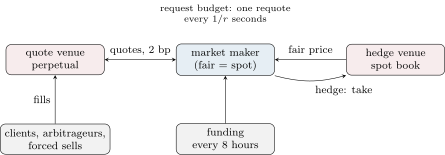
The chapter’s week (Figure 24.1): a coin at $60 000 with 3% daily volatility; clients send $10 000 orders to the perpetual half a second apart on average, 52% of them buys; arbitrageurs take $20 000 whenever a quote has gone stale by more than its half-spread plus a basis point. The maker quotes 2 basis points either side of the fair price, pays a maker fee of basis point (a rebate), and hedges on spot by taking at a half-spread of 0.5 basis point plus a 1-basis-point fee and 20 milliseconds of slippage. It holds at most $200 000 of perpetual inventory on either side (the hedge makes it delta-neutral; the limit bounds the basis risk).
24.2 Funding and basis at speed
A perpetual future (One Quant Book 3, chapter 17) has no expiry; a funding payment at fixed times keeps it close to the index. A maker whose perpetual position is hedged in spot is exposed not to the coin but to the basis between the two and to the funding paid on the perpetual leg. In the model the clients’ slight preference for buying leaves the maker short the perpetual (long spot) most of the week; with funding at 1 basis point per interval on average, it receives a few hundred dollars. Funding matters more to the maker’s timing than to its level: positions carried across a funding timestamp pay or earn the interval’s rate, positions opened after it do not, and the rate is known in advance from the premium index.
24.3 Liquidation flows
Definition 24.3 (Liquidation absorption)
Liquidation absorption is providing liquidity to the forced orders a venue’s liquidation engine sends into its book during a cascade, at prices that discount the forced selling, with a hedge on another venue and the capacity to hold the position until the dislocation reverts.
The planted cascade: on the fourth day at noon the perpetual falls 80 basis points below spot over five minutes and recovers over the next hour, with a ten-minute time constant (Figure 24.2); forced sells of $50 000 a second arrive for five minutes. A maker that pulls its bid while the forced sells arrive earns nothing from it ($600 over the week’s cascade account). One that absorbs them into a $5 million limit from the first second buys early, at shallow discounts, and earns $5 200 from the basis’s recovery; one that waits until the perpetual is 40 basis points below spot earns $20 800; at 60 basis points it is too late to fill the limit, and earns $17 800.
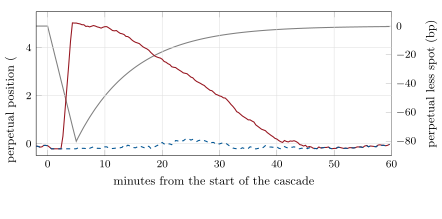
hf_crypto.absorption.As of September 2026 — Limits, funding clocks and the October 2025 cascade
A large spot venue’s exchange-information endpoint returned, on 24 September 2026, request-weight limits of 6 000 a minute and order limits of 100 per 10 seconds and 200 000 a day. The same venue’s futures funding is exchanged at 00:00, 08:00 and 16:00 UTC, with an interest component of 0.01% per interval for most contracts. On 10 October 2025, after a tariff announcement, $19 billion of leveraged crypto positions were liquidated within 24 hours, as a research report of a crypto news publisher counted them (One Quant Book 3, chapter 18).
24.4 Rate-limit-aware quoting
A crypto venue meters requests (One Quant Book 3, chapter 15): weights per minute, orders per ten seconds, orders per day. The tightest rule sets how often the maker can move its quotes. With the dated box’s limits and one instrument, the daily order cap allows 2.3 orders a second, 1.16 requotes of two orders each: the daily cap, not the ten-second one, binds. Quoting five instruments within the same budget leaves each 0.23 requotes a second.
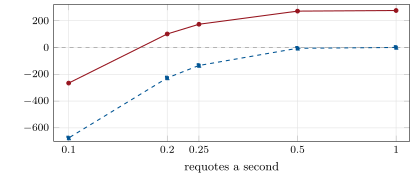
hf_crypto.budget.The cost of a thin budget is stale quotes (Figure 24.3): at one requote a second the arbitrageurs find nothing; every two seconds they take $6 400 over the week; every four, $135 000; every ten, $675 000, and the week loses $266 000. Quoting five instruments within one account’s budget turns a $275 000 week into roughly $100 000; a maker adds accounts, venues’ market-maker tiers with larger limits, or fewer instruments, before it adds quotes.
24.5 Market-maker programmes and their obligations
Venues pay makers for liquidity through programmes (One Quant Book 3, chapter 25): a rebate on maker volume if the maker’s quotes meet an uptime requirement, the share of sampled moments at which both sides are within a maximum spread and carry a minimum size. The chapter’s maker is two-sided and within 10 basis points 90% of the time; its inventory limits, which pull a side when full, are what cost it uptime, and the programme’s requirement is a constraint on its risk management as much as on its technology. Token issuers sign market-making agreements with obligations of the same kind (One Quant Book 3, chapter 24).
24.6 Strategy files
Strategy file 24.1 — Cross-exchange market making
Who pays you, and why. Traders on the less liquid venue, who pay the spread there for immediacy that the deep venue provides more cheaply.
Instruments and venues. One coin’s perpetual or spot on a quote venue; the deepest spot book as hedge venue.
Signal. The hedge venue’s book as fair value; the quote venue’s queue and flow.
Sizing and execution. Quote at a half-spread above the hedge’s cost; hedge every fill at once; cap inventory to bound the basis risk.
Costs. The hedge (1.5 basis points a fill in the model), transfers between venues, custody.
How it dies. Venues that cannot be reached with money: Makarov and Schoar’s cross-country premia persisted because capital could not move.
Horizon, capacity, infrastructure. Milliseconds; accounts and inventory on both venues.
Backtest honestly. Both books on one clock; transfer times; the hedge’s real fill price.
Sources. Makarov and Schoar (2020); this chapter.
Strategy file 24.2 — Cross-exchange latency taking
Who pays you, and why. Makers on slower venues whose quotes lag the leading book (chapter 8).
Instruments and venues. One coin on several venues; the leader, usually the deepest.
Signal. The leader’s move against a lagging venue’s quotes, beyond fees.
Sizing and execution. Take the stale quote; offset on the leader or hold to convergence within inventory limits.
Costs. Taker fees on both venues; the risk that the lag is information, not staleness.
How it dies. Makers who requote faster: in the model a maker requoting every second leaves nothing; every four seconds, $135 000 a week.
Horizon, capacity, infrastructure. Milliseconds; co-location where venues offer it.
Backtest honestly. The lagging venue’s quotes as they were, including the maker’s own requote schedule.
Sources. Chapter 8; this chapter.
Strategy file 24.3 — Funding-timestamp trading
Who pays you, and why. Leveraged traders who hold perpetuals across funding times and pay the rate.
Instruments and venues. Perpetuals and their spot hedges; funding at fixed times (00:00, 08:00 and 16:00 UTC on one large venue).
Signal. The predicted funding rate from the premium index before each timestamp.
Sizing and execution. Hold the side that receives across the timestamp, hedged in spot; unwind after it.
Costs. Two legs’ fees twice; basis moves around the timestamp as others do the same.
How it dies. Crowding: the basis moves before the timestamp and takes the rate with it.
Horizon, capacity, infrastructure. Minutes around each timestamp.
Backtest honestly. Funding rates as published before the timestamp; the basis in the minutes around it.
Sources. One Quant Book 3, chapter 17.
Strategy file 24.4 — Liquidation-flow absorption
Who pays you, and why. Leveraged traders whose positions the liquidation engine sells regardless of price.
Instruments and venues. Perpetuals during cascades; spot on another venue as the hedge.
Signal. The basis’s depth, the liquidation engine’s forced orders, open interest near liquidation prices.
Sizing and execution. Absorb once the basis is deep (40 basis points in the model), up to capacity; hedge on spot; hold to the recovery.
Costs. Hedging in a falling market; the risk that the dislocation is the new price; the venue’s own solvency.
How it dies. Cascades deeper than capacity, and venues that auto-deleverage the absorbers’ winning positions, as some did on 10 October 2025 when $19 billion of positions were liquidated in a day.
Horizon, capacity, infrastructure. Minutes to hours; balance sheet on several venues.
Backtest honestly. Liquidation flows as the engine sent them; auto-deleveraging rules as of the date.
Sources. One Quant Book 3, chapter 18; the dated box.
Strategy file 24.5 — Rate-limit-aware quoting under a programme
Who pays you, and why. The venue’s programme rebate, and clients through the spread.
Instruments and venues. Quote venues with request budgets and maker programmes.
Signal. The value of a requote: the fair price’s move since the last quote against the half-spread.
Sizing and execution. Spend requests where the quote is stalest; keep both sides up for uptime; fewer instruments per account.
Costs. Stale quotes when the budget binds ($102 000 a week at one requote every four seconds in the model).
How it dies. Budgets cut by the venue, programmes changed.
Horizon, capacity, infrastructure. Seconds; a request governor (firm.ratelimit).
Backtest honestly. The venue’s limits as of the date (dated box), not the documentation’s example values.
Sources. One Quant Book 3, chapters 15 and 25.
Strategy file 24.6 — Spot-perpetual basis market making
Who pays you, and why. Traders paying for leverage in the perpetual, through funding and the basis.
Instruments and venues. A perpetual and its spot, on one or two venues.
Signal. The basis against its expected level given the funding rate.
Sizing and execution. Quote the basis as one instrument; hedge the legs; carry the position across funding times when the rate pays.
Costs. Two legs’ fees; basis dislocations in cascades.
How it dies. Funding reversals and cascades; the first perpetual, BitMEX’s XBTUSD, listed in 2016 with eight-hourly funding, set the template every venue copied (One Quant Book 3, chapter 17).
Horizon, capacity, infrastructure. Hours to weeks.
Backtest honestly. Funding and basis histories by venue.
Sources. One Quant Book 3, chapter 17.
24.7 Tutorial: around the clock
Goal. Run a week of cross-exchange market making with funding, a cascade and a request budget, and decompose the result. End state: the three figures and the table below.
The quotes move only when the budget allows; the inventory limits, and absorption in a cascade.
    path = []
    for t in range(n):
        f = w.fair[t]
        perp_mid = f * (1.0 + w.basis[t])
        if t % period == 0:
            quote_mid = perp_mid
            requests += 2
        hs = half_bp * 1e-4 * quote_mid
        bid, ask = quote_mid - hs, quote_mid + hs
        deep = w.basis[t] <= -absorb_from_bp * 1e-4
        lim_bid = absorb_limit if (absorb and w.basis[t] < 0.0 and deep) else inv_limit
        quoting_bid = (perp * f < lim_bid) and (w.forced[t] == 0.0 or (absorb and deep))
        quoting_ask = perp * f > -inv_limit
        on += 1
Listing 24.1. Requote on the budget’s schedule; each side’s limit; absorption only when the basis is deep. code/firm/cryptohft/firm_cryptohft.py The fills and the hedge: clients, forced sells, arbitrageurs on stale quotes; each fill hedged on spot at once.
        up_ok += quoting_bid and quoting_ask and 2 * hs / quote_mid * 1e4 <= max_spread_bp
        fills = []                                   # (coins, price): + the maker buys
        for _ in range(int(w.clients[t])):
            if w.buy[t] and quoting_ask:
                fills.append((-w.clip / ask, ask))
            elif (not w.buy[t]) and quoting_bid:
                fills.append((w.clip / bid, bid))
        if w.forced[t] > 0.0 and quoting_bid:
            fills.append((w.forced[t] / bid, bid))
        thr = arb_threshold_bp * 1e-4 * perp_mid
        if ask < perp_mid - thr and quoting_ask:
            fills.append((-arb_clip / ask, ask))
        elif bid > perp_mid + thr and quoting_bid:
            fills.append((arb_clip / bid, bid))
        for coins, px in fills:
            parts["spread"] += abs(coins) * hs
            parts["adverse"] += coins * (perp_mid - px) - abs(coins) * hs     # value vs the perp mid, net of spread
            parts["fees"] -= abs(coins) * px * maker_bp * 1e-4
            # hedge on spot at once: sell spot if the maker bought the perp
            slip = abs(coins) * f * (hedge_half_bp * 1e-4 + slip_sd * abs(w.hedge_noise[t]))
            parts["hedge"] -= slip + abs(coins) * f * taker_bp * 1e-4
Listing 24.2. Fills against the quotes, the maker’s edge against the perpetual’s mid, fees and the hedge’s cost. code/firm/cryptohft/firm_cryptohft.py - The week, the budget sweep and the absorption variants (
hf_crypto); the budget fromfirm.ratelimit’s governor.
What to change next. Skew quotes with inventory instead of pulling a side; let the fair price come from two hedge venues; add transfer delays and a withdrawal freeze on the quote venue.
| week’s component (requote every second, absorbing from 40 bp) | $ |
|---|---|
| spread earned on the perpetual | 574 912 |
| lost to stale quotes | 0 |
| hedging on spot (half-spread, fee, slippage) | |
| maker rebates | 143 728 |
| funding | 274 |
| cascade (basis recovery) | 20 842 |
| total | 275 445 |
24.8 Build: the crypto cross-exchange maker
Purpose. Simulate cross-exchange making with hedging, funding, a liquidation cascade and a request budget.
Interface. Week(seed, days, sigma_day, clients_per_s, clip, buy_share, cascade_day, cascade_depth_bp, forced_per_s), run(week, half_bp, requote_per_s, inv_limit, absorb, absorb_limit, absorb_from_bp, record) and fee and latency parameters, budget_from(governor, instruments). Built on Book 3’s firm.perp, firm.ratelimit and firm.mmprogram.
Rules. Dollars; basis points; one-second steps; every fill hedged at once; funding paid by the holder at eight-hour marks.
Acceptance tests. code/firm/cryptohft/tests/: the parts add up to the total; fresh quotes are never picked off; stale quotes cost more and use fewer requests; the budget from the governor’s daily cap; absorbing earns more from the cascade than pulling and builds a multi-million position.
Stretch. Inventory skew; two hedge venues; transfer delays; auto-deleveraging of the absorber.
Sources and further reading
- I. Makarov, A. Schoar, Trading and arbitrage in cryptocurrency markets, Journal of Financial Economics 135(2), 2020, 293–319.
- One Quant Book 3, chapters 15, 17, 18 and 25, and their sources for the dated box.
24.9 Exercises
Exercise 24.1 ★
A maker quotes 2 basis points either side, receives a 0.5-basis-point maker rebate, and hedges by taking at a 0.5-basis-point half-spread and a 1-basis-point fee. What is its edge per round trip, before slippage?
Solution
Solution of Exercise 24.1.
basis point a fill.
Exercise 24.2 ★
A venue allows 200 000 orders a day. How many requotes (cancel and new) a second is that for one instrument, and for five?
Solution
Solution of Exercise 24.2.
orders a second, 1.16 requotes; for five instruments, 0.23 each.
Exercise 24.3 ★
A maker is short $150 000 of perpetual at a funding timestamp with a rate of 0.01%. What does it receive or pay?
Solution
Solution of Exercise 24.3.
Longs pay shorts when the rate is positive: it receives .
Exercise 24.4 ★★
Why does absorbing from the first second of the cascade earn less than waiting until the basis is 40 basis points deep?
Solution
Solution of Exercise 24.4.
From the first second the limit fills at shallow discounts and the position then suffers the rest of the fall before it recovers; waiting until 40 basis points buys at deeper discounts and gains the whole recovery from there: $20 800 against $5 200.
Exercise 24.5 ★★
Why does a thin request budget lose money to arbitrageurs even though the maker’s spread is unchanged?
Solution
Solution of Exercise 24.5.
Between requotes the fair price moves; when it moves by more than the half-spread plus the arbitrageurs’ threshold, they take the stale quote at a price already worse than the fair one. The spread is earned only on fills at fresh quotes.
Exercise 24.6 ★★
What made Makarov and Schoar’s cross-country premia persist?
Solution
Solution of Exercise 24.6.
Capital controls and the difficulty of moving funds between countries, which kept arbitrageurs from closing cross-country gaps.
Exercise 24.7 ★★★
Coding. Rerun the absorption with a 60-basis-point threshold and with a $2 million limit from the first second. Which does better, and why?
Solution
Solution of Exercise 24.7.
The 60-basis-point threshold earns $17 800 from the cascade; the $2 million limit from the first second loses $600. Timing matters more than capacity: the small early position is full before the discount is worth taking.
Exercise 24.8 ★★★
Find the flaw. “Our backtest quotes 20 instruments on one account and requotes each every second; it made $5 million last month.”
Solution
Solution of Exercise 24.8.
One account’s daily order cap allows about 0.06 requotes a second per instrument across twenty; requoting each every second would be refused, and at the rate allowed the quotes would be stale and picked off. The backtest must enforce the venue’s limits.
24.10 Problem: Around the Clock
Problem 24.1
Weekend problem — around the clock
A crypto market maker quotes a perpetual on one venue and hedges on another for a week that contains one liquidation cascade.
Part I — The structure.
- Define cross-exchange market making and the hedge venue.
- What did Makarov and Schoar find?
- Summarise the dated box.
- Describe the chapter’s week.
Part II — Funding and cascades.
- What is the maker exposed to once hedged?
- Define liquidation absorption.
- Give the cascade’s result for pulling, absorbing at once, from 40 and from 60 basis points.
- What can go wrong with absorption?
Part III — Budgets and programmes.
- Which of the dated box’s limits binds, and at how many requotes a second?
- Give the week’s result at one requote every 1, 2, 4 and 10 seconds.
- What does a programme’s uptime requirement measure, and what costs the maker uptime here?
- How would you spend a thin budget?
Part IV — The verdict.
- State the named result: the cross-exchange maker’s P&L by component over a week with one cascade, and the capture it gives up to stay inside its request budget.
- Which component is largest, and which is most fragile?
- What would a second hedge venue add?
- Which strategy file is most exposed to a venue’s failure?
- How should funding timestamps change the maker’s inventory policy?
- What does the maker owe the venue under a programme?
- How would you test the model’s cascade against the October 2025 record?
- In one sentence: what does a cross-exchange maker sell?
Solution
Solution of Problem 24.1.
- See Definition 24.1 and Definition 24.2.
- Large, recurrent arbitrage opportunities across exchanges, larger across countries than within, kept open by capital controls.
- 6 000 weight a minute, 100 orders per 10 seconds, 200 000 a day; funding at 00:00, 08:00 and 16:00 UTC; $19 billion liquidated on 10 October 2025.
- A coin at $60 000, 3% daily volatility, clients every half second, arbitrageurs on stale quotes, 2 basis points either side, a spot hedge, funding every eight hours, a cascade on day four.
- The basis between perpetual and spot, and funding.
- See Definition 24.3.
- $600, $5 200, $20 800 and $17 800.
- A deeper cascade, the dislocation becoming the price, auto-deleveraging, the venue’s solvency.
- The daily cap: 1.16 requotes a second for one instrument.
- $275 400, $270 800, $173 000 and .
- Both sides within a maximum spread with a minimum size; the inventory limits pulling a side.
- On the quotes that are stalest relative to the fair price, and on fewer instruments.
- Spread $574 900, hedging , rebates $143 700, funding $300, cascade $20 800: $275 400; a budget of one requote every four seconds gives up $102 400 of it, every ten seconds all of it and more.
- The spread is largest; the hedge’s cost and the budget are the most fragile.
- A second fair price and a second place to hedge, reducing slippage and venue risk.
- Liquidation absorption, which holds positions on venues during their worst moments.
- Carry the side that receives across timestamps when the basis allows; flatten the side that pays before them.
- Uptime and depth, as the programme defines them.
- Compare the model’s basis path and forced flow with the venues’ records of that day.
- Immediacy on one venue, priced from another.
24.11 Interview questions
Interview question 24.1 ★ trader
Bitcoin is 30 dollars higher on one venue than another. What do you check before trading it?
Solution
Solution of Interview question 24.1.
Fees on both venues, whether funds and coins can be moved (withdrawal status, transfer time), the depth behind the prices, and whether one venue’s price is stale or halted.
What the interviewer is looking for: transferability and executable depth.
Interview question 24.2 ★★ developer
Design a request governor for three venues with different limits and a quoting engine that must never be banned.
Solution
Solution of Interview question 24.2.
One governor per venue and account, mirroring each limit as a window; a priority queue of requests by value; hedges before requotes; a safety margin below the limit; react to 429 by pausing.
What the interviewer is looking for: priorities and margins.
Interview question 24.3 ★★ researcher
How would you forecast the next funding rate, and how much of it is known before the timestamp?
Solution
Solution of Interview question 24.3.
The rate is a time average of the premium index over the interval plus a clamped interest term; most of it is known before the timestamp as the average accumulates.
What the interviewer is looking for: the formula’s averaging.
Interview question 24.4 ★★ risk
Your firm holds $20 million of coins on a venue that suspends withdrawals. What is at risk, and what should the limits have been?
Solution
Solution of Interview question 24.4.
The coins and the positions hedged elsewhere against them; limits on balances per venue by the venue’s risk, and hedges that do not depend on that venue.
What the interviewer is looking for: venue counterparty risk.
Interview question 24.5 ★★ trader
Open interest is high and the basis is falling fast. Do you bid the perpetual? How much, and where do you hedge?
Solution
Solution of Interview question 24.5.
Only once the basis is deep and the forced flow visible, within a capacity set by the recovery’s likely size; hedge on the deepest spot venue.
What the interviewer is looking for: timing and capacity.
Interview question 24.6 ★★★ researcher
With a requote every seconds, a price volatility per square-root second and a half-spread , estimate the rate at which an arbitrageur finds a quote stale by more than .
Solution
Solution of Interview question 24.6.
The price’s change over has standard deviation ; the chance it exceeds in size is , so stale quotes appear at about that rate per requote interval.
What the interviewer is looking for: diffusion over the requote interval.