Market Making and High-Frequency Trading · Market making
14Depositary Receipts and Dual Listings
A company’s shares trade in London and its receipts in New York. For two hours both are open and one is a currency conversion of the other; for the rest of New York’s day one of them is priced by a market maker who can only estimate. In this chapter’s simulation, the receipt’s fair value is known to 2 basis points while the home market is open and to 74 once it has closed, 94 without a proxy for the home market; a conversion through the depositary pays only when the gap exceeds 29 basis points.
14.1 Receipts, ratios and the depositary
A depositary receipt (Book 1, chapter 17) is issued by a depositary bank against shares it holds in custody in the home market. Each receipt represents a fixed number of shares.
Definition 14.1 (Depositary receipt ratio)
The depositary receipt ratio is the number of home-market shares one receipt represents (or its inverse, as the depositary states it); with it and the exchange rate, a receipt’s parity value is the home price times the ratio times the currency’s price in the receipt’s currency.
Definition 14.2 (Depositary receipt issuance)
Depositary receipt issuance is the creation of new receipts by the depositary against shares delivered into its custody; cancellation is the reverse, receipts surrendered for the shares they represent. Both carry the depositary’s fee per receipt and settle on both markets’ settlement cycles.
Issuance and cancellation play for receipts the role creation and redemption play for exchange-traded funds (chapter 12): they let an arbitrageur move inventory between the two markets when the prices part. A dual listing, the same shares listed on two exchanges, needs no depositary: the shares move between registers, with the same economic effect and its own frictions.
Definition 14.3 (Pre-release)
Pre-release is the issuance of depositary receipts before the corresponding shares have been deposited, allowed under depositary agreements only if the broker receiving them has an agreement with the depositary and the broker or its customer owns the corresponding shares.
As of September 2026 — Pre-release in enforcement, and a depositary’s fees
On 26 December 2018 the SEC announced that JPMorgan would pay more than $135 million to settle charges of improper handling of pre-released American depositary receipts: it had provided receipts to brokers in thousands of pre-release transactions when neither the broker nor its customers had the foreign shares needed to support them. The SEC said it had then held all four depositary banks accountable; its 2018 releases announced settlements of nearly $75 million with Deutsche Bank subsidiaries, more than $54 million with BNY Mellon and more than $38 million with Citibank. A depositary’s fee schedule, as NIO disclosed it in its annual report for 2018, charged up to $0.05 per receipt issued and up to $0.05 per receipt cancelled.
14.2 Arbitrage in overlapping hours
While both markets are open, the receipt is a portfolio of three prices: the home shares, the currency and the receipt itself. Gagnon and Karolyi compared intraday receipt prices with synchronous home prices, currency-adjusted, for 506 cross-listed stocks from 35 countries: deviations from parity averaged an economically small 4.9 basis points, but were volatile and could be large, and they rose with proxies for the holding costs that impede arbitrage. A receipt market maker in the overlap quotes the receipt from the home market’s live price (chapter 2’s cross-instrument fair price) and hedges in the home shares and the currency; an arbitrageur takes the receipt when its gap to parity exceeds the round trip in three instruments.
In the chapter’s simulation, with 2 basis points of noise in the home mid and 4 in the receipt’s, the gap between the receipt and parity has a standard deviation of 4.5 basis points and exceeds a 10-basis-point round trip in 2.7% of the overlap’s minutes: an arbitrage that exists, rarely, and goes to whoever sees it first.
14.3 Pricing across non-overlapping hours
When the home market closes, the receipt keeps trading and its market maker needs a fair value without the home price. The last home price moved by the currency is the naive answer; the last home price moved by a proxy that still trades (a futures contract on the home index, a fund on the home market listed alongside the receipt) and by the currency is better; the receipt’s own trading, and the prices of other receipts from the same country, add information the proxy does not have.
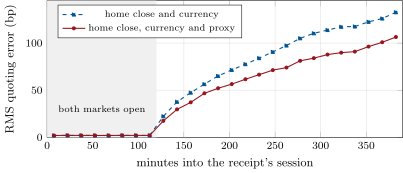
hf_dr.by_minute.The error grows with the square root of the time since the home close (Figure 14.1): the proxy removes the market’s part and leaves the company’s own, which no proxy can carry. A market maker quoting the receipt in those hours widens its spread with the time since the home close, skews with its forecast, and hedges the market part in the proxy.
Froot and Dabora studied a sharper case, companies that pool their cash flows but list twin shares in different markets: the twins’ relative price moved with the markets in which each traded most. A twin’s relative price rose when the market on which it traded relatively intensively rose, which no explanation they tested (dividends, expenditures, voting rights, currency, ex-dividend timing, taxes) fully accounted for.
14.4 Conversion: issuance, cancellation and its frictions
Conversion moves shares between markets at a cost: the depositary’s fee per receipt, the spreads of the legs, the currency, and financing over the settlement lag. For a $25 receipt, a $0.05 fee is 20 basis points; with 6 basis points of trading costs and two days’ financing at 5%, the gap must exceed 28.8 basis points before converting pays (Listing 14.2). A market maker therefore converts to move inventory it could not unwind by trading, not to capture the everyday gap. In markets with limits on foreign ownership, conversion into receipts may be capped, and the receipt then trades at a lasting premium that no arbitrage can close.
14.5 Strategy files
Strategy file 14.1 — Receipt against ordinary shares in overlapping hours
Who pays you, and why. Investors in the receipt or the home shares who trade without watching the other listing, and liquidity providers whose quotes follow the other market late.
Instruments and venues. The receipt on a US exchange, the ordinary shares at home, the currency.
Signal. The receipt’s price against the home price times the ratio times the currency, beyond the three legs’ round-trip cost.
Sizing and execution. Take the dearer side and buy the cheaper; or quote the receipt from the home market and hedge fills there and in the currency; hold until the gap closes or convert when inventory builds.
Costs. Three spreads, fees on both exchanges, stamp duties at home where they apply, the currency’s spread.
How it dies. Gaps average a few basis points (4.9 in Gagnon and Karolyi’s sample) and go to the fastest link between the two markets.
Horizon, capacity, infrastructure. Milliseconds to minutes in the overlap; links between the two markets’ data centres.
Backtest honestly. Synchronous prices on one clock; the currency’s executable price; the home market’s settlement and stamp duty.
Sources. Gagnon and Karolyi (2010).
Strategy file 14.2 — Pricing the receipt when the home market is closed
Who pays you, and why. Investors who trade the company in their own hours and pay for immediacy when the home market cannot provide it.
Instruments and venues. The receipt; a proxy for the home market (index future, country fund); the currency.
Signal. The home close moved by the proxy and the currency, updated by the receipt’s own trading and by other receipts from the same market.
Sizing and execution. Quote with a spread that widens with the time since the home close; hedge the market part in the proxy; carry the company’s own part to the home open.
Costs. The proxy’s spread and basis; the company-specific risk overnight.
How it dies. Company news while the home market is closed: in the simulation the error with the proxy still reaches 109 basis points at the end of the session.
Horizon, capacity, infrastructure. Hours; capacity from the receipt’s volume and the market maker’s appetite for overnight risk.
Backtest honestly. The proxy’s price at each quote; company announcements timed as released; the home open, not the close, as the exit.
Sources. This chapter; Froot and Dabora (1999) on how the location of trade moves prices.
Strategy file 14.3 — Conversion arbitrage through the depositary
Who pays you, and why. Demand concentrated on one listing (index inclusion, a local fund flow) that pushes it away from the other.
Instruments and venues. Receipts, ordinary shares, the depositary’s issuance and cancellation, the currency.
Signal. A gap beyond the conversion threshold: the fee per receipt as a share of its price, the legs’ costs and financing over the settlement lag.
Sizing and execution. Buy the cheap listing, convert, deliver into the dear one; size to the gap’s persistence, not its peak.
Costs. The depositary’s fee (up to $0.05 a receipt each way in the disclosed schedule), custody, taxes on transfer, financing.
How it dies. Ownership limits that cap conversion; and the temptation of pre-release, which the SEC’s 2018 cases show is a legal line.
Horizon, capacity, infrastructure. Days; capacity from the depositary’s processing and the gap’s size.
Backtest honestly. Settlement dates on both markets, the fee schedule in force, and the conversion’s real completion time.
Sources. SEC press releases on pre-release (2018); NIO’s annual report (fee schedule).
14.6 Tutorial: two prices, one company
Goal. Measure how well a receipt market maker knows its fair value in open and closed hours, and when conversion pays. End state: Figure 14.1 and the numbers in the text.
- The pair.
firm.drarb.Pair: 40 receipt sessions of 390 minutes, the home market open for the first 120; a receipt of two shares at 1.25 dollars per unit of home currency; the company’s value a market part (1% a day) and its own part (1.2%); the currency 0.6%; a proxy following the market part with a basis of 0.2% a day. Fair values from the last home mid, the currency and, after the home close, the proxy’s move.
    def quote(self, method: str = "proxy") -> np.ndarray:
        last = self.home_mid[self.t_home] * self.ratio * self.fx
        if method == "home":
            return last
        return last * (1.0 + (self.proxy - self.proxy[self.t_home]))
Listing 14.1. The receipt’s fair value: last home mid times ratio times currency, moved by the proxy since the home close. code/firm/drarb/firm_drarb.py - Errors against the true value, by minute of the session (
hf_dr.errors,hf_dr.by_minute). Conversion. The threshold for a $25 receipt with a $0.05 fee.
def threshold_bp(dr_price: float, fee_per_dr: float, cost_bp: float, days: int = 2, rate: float = 0.05) -> float:
    return 1e4 * fee_per_dr / dr_price + cost_bp + 1e4 * rate * days / 360.0


def conversion_edge(dr: float, home: float, ratio: float, fx: float, fee_per_dr: float, cost_bp: float,
                    days: int = 2, rate: float = 0.05) -> tuple[str, float]:
    parity = dr_fair(home, ratio, fx)
    cost = fee_per_dr + (cost_bp * 1e-4 + rate * days / 360.0) * parity
    if dr - parity > cost:
        return "issue", dr - parity - cost
    if parity - dr > cost:
        return "cancel", parity - dr - cost
    return "none", 0.0
Listing 14.2. The conversion threshold and decision: fee, trading costs, financing over the settlement lag. code/firm/drarb/firm_drarb.py
What to change next. Update the fair value from the receipt’s own trades after the home close (chapter 2’s filter); add other receipts from the same country as a second proxy; model the overnight gap to the home open.
The numbers: 2.0 basis points of root-mean-square error while the home market is open (the home mid’s own noise), 74 after it closes with the proxy and 94 without, rising to 109 and 137 at the end of the session. The proxy removes the market’s share of the error and leaves the company’s.
14.7 Build: the receipt arbitrage module
Purpose. Price a receipt across open and closed hours and decide conversions.
Interface. dr_fair(home, ratio, fx), closed_fair(home_close, ratio, fx, proxy_move, beta), threshold_bp(dr_price, fee_per_dr, cost_bp, days, rate), conversion_edge(dr, home, ratio, fx, fee_per_dr, cost_bp, days, rate), Pair(days, seed) with quote(method) and error_bp(method).
Rules. The currency is dollars per unit of home currency; conversion costs include financing over the settlement lag.
Acceptance tests. code/firm/drarb/tests/: fair values by hand; threshold and edges for issue, cancel and nothing; the home reference is the current minute while open and the close afterwards; the two methods agree while open; the proxy lowers the closed-hours error, which is more than ten times the open-hours error.
Stretch. The receipt’s own trades as information; overnight gaps; ownership limits on conversion.
Sources and further reading
- L. Gagnon, G. A. Karolyi, Multi-market trading and arbitrage, Journal of Financial Economics 97(1), 2010, 53–80.
- K. A. Froot, E. M. Dabora, How are stock prices affected by the location of trade?, Journal of Financial Economics 53(2), 1999, 189–216.
- US Securities and Exchange Commission, press releases 2018-138, 2018-255, 2018-285 and 2018-306 on pre-released ADRs.
- NIO Inc., annual report on Form 20-F for 2018, fees and charges for ADS holders.
14.8 Exercises
Exercise 14.1 ★
Home shares trade at 10 in home currency, the ratio is two shares per receipt and the currency is at 1.25 dollars. What is parity? After the home close a proxy rises 1% and the stock’s beta to it is 1.2; what is the receipt’s fair value?
Solution
Solution of Exercise 14.1.
Parity ; after the close, .
Exercise 14.2 ★
What is the conversion threshold for a $25 receipt with a $0.05 fee, 6 basis points of trading costs, and two days’ financing at 5%?
Solution
Solution of Exercise 14.2.
basis points, plus 6, plus : 28.8 basis points.
Exercise 14.3 ★
The receipt trades at $25.20 and parity is $25.00. Issue, cancel or neither, and with what edge per receipt?
Solution
Solution of Exercise 14.3.
The gap is $0.20 (80 basis points), above the threshold: issue (buy shares, deposit, sell receipts). Edge a receipt.
Exercise 14.4 ★★
Why does the closed-hours error grow with the square root of time, and what remains after the proxy?
Solution
Solution of Exercise 14.4.
The unobserved moves accumulate as a random walk, so their standard deviation grows with the square root of the time since the last observation. The proxy carries the market part; the company’s own part (1.2% a day here) remains.
Exercise 14.5 ★★
Gagnon and Karolyi found parity deviations averaging 4.9 basis points. Why can a market maker still earn from receipts?
Solution
Solution of Exercise 14.5.
By providing liquidity: the spread paid by investors on each side, with the other listing as a hedge; the average deviation is small because market makers and arbitrageurs keep it so, and it is their spread that pays them.
Exercise 14.6 ★★
What made pre-release improper in the SEC’s 2018 cases?
Solution
Solution of Exercise 14.6.
Receipts were provided to brokers when neither the broker nor its customers had the foreign shares: receipts were created without shares behind them.
Exercise 14.7 ★★★
Coding. Rerun hf_dr.errors with the company’s own daily volatility at 0.6% instead of 1.2%. How much does the closed-hours error with the proxy fall?
Solution
Solution of Exercise 14.7.
The closed-hours error with the proxy falls from 74 to 38 basis points (from 109 to 57 at the end of the session); without the proxy, from 94 to 70. Halving the company’s own volatility nearly halves the error the proxy leaves.
Exercise 14.8 ★★★
Find the flaw. “The receipt trades 40 basis points below parity at 21:00 London time: buy it and sell the shares at tomorrow’s open.”
Solution
Solution of Exercise 14.8.
At 21:00 London the home market is closed: the 40 basis points are measured against a stale home close. The receipt may be right and the parity stale; the trade is a bet on the home open, with the company’s news risk overnight, not an arbitrage.
14.9 Problem: Two Prices, One Company
Problem 14.1
Weekend problem — two prices, one company
A market maker quotes a company’s receipt in New York through the hours when its home market is open and closed.
Part I — The instrument.
- Define the depositary receipt ratio and parity.
- Define depositary receipt issuance and cancellation.
- Define pre-release and the condition that makes it proper.
- Summarise the dated box.
Part II — Prices.
- What did Gagnon and Karolyi measure, and find?
- What did Froot and Dabora find about twin shares?
- Write the closed-hours fair value.
- What information does the receipt’s own trading add after the home close?
Part III — The simulation.
- Give the open-hours and closed-hours errors, with and without the proxy.
- How large are the overlap’s gaps, and how often do they exceed a 10-basis-point round trip?
- What is the conversion threshold, and why is it so much larger than the everyday gap?
- How should the market maker’s spread change through the session?
Part IV — The verdict.
- State the named result: the receipt market maker’s quoting error in closed hours against open hours, and the conversion threshold after fees.
- When does conversion pay?
- What do foreign ownership limits do to the arbitrage?
- Which of the three strategy files carries overnight risk?
- How would you hedge the company’s own part overnight?
- Why must the backtest use the home open, not the close, as the exit?
- What would a second proxy (another receipt from the same market) add?
- In one sentence: what does the receipt market maker sell in the hours after the home close?
Solution
Solution of Problem 14.1.
- See Definition 14.1; parity is home price times ratio times the currency.
- See Definition 14.2.
- See Definition 14.3: the broker or its customer must own the shares.
- JPMorgan paid more than $135 million (December 2018) for pre-release without the shares; all four depositary banks were charged; fees up to $0.05 a receipt each way.
- Intraday parity deviations for 506 cross-listed stocks from 35 countries: 4.9 basis points on average, volatile, larger with holding costs.
- Twins’ relative prices moved with the markets where each traded most.
- The home close times ratio times the current currency, times one plus beta times the proxy’s move since the close.
- Buyers and sellers who know something about the company that the proxy does not carry.
- 2.0 open; 74 closed with the proxy, 94 without; 109 and 137 at the session’s end.
- A standard deviation of 4.5 basis points; above 10 in 2.7% of the overlap’s minutes.
- 28.8 basis points for a $25 receipt; the fee alone is 20.
- Narrow in the overlap, widening with the square root of the time since the home close.
- 2 basis points while the home market is open against 74 after (with a proxy), and 28.8 basis points to convert.
- When a gap persists beyond the threshold for longer than the settlement lag, typically from concentrated demand on one listing.
- They cap conversion in one direction, so a premium can last.
- Pricing the receipt when the home market is closed.
- It cannot be hedged by a proxy: only by the home shares at the open, or by a smaller position.
- The trade ends when the home market opens; the close is before the risk.
- Part of the company-specific and sector moves the index proxy misses.
- Immediacy in a company whose home price is unknown until morning.
14.10 Interview questions
Interview question 14.1 ★ trader
A receipt represents two shares. The shares are at 800 pence and sterling at $1.27. Where should the receipt trade?
Solution
Solution of Interview question 14.1.
, before fees and costs.
What the interviewer is looking for: ratio, currency, parity.
Interview question 14.2 ★★ researcher
How would you estimate a receipt’s fair value at 19:00 London time?
Solution
Solution of Interview question 14.2.
Home close times the current exchange rate, moved by the home index future’s change since the close times the stock’s beta; updated by the receipt’s own trades and those of related receipts, with an error that grows with time.
What the interviewer is looking for: proxy plus own-trade information, with an error model.
Interview question 14.3 ★★ trader
The receipt trades 1% above parity for a week. Why might nobody arbitrage it?
Solution
Solution of Interview question 14.3.
Conversion may be capped by ownership limits or suspended; the home shares may be hard to borrow; the costs (fees, taxes, settlement) may exceed 1%.
What the interviewer is looking for: limits to arbitrage.
Interview question 14.4 ★★ risk
Your desk wants to receive receipts before delivering the shares to the depositary. What do you check?
Solution
Solution of Interview question 14.4.
That the desk or its customer owns the shares, that the depositary agreement allows it, and that the process is documented; the 2018 cases turned on receipts issued with no shares behind them.
What the interviewer is looking for: ownership and the SEC’s cases.
Interview question 14.5 ★★ developer
Design the fair-value service for 300 receipts across four home markets and their currencies.
Solution
Solution of Interview question 14.5.
Reference data (ratios, fees, hours), live home prices and currencies, proxies per home market, a model per receipt updated on each input with its age, published with a confidence band to the quoting engines.
What the interviewer is looking for: hours-aware inputs and staleness.
Interview question 14.6 ★★★ researcher
Derive the root-mean-square error of the closed-hours fair value as a function of time since the home close, with and without the proxy.
Solution
Solution of Interview question 14.6.
With daily variances (market), (company) and (proxy basis), after a fraction of a day the error’s variance is without the proxy and with it, plus the home mid’s noise; the root grows with .
What the interviewer is looking for: variance accumulation by component.