Market Making and High-Frequency Trading · Market making
16Auctions and the Close
At ten to four the exchange publishes a buy imbalance of two hundred thousand shares in a stock. In the next ten minutes someone will sell them into the auction, and the price at which they do is set by whoever shows the best offer. In this chapter’s closing book the imbalance alone would lift the close by 14 cents on a $100 stock; a provider that offers 120 000 shares at the reference price holds the move to 9 cents and earns 6.9 cents a share, if 85% of the move would have reverted by the next morning. Late orders that change the imbalance cut that to 5.5 cents, unless the provider asks for a premium.
16.1 The closing auction as a liquidity event
The closing auction (Book 1, chapter 13) sets the price at which index funds, benchmarked managers and derivatives settle. That makes it the day’s largest single pool of liquidity, and one whose buyers and sellers care about getting the closing price more than about the price itself. Bogousslavsky and Muravyev measured the closing auction at 7.5% of daily US volume in 2018, up from 3.1% in 2010. Closing prices typically matched the pre-close bid or ask; price impact was lower than in continuous trading; and auction price deviations reverted quickly and almost completely, on average. Auction volume relative to intraday volume jumped on S&P 500 additions and rose permanently afterwards, which they read as the growth of indexing and exchange-traded funds feeding the close.
A market maker’s role there is to provide the other side of an imbalance, at a price, and carry the position overnight or hedge it.
16.2 Reading the imbalance publication
Before the auction the exchange publishes what it would do if it uncrossed now: the reference or indicative price, the paired shares, the imbalance and its side (the imbalance publication of One Quant Book 10, chapter 10).
As of September 2026 — One exchange’s closing schedule
Nasdaq’s frequently asked questions on its crosses (as published in November 2025) state that between 3:50 and 3:55 p.m. it disseminates the current reference price, the paired shares, the imbalance shares and the imbalance side every 10 seconds, and between 3:55 and 4:00 p.m. every second, adding near and far indicative clearing prices. Market-on-close orders must be received before 3:55 p.m.; limit-on-close orders before 3:58 p.m., those after 3:55 re-priced if more aggressive than the 3:50 or 3:55 reference prices; on-close orders can be modified or cancelled before 3:50 p.m. Imbalance-only orders exist to offset a market-on-close imbalance.
The publications are a forecast, not the answer: market-on-close orders keep arriving until their cutoff and limit-on-close orders after it. A provider that sizes its order on a publication must allow for the imbalance changing before the uncross.
16.3 Offsetting imbalances: pricing the order
Definition 16.1 (Imbalance-offsetting order)
An imbalance-offsetting order is a closing-auction order on the opposite side of a published imbalance, priced and sized to trade only if the auction needs it: a sell against a buy imbalance, a buy against a sell imbalance.
Definition 16.2 (Auction impact curve)
An auction impact curve is the uncrossing price’s move from the reference price as a function of the size of an imbalance, given the rest of the auction book; it is the auction’s supply curve seen from the imbalance.
In the chapter’s closing book (300 000 shares paired, limit-on-close orders of shares cents from $100 on each side), the impact curve is concave: 5 cents for 25 000 shares, 10 for 100 000, 14 for 200 000, 20 for 400 000. The provider’s offer moves the close back toward the reference; its profit is the gap between the close and tomorrow’s value on each share it sells. If a share of the closing move is information that stays, and the rest reverts, the provider sells at the close and expects tomorrow’s value , where is the move the imbalance alone would have caused (Listing 16.2). The best offer trades off size against price: selling more lowers the close for every share sold.
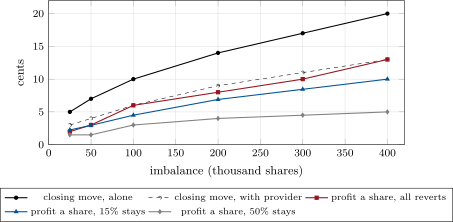
firm.auction. Data: hf_auction.offers.The profit a share grows with the imbalance, less than proportionally (Figure 16.1): 4.5 cents at 100 000 shares, 6.9 at 200 000 and 10 at 400 000 when 15% of the move stays. It depends as much on the reversal assumption as on the imbalance: at 200 000 shares, 8 cents if everything reverts, 4 if half stays. The reversal is what the provider must estimate from history, stock by stock, and it is the part of its model that can be wrong on the day that matters: an imbalance caused by news.
16.4 The auction and the continuous book before it
The auction does not happen in isolation. Traders who see the imbalance publication can trade in the continuous book before the close, and the closing book’s limit orders can be priced from it. A provider can hedge before the close (sell some of the stock in the continuous book, or a correlated future) or after (the closing price is a known number; the futures market trades on). The trade-at-settlement futures of Book 1, chapter 21 let a provider lock in a hedge at the index’s settlement price, removing the market part of its overnight risk at a known basis.
Late orders are the provider’s main risk inside the auction. With a late-order uncertainty of 60 000 shares on a published 200 000, the offer that was best on the publication (120 000 shares at the reference price) earns 5.5 cents a share instead of 6.9; the best offer given the uncertainty keeps the size and asks 4 cents above the reference, earning 6.0: a premium that protects the provider when the imbalance shrinks and its offer would otherwise set the close.
16.5 Opening auctions and reopenings
The opening auction and the reopening after a halt have the same mechanics with less information and more risk: the overnight news is not yet in any price, the imbalance is smaller relative to the day’s uncertainty, and the reference price is stale. Providers ask for more, and hedge in the index future as soon as the stock opens.
16.6 Strategy files
Strategy file 16.1 — Closing-auction imbalance liquidity provision
Who pays you, and why. Index funds and benchmarked managers who must trade at the close and pay the auction’s impact to do so.
Instruments and venues. Closing auctions of the listing exchanges; imbalance-only or limit-on-close orders.
Signal. The published imbalance and reference price, the stock’s closing book, the estimated share of the move that stays overnight.
Sizing and execution. Offer the size and price that maximise expected profit against the impact curve; add a premium for late orders; hedge the market part with index futures at settlement.
Costs. Overnight risk of the part that stays; exchange fees; hedge costs.
How it dies. Information: an imbalance caused by news leaves most of the move in place (4 cents a share at half staying instead of 6.9); competition among providers.
Horizon, capacity, infrastructure. Ten minutes into the close and overnight; capacity from imbalances across thousands of stocks; the imbalance feeds of every exchange.
Backtest honestly. Publications as disseminated at each time, late orders, the uncross rules, and the next open as the exit.
Sources. Bogousslavsky and Muravyev (2023); the dated box.
Strategy file 16.2 — Opening-auction liquidity provision
Who pays you, and why. Traders who must execute at the open after overnight news or flows.
Instruments and venues. Opening auctions; imbalance publications before the open.
Signal. The opening imbalance and indicative price against a fair value from overnight futures and news.
Sizing and execution. Smaller sizes and wider premiums than at the close; hedge in the future as soon as the stock opens.
Costs. Overnight information not in the reference price; the first minutes’ volatility.
How it dies. News that the provider’s fair value misses.
Horizon, capacity, infrastructure. Minutes; the pre-open data of every venue.
Backtest honestly. Futures and news as known at each pre-open time.
Sources. Book 1, chapter 13; this chapter’s closing-auction model, applied with less information.
Strategy file 16.3 — Close hedged with trade-at-settlement futures
Who pays you, and why. As the closing provision, with the market part of the overnight risk transferred at a known basis.
Instruments and venues. Closing auctions of index constituents; trade-at-settlement index futures (Book 1, chapter 21).
Signal. Aggregate imbalances across the index’s constituents, which predict the index’s closing move.
Sizing and execution. Provide against constituents’ imbalances; buy or sell trade-at-settlement futures for the aggregate beta during the day, before the close is known.
Costs. The trade-at-settlement basis, fees, the idiosyncratic part left unhedged.
How it dies. Crowding in the trade-at-settlement basis; imbalances offsetting across names so the hedge overshoots.
Horizon, capacity, infrastructure. The last hour and overnight.
Backtest honestly. The trade-at-settlement prices available at each time, not the settlement itself.
Sources. Book 1, chapter 21.
16.7 Tutorial: two hundred thousand to sell
Goal. Price an imbalance-offsetting order from the auction impact curve and the overnight reversal, and measure the cost of late orders. End state: Figure 16.1 and the numbers in the text.
The closing book and its orders for
firm.auction.uncross.def orders(self, imbalance: int, q: int = 0, k: int = 0) -> list[fa.AuctionOrder]: o, seq = [], 0 for side in (1, -1): o.append(fa.AuctionOrder(f"moc{side}", side, self.paired, None, seq)) seq += 1 for j in range(1, self.levels + 1): o.append(fa.AuctionOrder(f"s{j}", -1, self.d0 * j, self.p0 + j, seq)) o.append(fa.AuctionOrder(f"b{j}", 1, self.d0 * j, self.p0 - j, seq + 1)) seq += 2 if imbalance: o.append(fa.AuctionOrder("imb", 1 if imbalance > 0 else -1, abs(int(imbalance)), None, seq)) seq += 1 if q: side = -1 if imbalance >= 0 else 1 o.append(fa.AuctionOrder("prov", side, int(q), self.p0 - side * k, seq)) return oListing 16.1. Paired market-on-close interest, limit-on-close orders deepening away from the reference, the imbalance and the provider. code/firm/auctionmm/firm_auctionmm.py The provider’s P&L against tomorrow’s value, with late orders.
def provider(book: ClosingBook, imbalance: int, q: int, k: int, perm: float = 0.15, late_sd: float = 0.0,
             n: int = 1, seed: int = 0) -> dict:
    """The provider sells (buys) q shares k ticks above (below) P0 against a buy (sell) imbalance. Late orders move
    the final imbalance by N(0, late_sd); tomorrow's value is P0 + perm * (the no-provider move at the final
    imbalance). P&L in ticks: sign * fill * (close - value)."""
    rng = np.random.default_rng(seed)
    sign = 1 if imbalance >= 0 else -1
    fills, pnl = [], []
    for _ in range(n):
        final = int(round(imbalance + (rng.normal(0.0, late_sd) if late_sd else 0.0)))
        p, f = close_price(book, final, q, k)
        move = close_price(book, final)[0] - book.p0
        value = book.p0 + perm * move
        fills.append(f)
        pnl.append(sign * f * (p - value))
    fills, pnl = np.array(fills, float), np.array(pnl, float)
    tot = float(pnl.mean())
    return {"fill": float(fills.mean()), "pnl": tot, "per_share": tot / float(fills.mean()) if fills.mean() else 0.0}
Listing 16.2. Uncross with and without the provider; tomorrow’s value keeps a share of the move the imbalance alone would cause. code/firm/auctionmm/firm_auctionmm.py - The best offer over sizes of 20 000 to 400 000 shares and limits 0 to 10 cents through the reference (
hf_auction.offers). - Late orders: a standard deviation of 60 000 shares on a published 200 000 (
hf_auction.late).
What to change next. Add a second provider and find the equilibrium; estimate the share that stays from the history of each stock’s closing deviations; run the auction on firm.exchsim’s auction_venue preset with its publications.
16.8 Build: the auction liquidity module
Purpose. Model closing books, impact curves and imbalance-offsetting orders, with late orders and the overnight reversal.
Interface. ClosingBook(p0, levels, d0, paired) with orders(imbalance, q, k), close_price, impact_curve, provider(book, imbalance, q, k, perm, late_sd, n, seed), best_offer, publications. Built on firm.auction (Book 1).
Rules. Prices in ticks; the provider’s order is a limit ticks through the reference on the side opposite the imbalance; P&L against tomorrow’s value.
Acceptance tests. code/firm/auctionmm/tests/: a balanced book closes at the reference; an imbalance of 30 in a toy book closes two ticks away on either side; the impact curve rises; the provider moves the close and fills; its P&L falls when the move stays; the best offer is at least as good as a given one; publications converge to the final imbalance.
Stretch. Several providers; hedging with trade-at-settlement futures; opening auctions with overnight information.
Sources and further reading
- V. Bogousslavsky, D. Muravyev, Who trades at the close? Implications for price discovery and liquidity, Journal of Financial Markets 66, 2023, 100852.
- Nasdaq, The Nasdaq Opening and Closing Crosses: frequently asked questions (November 2025).
16.9 Exercises
Exercise 16.1 ★
In a toy closing book, sell limit-on-close orders rest at 101 (10 shares), 102 (20) and 103 (30) against a reference of 100. Where does a market-on-close buy imbalance of 30 shares close the auction?
Solution
Solution of Exercise 16.1.
Supply reaches 30 shares at 102 (10 at 101 plus 20 at 102): the auction closes at 102.
Exercise 16.2 ★
The close moves 9 cents with the provider’s order; tomorrow’s value keeps 15% of the 14-cent move the imbalance alone would cause. What does the provider earn a share, and on 120 000 shares?
Solution
Solution of Exercise 16.2.
cents a share; $8 280 on 120 000 shares.
Exercise 16.3 ★
Under the dated box’s schedule, until when can a market-on-close order be entered, and when does the imbalance start being published every second?
Solution
Solution of Exercise 16.3.
Before 3:55 p.m.; every second from 3:55 p.m.
Exercise 16.4 ★★
Why does the provider’s best offer rarely fill the whole imbalance?
Solution
Solution of Exercise 16.4.
Each extra share sold lowers the close for all the shares sold; the marginal share’s profit falls to zero before the imbalance is filled (120 000 of 200 000 here), and the auction’s other sellers fill the rest at a higher price.
Exercise 16.5 ★★
Why does the profit a share fall from 8 to 4 cents at 200 000 shares when half the move stays instead of none?
Solution
Solution of Exercise 16.5.
The profit is the close less tomorrow’s value; when half the 14-cent move stays, tomorrow’s value is 7 cents higher and the provider also offers less (80 000 shares), so its close is higher but its margin smaller: 4 cents a share instead of 8.
Exercise 16.6 ★★
Why does a premium of 4 cents help when late orders make the imbalance uncertain?
Solution
Solution of Exercise 16.6.
If late sell orders shrink the imbalance, an offer at the reference would set a close too low for the provider to profit; a limit 4 cents above keeps the provider out of those auctions, and costs little when the imbalance holds: 6.0 cents a share against 5.5.
Exercise 16.7 ★★★
Coding. Double the depth of the closing book (d0=4000). What happens to the impact of a 200 000-share imbalance and to the provider’s best profit a share with 15% staying?
Solution
Solution of Exercise 16.7.
The imbalance moves the close 10 cents instead of 14; the provider’s best offer is 100 000 shares at the reference for 5.5 cents a share (against 6.9): a deeper book leaves less to earn.
Exercise 16.8 ★★★
Find the flaw. “Closing deviations revert almost completely on average, so we offset every imbalance at full size.”
Solution
Solution of Exercise 16.8.
The average hides the days when the imbalance carries news: then most of the move stays and a full-size offset loses. The provider must size to the expected profit, which falls as the share that stays rises, and cut size when the imbalance coincides with news.
16.10 Problem: Two Hundred Thousand to Sell
Problem 16.1
Weekend problem — two hundred thousand to sell
A provider decides at 3:55 p.m. how many shares to offer against a published buy imbalance of 200 000.
Part I — The auction.
- Why is the close the day’s largest pool of liquidity?
- What did Bogousslavsky and Muravyev find about volume, prices and reversals at the close?
- Summarise the dated box’s schedule.
- What does an imbalance publication contain?
Part II — Pricing.
- Define an imbalance-offsetting order.
- Define the auction impact curve and give its values in the chapter’s book.
- Write the provider’s profit given the share that stays.
- Why does selling more lower the profit a share?
Part III — Measurements.
- Give the best offer and profit at 200 000 shares with 15% staying.
- How does the profit a share vary with the imbalance and with ?
- What do late orders cost, and what recovers part of it?
- How much does the provider move the close?
Part IV — The verdict.
- State the named result: the offsetting provider’s expected profit a share against the imbalance size, and the share of the closing move that reverts overnight.
- How would you estimate stock by stock?
- How would you hedge the overnight position?
- What changes at the open?
- What does a second provider do to the first’s profit?
- What does the provider contribute to the closing price’s quality?
- Which strategy file is most exposed to news?
- In one sentence: what does an imbalance provider sell?
Solution
Solution of Problem 16.1.
- Index funds, benchmarked managers and derivatives settle at the closing price.
- 7.5% of daily volume in 2018 (3.1% in 2010); closing prices typically at the pre-close bid or ask; lower impact than continuous trading; deviations reverting quickly and almost completely on average.
- Publications every 10 seconds from 3:50, every second from 3:55; market-on-close orders before 3:55; limit-on-close before 3:58; modifications before 3:50.
- The reference price, paired shares, imbalance shares and side, and near and far indicative prices in the last minutes.
- See Definition 16.1.
- See Definition 16.2; 5, 10, 14 and 20 cents for 25 000, 100 000, 200 000 and 400 000 shares.
- for shares sold at the close .
- The close falls with every share sold.
- 120 000 shares at the reference; the close moves 9 cents instead of 14; 6.9 cents a share, $8 280.
- It rises less than proportionally with the imbalance (4.5, 6.9 and 10 cents at 100 000, 200 000 and 400 000) and falls with (8, 6.9 and 4 cents at 200 000 for 0, 15% and 50%).
- From 6.9 to 5.5 cents a share; a 4-cent premium recovers 6.0.
- From 14 cents to 9.
- With 15% of the move staying: 2.25, 2.95, 4.5, 6.9, 8.45 and 10 cents a share for imbalances of 25 000 to 400 000 shares; 85% of the closing move reverts by assumption, and the profit is most sensitive to that assumption.
- Regress the next open’s price against the close’s deviation from the pre-close mid, by stock and by type of day.
- Index futures at settlement for the market part; the idiosyncratic part only by size.
- Less information, stale reference prices: smaller sizes, larger premiums.
- It lowers it, by moving the close back toward the reference and taking part of the imbalance.
- It makes the close nearer to the value the next day confirms.
- Closing-auction provision on news days.
- Immediacy at the close, paid for by the part of the move that reverts.
16.11 Interview questions
Interview question 16.1 ★ trader
A stock shows a 500 000-share buy imbalance at 3:50 p.m. What do you look at before offering?
Solution
Solution of Interview question 16.1.
The imbalance relative to the stock’s closing volume and depth, the reference price against the continuous book, any news, index events, the history of the stock’s closing reversals, and the firm’s overnight risk budget.
What the interviewer is looking for: size relative to depth, news, reversal history.
Interview question 16.2 ★★ researcher
How would you measure the share of closing-auction price moves that reverts overnight?
Solution
Solution of Interview question 16.2.
For each close, the deviation of the closing price from the pre-close mid, and the next morning’s (or next day’s) price against the close; regress the later move on the deviation, by stock and period.
What the interviewer is looking for: deviation and subsequent move.
Interview question 16.3 ★★ developer
Implement the uncrossing rule of a call auction. How do you handle ties?
Solution
Solution of Interview question 16.3.
Maximise executed volume, then minimise surplus, then follow market pressure, then the reference price, with a fixed rule for exact ties (the lower price, or the one nearest the reference).
What the interviewer is looking for: the hierarchy of rules.
Interview question 16.4 ★★ risk
Your desk offsets imbalances in 800 stocks each day. What is the firm’s overnight risk, and how is it limited?
Solution
Solution of Interview question 16.4.
The sum of 800 overnight positions: a market exposure (hedged with futures) and 800 idiosyncratic gaps; limit it by a firm-wide overnight value at risk and a per-stock size relative to the imbalance and the stock’s volatility.
What the interviewer is looking for: aggregation and limits.
Interview question 16.5 ★★ trader
Why might closing prices be distorted on index rebalance days, and who benefits?
Solution
Solution of Interview question 16.5.
Index funds must trade the rebalance at the close whatever the price, so imbalances are large and predictable; providers who offset them earn the reversal.
What the interviewer is looking for: forced demand and its providers.
Interview question 16.6 ★★★ researcher
With a linear impact curve , a share that stays, and a provider offering at the reference, find the optimal .
Solution
Solution of Interview question 16.6.
The close is , so profit is , maximised at .
What the interviewer is looking for: the first-order condition.